A worst-of option selects the weakest contract-defined asset outcome. See why a performance call needs both returns above the strike, with a normalized USD payoff example.
Worst-of option
A worst-of option bases its payoff on the least favourable of several contract-defined asset outcomes. A long worst-of performance call pays only when the lowest underlying return exceeds its strike. One strong asset cannot rescue a weak one, so a bullish view on the group is insufficient unless the contract's weakest performer also clears the hurdle.
This is a rainbow option. The label identifies a selection rule; the confirmation must still specify what is ranked, the option type, the position and the payment terms. This page uses a long, cash-settled European call on the minimum of two normalized returns.
Normalize before choosing the weakest asset
Consider a synthetic contract with one terminal observation and cash payment one year after inception. Both stock prices are quoted in USD per share. Returns exclude dividends; there is no currency conversion.
Asset
Initial price
Price at one year
Simple price return
A
USD 100
USD 120
+20%
B
USD 200
USD 220
+10%
For each asset, its price return is Ri=Si(T)/Si(0)−1. B is the weaker performer despite its higher share price. Comparing the raw terminal prices would select a different exposure.
Let N be the USD notional and k the performance strike, quoted as a decimal return. The long holder receives
Xworst=Nmax(min(RA,RB)−k,0).
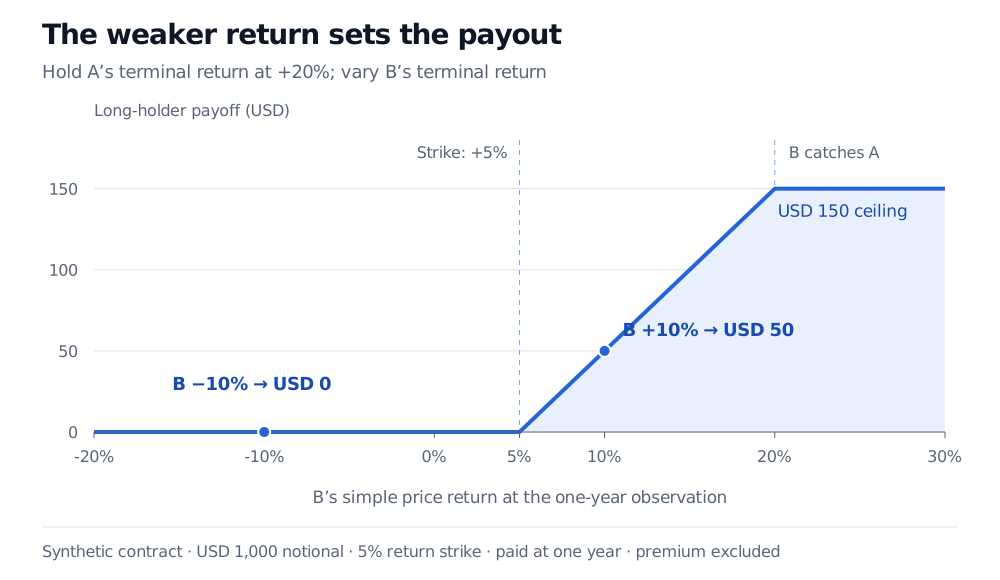
Set N=1,000 and k=0.05. B's 10% return exceeds the 5% strike by 5 percentage points, giving a terminal payoff of USD 50. The matching best-of call selects A's return and pays USD 150 under the same terms.
If B instead ends at USD 180, its return is −10%. The worst-of call then pays zero, even though A still gains 20%. A positive payoff requires both returns to exceed the strike; equality gives zero.
With A's return fixed at plus 20%, a worst-of call on USD 1000 notional and a 5% return strike pays zero when B returns minus 10%, USD 50 when B returns plus 10%, and at most USD 150 once B reaches plus 20%.
Original synthetic terminal-payoff curve, holding A's price return at +20%. Cash settlement occurs at the one-year observation; the premium is excluded. The USD 150 ceiling applies to this slice with A fixed, rather than to the contract across all possible outcomes.
Once B outperforms A, A becomes the weakest link. Further gains in B alone cannot increase this payoff. Conversely, improving A while B remains at 10% leaves the USD 50 payoff unchanged.
A useful bound, and a different meaning of “worst”
Write Ci=Nmax(Ri−k,0) for each individual performance call's cash payoff with the same notional, strike and payment date. Since taking the positive part preserves the ordering,
Xworst=min(CA,CB).
The worst-of call therefore never pays more than either individual call in a given outcome. This state-by-state bound is useful when checking a payoff implementation; Stulz establishes the corresponding dominance result for calls on asset values. (Stulz, §3.2)
“Worst” refers here to the lowest asset return, not the worst possible financial outcome for every party. A put on that minimum has a different payoff, and selling that put reverses the holder's cash-flow exposure. A structured note can add coupons, barriers, early redemption and principal-repayment rules. None of those features follows from the phrase “worst-of option.”
The USD 1,000 in this example scales the option payment; it is not a deposit returned at maturity or a capital guarantee. USD 50 is a payoff before deducting the option premium and financing costs, so it does not establish a profit.
The missing input in a valuation
The payoff rule can be evaluated from a terminal scenario. Its present value also needs a model for the assets' joint outcomes and discounting. Knowing each asset's separate return distribution does not tell us how often both clear the strike. Correlation helps describe dependence, but a correlation number alone does not specify an arbitrary joint distribution or establish a universal price comparison.
For the joint-model step, §2.1 of Correlated Randoms and Low-Discrepancy Sequences shows how a matrix factorization turns independent normal draws into correlated shocks. The full lesson requires membership and has a public preview. Those shocks can feed a specified multi-asset model; the selection and strike rule above must then be applied to each resulting pair of returns.
John C. Hull, Options, Futures, and Other Derivatives, 9th Global Edition, Pearson 2018, §§26.14–26.15, pp. 633–635: better/worse-of asset identities and multi-asset option context. The normalized return contract and terminal scenarios here are synthetic.