A quanto option converts a foreign asset option payoff at a fixed contractual rate. Follow a EUR-to-USD payoff ledger and the correlation adjustment behind valuation.
Quanto option
A quanto option references an asset quoted in one currency and settles its option payoff in another currency using a conversion factor fixed in the contract. A USD investor can therefore take an option position on a EUR stock while fixing how each euro of option payoff becomes dollars. Fixing that conversion removes the terminal spot exchange rate from the specified payoff; it does not remove the underlying asset risk or the role of currency dynamics in valuation.
Fix the conversion, not the stock outcome
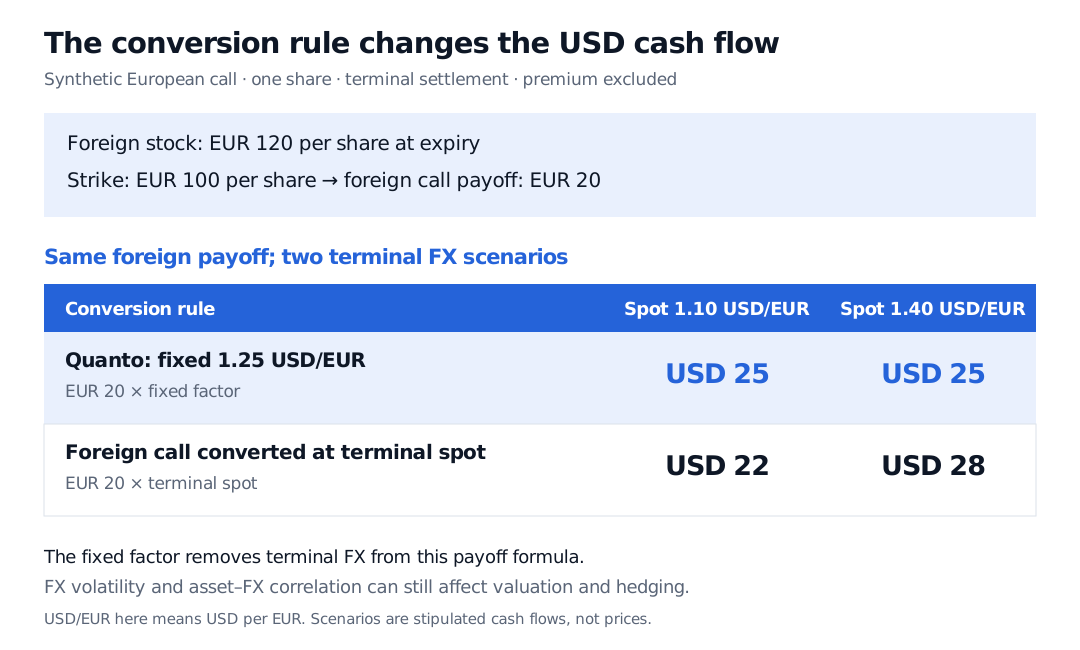
Consider a synthetic European call on one share of a EUR stock. The strike is EUR 100 per share. At expiry the stock is EUR 120 per share, so the ordinary foreign-currency call payoff is EUR 20. The quanto contract converts that amount at an agreed 1.25 USD per EUR, giving USD 25 at the same terminal settlement date.
Write ST and K in EUR per share, and let Xˉ be the fixed conversion in USD per EUR. For a contract covering one share, its USD payoff is
HTquanto=Xˉmax(ST−K,0).
The currency units matter: EUR per share, multiplied by one share and then USD per EUR, leaves USD. Here Xˉ is a contractual conversion factor; it need not equal either the initial spot rate or an FX forward rate.
A one-share foreign call with EUR 100 strike and EUR 120 terminal stock price pays EUR 20. Fixed conversion at 1.25 USD per EUR gives USD 25 in both scenarios. Converting the ordinary foreign call at terminal spot gives USD 22 at 1.10 USD per EUR, or USD 28 at 1.40.
Original synthetic terminal-payoff ledger. One European call covers one share; settlement occurs at expiry. USD/EUR in the figure means USD per EUR. Premium and financing are excluded.
If terminal spot is 1.10 USD per EUR, the ordinary EUR 20 call payoff converts to USD 22. If terminal spot is 1.40, it converts to USD 28. The quanto pays USD 25 in both cases. These are stipulated payoff scenarios, not option prices or a claim that either contract is better value.
The comparator is precisely a foreign-currency call whose payoff is subsequently converted at terminal spot:
HTspot=XTmax(ST−K,0).
A call on the stock's domestic-currency value with a fixed USD strike Kd instead pays max(XTST−Kd,0). That is a different strike convention, often called a composite or compo call. Replacing one formula with the other changes the contract. In particular, the first formula effectively converts the foreign strike along with the stock payoff, whereas Kd stays fixed in USD.
For a refresher on conversion direction, the FX lesson works through explicit quote units and distinguishes spot from forward exchange. The full lesson is available with a signed-in free account; the linked public page provides a preview.
Why a fixed conversion still needs a currency model
Before expiry, the quanto's price reflects the distribution of the foreign asset under the settlement currency's risk-neutral measure. That distribution can differ from the one used to price a plain option in the foreign currency. Asset–FX correlation is therefore relevant even though XT does not multiply the terminal quanto payoff. Hull discusses this change of currency numeraire in §30.3.
The sign can be checked directly in a simplified model. Let Xt mean domestic currency per foreign currency and let St be the foreign share price. Assume frictionless trading, constant domestic and foreign continuously compounded rates rd,rf, a continuous stock dividend yield q, and correlated geometric Brownian motions under the domestic measure Qd. Set
The domestic stock value XtSt must have ex-dividend drift rd−q. The Itô product rule gives its drift as μS+rd−rf+ρσSσX. Equating the two yields
μS=rf−q−ρσSσX.
The final term is the quanto drift adjustment in this quote convention. Reversing the FX quote also reverses its Brownian exposure, so the correlation convention must change consistently. This model derivation agrees with Haugh's equations (14) and (17).
The fixed conversion protects the holder's specified terminal cash flow from direct spot conversion. A dealer replicating it can still need the foreign stock, currency positions and funding; changing volatility or correlation assumptions can change the model value and hedge. A fixed payoff conversion is therefore a contract feature, rather than a promise that every pre-expiry risk sensitivity vanishes.
John C. Hull, Options, Futures, and Other Derivatives, 9th Global Edition, Pearson 2018, §30.3, pp. 721–724: quanto contracts and adjustments when changing the currency numeraire. Hull's exchange-rate direction differs from the one stated here; signs must be compared with that direction in view.