A long strangle buys a lower-strike put and higher-strike call. Calculate its expiry loss region, premium-adjusted break-evens and trade-off against a straddle.
Long strangle
A long strangle buys a put at a lower strike and a call at a higher strike on the same underlying, with the same expiry. It pays for exposure to a large move in either direction. The practical hurdle is recovering both premiums: finishing beyond one strike can produce an option payout while the combined trade still loses money.
A common construction places both options out of the money at entry. Different strikes distinguish it from a long straddle, whose call and put share a strike. Out-of-the-money entry is a usual choice, rather than a permanent property of either option.
The gap between a payout and a profit
Take a synthetic underlying initially at 100 USD/share. Buy one European put at strike 95 for 3 and one European call at strike 105 for 4. Premiums and results below are USD per share-equivalent. Both options have the same expiry and stipulated cash settlement; the position is held intact to expiry. Fees, funding, taxes and default are excluded.
Leg
Strike, USD/share
Premium paid, USD/share-equivalent
Entry cashflow, USD/share-equivalent
Buy one put
95
3
−3
Buy one call
105
4
−4
Total
7
−7
The terminal gross payoff adds the two exercise values. Profit then subtracts the entry debit:
HTΠT=max(95−ST,0)+max(ST−105,0),=HT−7.
Underlying at expiry, USD/share
Put payoff
Call payoff
Gross payoff
Profit
80
15
0
15
8
88
7
0
7
0
95
0
0
0
−7
100
0
0
0
−7
105
0
0
0
−7
108
0
3
3
−4
112
0
7
7
0
120
0
15
15
8
All payoff and profit columns are USD per share-equivalent.
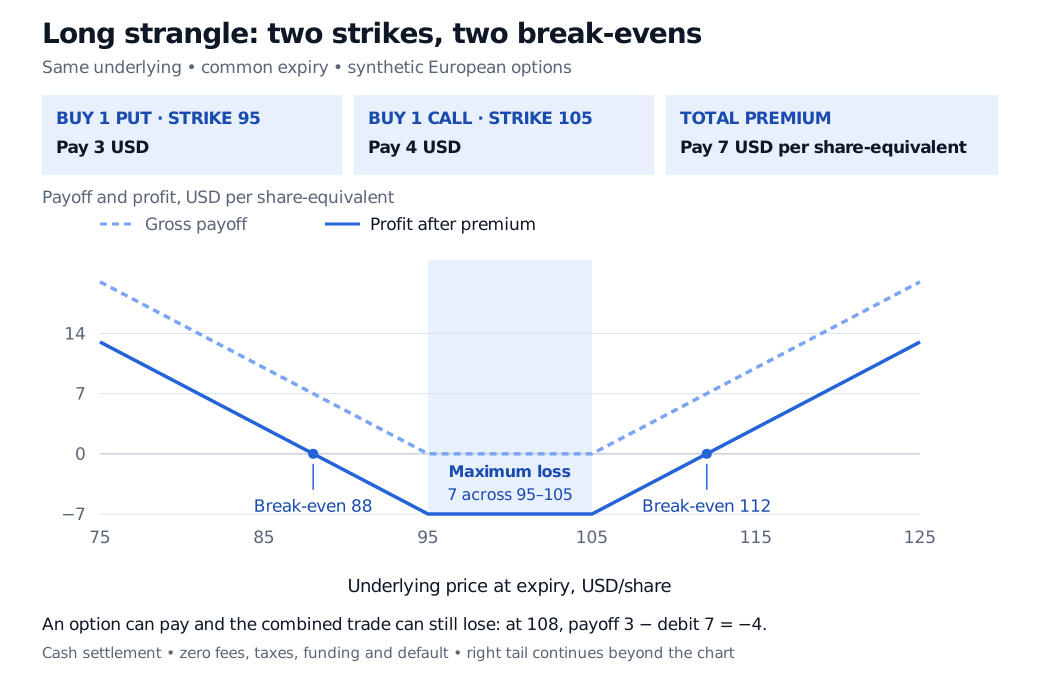
At 108, the call pays 3, but this recovers less than the combined premium of 7. The loss is 4. Between 95 and 105, including the endpoints, neither option has positive exercise value: the maximum loss of 7 occurs across the entire interval.
A long strangle with put strike 95, call strike 105 and total premium 7 USD per share-equivalent. Profit is −7 between 95 and 105, breaks even at 88 and 112, and equals 8 at expiry prices 80 and 120.
Original synthetic European-option diagram. The premium shifts gross payoff down by 7 USD per share-equivalent. Cash settlement and zero fees, funding, taxes and default are stipulated; the plotted price range is only a window onto the payoff.
For lower put strike Kp, higher call strike Kc and total premium d>0, the same calculation gives
With ST≥0 and d<Kp, the two feasible break-even prices are Kp−d and Kc+d: 88 and 112 here. Profit is positive below 88 or above 112. If a proposed lower break-even is negative, a nonnegative underlying cannot reach it.
The upside profit has no finite bound if the underlying can rise without bound. The falling-price branch is bounded by the underlying's zero floor: at ST=0, this example earns 95−7=88. Calling the strategy's profit “unlimited” therefore refers to the rising-price branch.
For one put contract and one call contract with a stipulated 100-share multiplier each, multiply the cash amounts by 100. The debit and maximum loss become USD 700. The underlying break-even prices remain 88 and 112 USD/share.
A cheaper entry is only part of the comparison
With the same underlying, expiry, exercise and settlement terms, compatible multipliers and comparable quotes, moving an at-the-money straddle's put strike down and call strike up reduces the options' gross terminal payout as well as usually reducing their purchase price. Whether the premium saving compensates for that lost payout must be calculated.
For example, compare the 95/105 strangle above with a hypothetical 100-strike straddle costing 5 for each leg, or 10 in total, under the same zero-cost conventions. At expiry price 120, the strangle earns 15−7=8 while the straddle earns 20−10=10. Saving 3 in premiums has sacrificed 5 in intrinsic value. The cheaper trade is not automatically the more profitable trade, even after a large move. These premiums are illustrative amounts, not live quotes or a common-volatility calibration.
“Long volatility” needs a valuation context
A long strangle is often described as long volatility. In a standard European pricing model, increasing the legs' implied volatilities while holding other inputs fixed raises their values. An early exit can therefore depend on volatility changes as well as spot and remaining time. Time decay can work against the buyer, and an anticipated event can already be reflected in the premiums. A volatility view alone establishes no profit guarantee.
The unhedged expiry result above depends on the final price, not the realised path variance. A price that makes large excursions and returns to 100 still produces the 7 loss if both options are held to expiry. Nor does buying an out-of-the-money call and put guarantee delta neutrality: their signed deltas need not cancel. Strike selection, quantities and model inputs matter.
To explore the ledger, use the public Option strategy designer. Clear its initial position and add two buy rows manually: one put at strike 95/premium 3 and one call at strike 105/premium 4, quantity 1 each. It uses a shared expiry and a 100-share option multiplier, so the expiry P&L view expresses this example in contract dollars. There is no long-strangle preset. Its European theoretical model excludes trading costs and physical exercise outcomes; a real contract's settlement and exercise instructions still matter. OIC's long-strangle guide also discusses pre-expiry volatility exposure and expiration considerations.
Sources
John C. Hull, Options, Futures, and Other Derivatives, 9th Global ed., Pearson, 2018, Chapter 12, p. 291, Figure 12.12 and Table 12.6: European strangle construction and terminal payoff regions. The examples, comparison and figure here are original and synthetic.