A delta-neutral portfolio has zero net delta with respect to a specified underlying at the current valuation inputs. Its first-order gain or loss from a small move in that underlying cancels across positions. This lets a trader reduce immediate directional exposure while retaining other exposures, such as option curvature or volatility risk.
“Neutral” describes a local sensitivity, not the portfolio’s value, cash balance or eventual profit. It also names a state: delta hedging is the trading process used to reach and maintain that state.
Add exposures in the same units
For options on one stock, write the current portfolio delta as
Here is the signed number of shares held, is the signed number of option contracts, is shares per contract, and is the delta of a long option quoted per share. Long holdings are positive; short holdings are negative. One stock share contributes , and one short share contributes .
The result is measured in share-equivalents: a net delta of means the portfolio has the local stock-price sensitivity of 1,000 long shares. With values in USD and stock price in USD per share, it is also USD of first-order portfolio value change per USD 1 stock-price change. It is not the portfolio’s market value or a count of option contracts.
Holding positions, time and the other valuation inputs fixed,
Setting eliminates this linear term. Cash held in the same currency has no direct stock-price delta in this calculation, although its financing still affects profit and loss. Deltas tied to different stocks must be tracked separately; simply adding them does not establish neutrality to each stock.
A neutral hedge that drifts
Take an original synthetic position: 100 long call-option contracts, each covering 100 shares, with a stipulated long-call delta of +0.60. These are exposure inputs, not estimates from live prices or a fitted model.
The calls contribute share-equivalents. Shorting 6,000 shares contributes , so net delta is zero. The hedge goes in the opposite direction to the long calls’ positive sensitivity. A short-call position would reverse the signs and require long stock.
Now suppose the call delta is +0.70, with the same contracts and stock holding. The calls contribute , leaving
Short 1,000 additional shares to bring the stock holding to and restore neutrality at the new inputs. The change in delta is 0.10 per underlying option share; the contract count and multiplier turn it into a 1,000-share rebalance. No elapsed time or intervening price move is specified, so this ledger does not calculate trading profit or a financing cost.
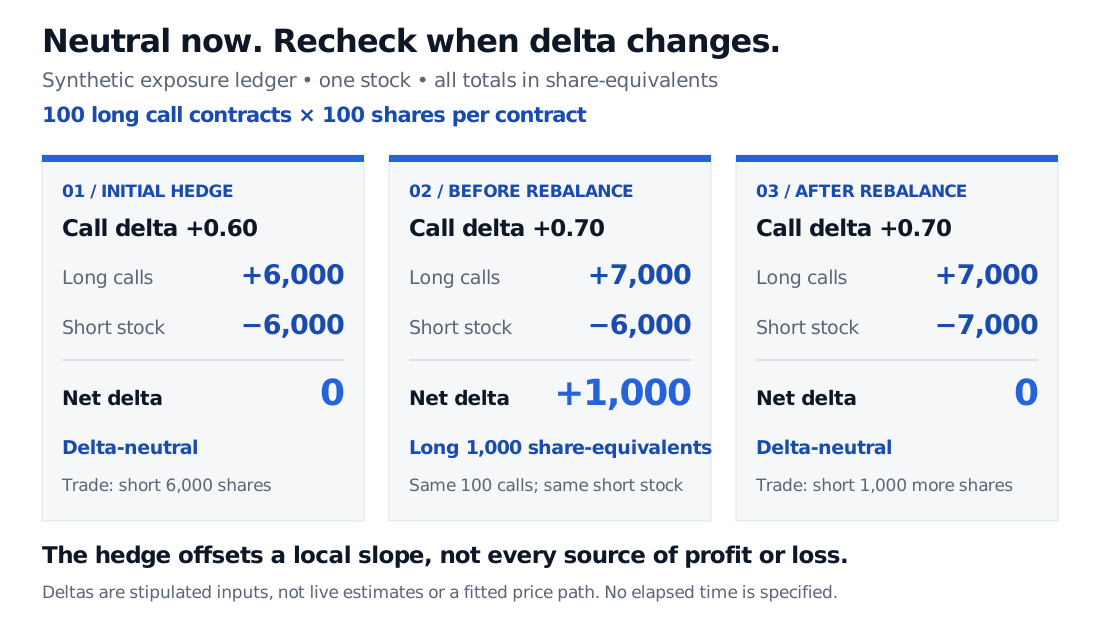
Original synthetic exposure ledger. All totals are share-equivalents for one underlying stock. The 100-share multiplier and deltas are stipulated; no live calibration, price path or elapsed time is implied.
What survives a zero delta
Gamma measures how delta changes as the stock price moves. Stock can offset the current slope without removing the options’ curvature. A large move or a jump can therefore produce a substantial gain or loss before the hedge is adjusted.
Changes in implied volatility and interest rates can move option values even at an unchanged stock price; vega and rho describe those sensitivities. Time passage also changes value and may change the required hedge. Model or estimation error can make a reported zero different from the actual local exposure.
Maintaining the hedge brings transaction costs, funding needs and, when stock is short, borrow fees and possible stock recall. Delta neutrality does not fund the option purchase, guarantee access to stock borrow or remove those costs. The practical target may be a tolerance band rather than an exact zero after every price change.
For the derivative definitions behind these distinctions, Greeks and Numerical Sensitivities connects delta, gamma and the other Greeks to hedge interpretation and estimation. The full lesson requires membership; its preview is public.
Sources
- Options Industry Council — Delta: theoretical local premium sensitivity, long/short position signs and changing deltas.
- CME Group — Options Delta: The Greeks: using signed deltas to build a neutral hedge and why the hedge ratio changes.
- John C. Hull, Options, Futures, and Other Derivatives, 9th Global Edition, Pearson, 2018, §19.4, pp. 424–430, and §19.6, pp. 433–435: portfolio delta aggregation, rebalancing and gamma risk.