Rho measures option-value sensitivity to interest rates. Distinguish decimal rates, percentage points and basis points, and compare local rho with full repricing.
Rho
Rho is the sensitivity of an option's model value to its interest-rate input, with the other pricing inputs held fixed. It isolates the rate contribution to a position's gain or loss: a long equity call can become more valuable when the rate rises even if the stock price stays unchanged.
If V is the option value per underlying unit and r is an annual interest rate expressed as a decimal,
ρ=∂r∂V,ΔV≈ρΔr.
This is a local derivative, one of the option Greeks. The rate change must use the same compounding convention as the pricing model. Spot, volatility, remaining time and dividend assumptions stay fixed; the estimate does not describe everything that happens to an option after a central-bank announcement.
A rate point is not a percent of the premium
Rho is often displayed as the estimated price change for a one-percentage-point rise in the annual rate. The Options Industry Council's example uses a move from 3% to 4% with other pricing factors unchanged. Calculus instead usually takes r in decimal units, so the reporting conversions are
One basis point is one hundredth of a percentage point. A move from 5% to 6% therefore means Δr=0.01, or 100 basis points. Multiplying raw rho by 1 would overstate that local price change by a factor of 100. Rho is a currency sensitivity; it is not the percentage return on the option premium.
Two options, opposite rate exposure
Consider a synthetic European call and put, each with spot and strikeUSD 100, exactly one year remaining, annual volatility 20%, continuous annual interest rate 5% and continuous dividend yield zero. Under the Black–Scholes–Merton model, the following values are per share:
Quantity
Long call
Long put
Model value, USD
10.450584
5.573526
Raw rho, USD per 1.00 absolute rate change
+53.232482
−41.890461
Rho, USD per percentage point
+0.532325
−0.418905
Rho, USD per basis point
+0.005323
−0.004189
For the call, a rise from 5% to 6% produces the first-order estimate
ΔC≈53.23248155×0.01=USD 0.53232482 per share.
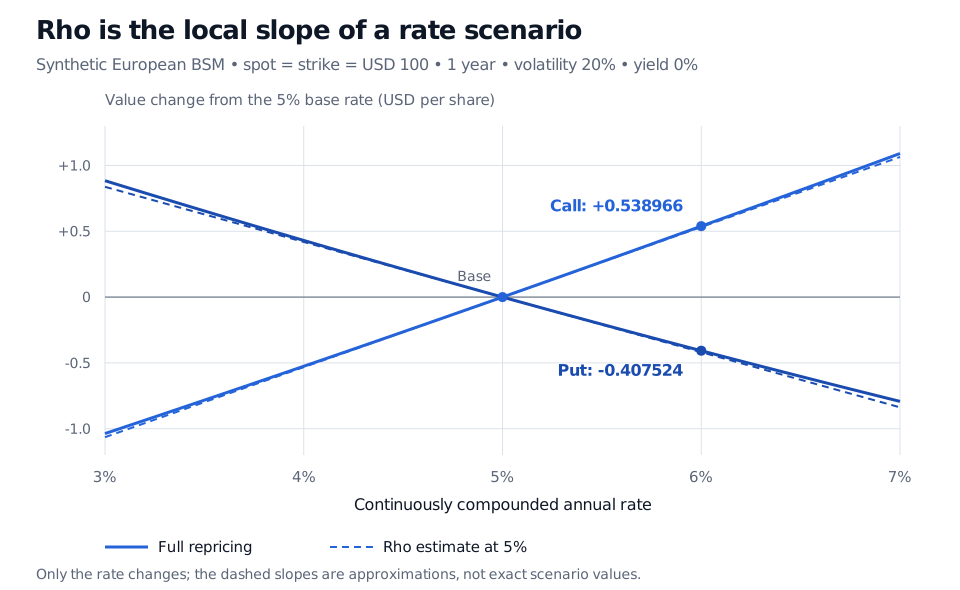
Repricing at 6% gives a change of USD 0.53896558 per share. For the put, the corresponding estimate is −USD 0.41890461, while repricing gives −USD 0.40752351. The derivative and a finite rate scenario are different objects: rho itself changes as the rate moves. For a substantial shock, reprice the position rather than treating the tangent as exact.
Synthetic European call and put value changes as the continuous annual rate varies from 3% to 7%, relative to 5%. Solid curves show full repricing and dashed lines show local rho estimates. At 6%, exact changes are plus USD 0.538966 per share for the call and minus USD 0.407524 for the put.
Original synthetic European BSM calculation, USD per share. Spot and strike are USD 100, remaining time one year, volatility 20% and dividend yield zero. Only the rate changes. Solid curves reprice the options; dashed lines use rho at 5%.
Position size adds a separate multiplier. Suppose a hypothetical contract covers 100 shares and the desk is short ten of these puts. A rate increase from 5% to 5.25%, or 25 basis points, gives
The short position gains under this isolated rate shock because the long put's rho is negative. The contract multiplier here is an example convention; check the actual instrument's deliverable. The estimate excludes trading costs and changes in the other inputs.
Why the signs differ
For European vanilla options with spot S>0, strike K>0, remaining years T>0, volatility σ>0, continuous annual rate r and fixed continuous dividend yield q,
Here N is the standard normal cumulative distribution function. Both the discount factor and the risk-neutral distribution move when r changes. Differentiating the full BSM formula makes the normal-density terms cancel, leaving the expressions above. The factors are positive apart from the put's minus sign.
Economically, the call holder can defer paying the strike until exercise. A higher rate makes that future payment cheaper in present-value terms. The put holder has the right to receive the strike; discounting that future receipt more heavily works against the put. ASX's option-pricing course describes this funding benefit and cost.
Matching calls and puts therefore do not have equal-and-opposite rho. Their difference in this example is 95.122942 USD per share per decimal rate unit. For the differentiation and cancellation, read Step 5 of Derivation: Analytic Greeks from the Black–Scholes Formula. The full lesson requires membership; its public page provides a preview.
Specify the rate shock before adding the rhos
The formula above shocks a flat rate while holding spot fixed. In a model with a yield curve, a single portfolio rho can instead describe a specified parallel curve shift. A steepening or a move concentrated at one maturity is a different scenario; sensitivities by curve tenor provide more detail. A policy-rate announcement does not imply an equal shift in every rate used for valuation.
Signed position rhos add under the same shock definition. Offsetting rhos can remove that first-order exposure while leaving sensitivity to curve shape, other Greeks and larger shocks. Nor do the positive-call and negative-put formulas automatically apply to every option model: holding a futures price fixed, changing a foreign rate, or allowing early exercise changes the valuation problem.
Sources
John C. Hull, Options, Futures, and Other Derivatives, 9th Global Edition, Pearson 2018, §19.9, pp. 439–440 — local rate sensitivity, European call/put formulas and decimal-rate scaling. §19.12 distinguishes futures and currency option sensitivities. Numerical examples and the figure here are original.
Options Industry Council: Rho — rate sensitivity and a one-percentage-point reporting example with other inputs held fixed.