Bond valuation discounts each dated payment in a consistent pricing framework. A two-year example reconciles the price with a funded zero-coupon replica and separates curve value, yield and clean-price conventions.
Bond valuation
Bond valuation is the calculation of a bond's value from its future payments and the prices today of taking those risks. For a fixed-rate bond with certain payments, this means discounting each coupon and principal repayment to the valuation date. It lets a trader compare the bond with other instruments that deliver the same cash flows, rather than treating its coupon rate as its value.
The essential inputs are a payment schedule, a settlement date and a valuation framework. A formula cannot correct a missing final coupon, the wrong payment date or a discount curve for a different currency or credit exposure.
Price the dates separately
For known payments CFi at future dates Ti, the full value at time zero is
Pfull=i=1∑nCFiD(0,Ti),
where the discount factorD(0,Ti) is today's value of one currency unit paid at date Ti, under the stated assumptions. The discount curve supplies a factor for every payment date. The Federal Reserve's yield-curve paper, §2.1–2.2 builds coupon-bond prices in exactly this way.
Consider a synthetic default-free USD bond with 100 USD face value, a 4% coupon rate paid annually and exactly two years remaining. Valuation and settlement coincide just after a coupon payment; accrued interest is stipulated to be zero. The remaining payments are 4 USD in one year and 104 USD in two years: the last amount includes both principal and the final coupon.
Assume matching default-free USD zero-coupon instruments are available. The one-year spot interest rate is 3% and the two-year spot rate is 4%, both annual effective. The bond and zero instruments share the same credit and funding framework; there are no collateral differences, taxes, trading costs or embedded options. The horizons are exact years, so no calendar day-count conversion is needed.
The two-year rate discounts the entire two-year payment over two years. It is not a rate used only for the second year. Nor should the 3% and 4% rates be averaged before discounting.
SelfMadeQuant's Bonds and Yields lesson develops the payment schedule, discount-factor formula and distinction between coupon and yield. Its public page is a preview; the full lesson requires membership.
The value is also the cost of matching the payments
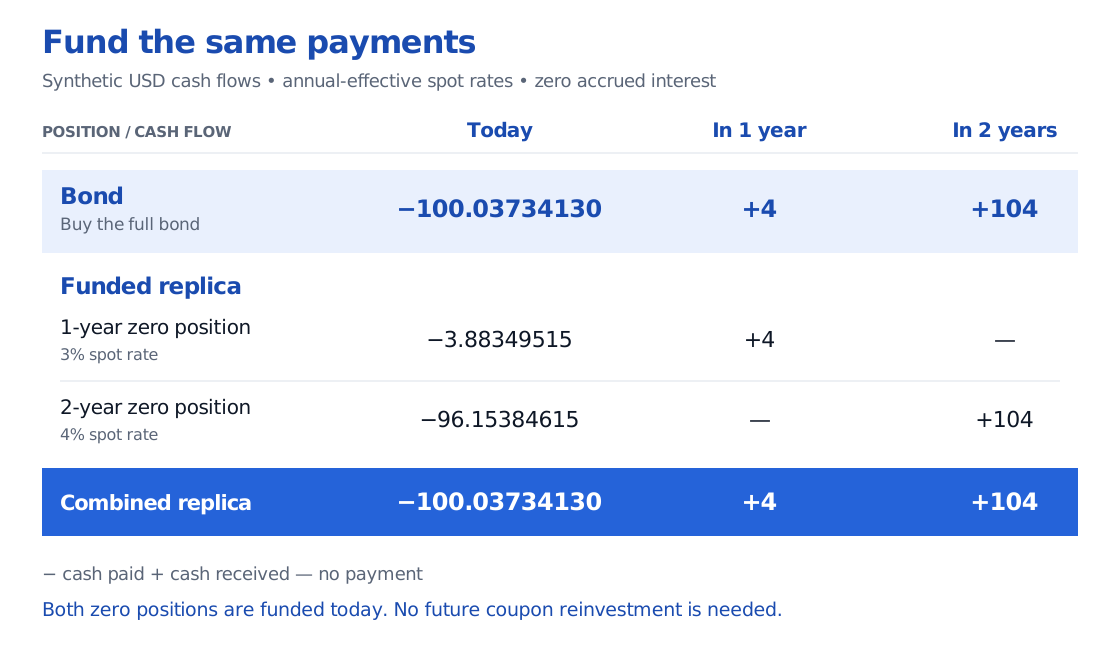
Buy a one-year zero-coupon bond position that pays 4 USD and a two-year zero position that pays 104 USD. They cost 3.88349515 USD and 96.15384615 USD today. Together they reproduce every remaining bond payment on its actual date.
Synthetic USD funded-replication ledger. Buying the bond costs 100.03734130 today and pays 4 at year one and 104 at year two. Buying a one-year zero position costs 3.88349515 and a two-year zero position costs 96.15384615; their combined cost and future payments match the bond.
Original synthetic illustration. Negative entries are purchase outlays; positive entries are receipts. All amounts are USD. Both zero positions are funded at settlement and match the bond's dated payments; no future reinvestment is needed.
This is the replicating portfolio interpretation of the discounted sum. Under idealised frictionless trading with compatible borrowing and short-selling opportunities, a different bond price would allow an arbitrage between the bond and its replica. In actual markets, financing costs, liquidity, taxes and trading restrictions can prevent a small apparent difference from being a profit opportunity.
One yield can summarise the answer
A yield to maturity is a single rate that reproduces a specified price. For this annual-payment bond, its annual-effective YTM y solves
100.03734130…=1+y4+(1+y)2104.
Curve valuation starts with maturity-specific discount factors and produces a price. Calculating YTM starts with a price and compresses it into one rate under a payment and compounding convention. The same curve can give different YTMs to bonds with different coupon schedules. The Bank of England distinguishes spot rates, which discount individual dated payments, from coupon-bond yields.
A single-yield formula is useful for quoting and comparing bonds under consistent conventions. It does not establish that every cash flow should be priced at that rate in the market. Nor does solving for YTM guarantee the investor's realised return: default, selling before maturity and the rates earned on reinvested coupons can change that outcome.
Compare prices on the same basis
The discounted sum is a dirty price, also called a full price. In a conventional quotation system,
Pfull=Pclean+AI,
where AI is accrued interest on the same amount or per-face-value quote basis. Here AI=0, so clean price and full price coincide. With a 100 USD face amount, 100.03734130 USD is also numerically 100.03734130 per 100 face. A larger position must be scaled before calculating the settlement cash amount.
Between coupon dates, compare a model's full settlement value with the market's full price. Comparing it directly with a clean quote can create a spurious pricing discrepancy. Apply the security's actual accrual, day-count and coupon-entitlement rules; FINRA explains the accrued-interest payment between buyer and seller.
When the promised schedule is insufficient
Credit changes the payments being valued. A corporate issuer can default, leaving missed coupons or a recovery payment. A model can value survival-contingent payments and recovery explicitly, or use an appropriately calibrated credit spread applied to promised payments. The assumptions must fit together: reducing cash flows for expected default loss and then adding a spread that already charges for that same loss counts it twice. A spread can also reflect liquidity and risk compensation, so it is not simply a default probability.
Options can change the payment dates and amounts. An issuer's right to redeem a callable bond early makes the remaining schedule depend on the exercise decision. Pricing its promised maturity payments as if exercise were impossible misses that option. Floating coupons, inflation-linked payments and prepayments similarly require a model for the changing cash flows. FINRA's bond guide describes default and call risks.
These extensions preserve the central idea: identify what is paid, when and under which conditions, then value those payments consistently. A default-free curve alone does not price every issuer's promise.
Sources
Frank J. Fabozzi, Bond Markets, Analysis, and Strategies, 9th ed., Pearson, 2016, Chapter 2, pp. 20–21 and 27–28; Chapter 5, pp. 107–109: payment schedules, pricing complications, spot-rate valuation and zero-coupon replication.
FINRA, Bonds, “Selling Before the Maturity Date,” “Bond Pricing,” “Call Risk” and “Credit Risk”: accrued interest, quote units and contingent payments.