The second derivative measures how a slope changes. See why bond prices can fall with positive curvature, how units affect sensitivities, and when the second derivative test applies.
Second derivative
The second derivative measures how a function's first derivative changes as its input changes. A derivative tells you the current slope; the second derivative tells you whether that slope is rising or falling. In finance, this distinguishes a price's immediate sensitivity from the way that sensitivity changes when the market moves.
For f differentiable near x, the second derivative exists where the following limit exists:
f′′(x)=dxdf′(x)=h→0limhf′(x+h)−f′(x).
It is also written d2f/dx2. This means differentiating twice, not squaring f′(x).
A falling bond price can have a positive second derivative
Consider a hypothetical zero-coupon bond paying USD 100 in exactly three years. Ignore default, transaction costs and any passage of time. Let y be its annual continuously compounded yield, expressed as a decimal: 4% means y=0.04. Its price is
P(y)=100e−3y,P′(y)=−3P(y),P′′(y)=9P(y).
The first derivative is negative, so price falls as yield rises. The second derivative is positive, so the slope becomes less negative as yield rises. These statements are compatible: a price can fall while its rate of decline eases.
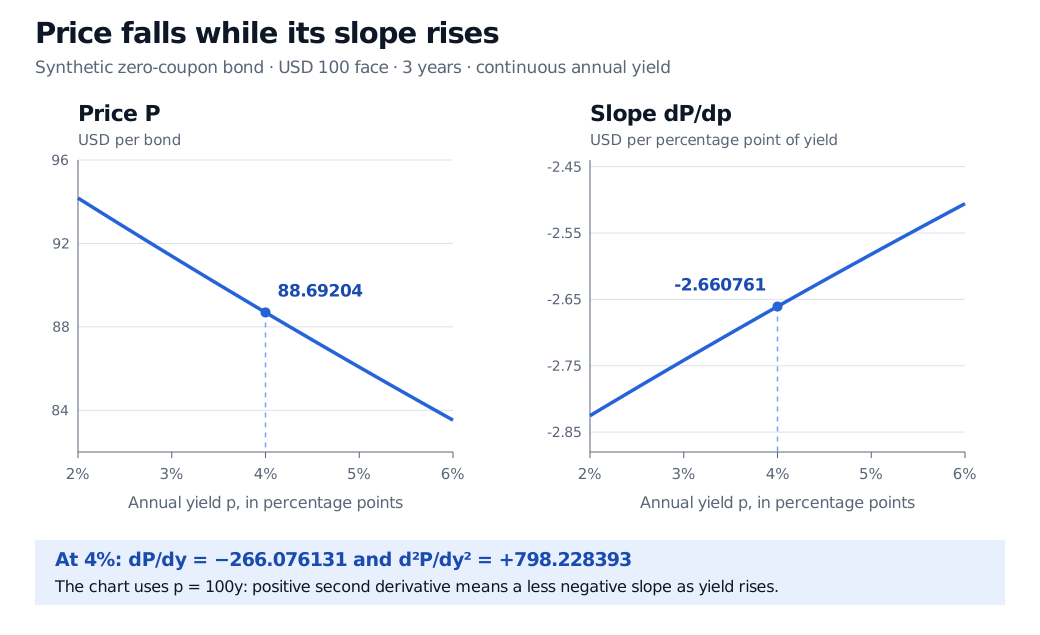
Two panels for a hypothetical three-year zero-coupon bond with USD 100 face value. Between yields 2% and 6%, price decreases while its slope increases. At 4%, price is USD 88.69204 and slope is minus USD 2.660761 per percentage point of yield.
Original synthetic example. Time and the promised payment are fixed. The chart's horizontal coordinate is yield in percentage points; the equations use decimal yield.
At 4%, the price is USD 88.69204, with
P′(0.04)=−266.076131,P′′(0.04)=798.228393.
Suppose yield immediately rises to 5%, a change of Δy=0.01. Keeping only the original slope predicts a price change of P′(0.04)Δy. Allowing the slope to change adds the second-order term:
ΔP≈P′(0.04)Δy+21P′′(0.04)(Δy)2.
Calculation
Price change, USD per bond
Original slope only
−2.660761
Second-order correction
+0.039911
Slope plus correction
−2.620850
Exact repricing, P(0.05)−P(0.04)
−2.621246
The positive correction reduces the predicted loss; it does not turn it into a gain. Exact repricing gives a new price of USD 86.070798. Here the second-order estimate overstates that price by about USD 0.000396. The correction belongs to a local Taylor approximation, so its accuracy for larger moves must be checked rather than assumed.
Name the input before interpreting the number
If an output has units U and its input has units X, its first derivative has units U/X and its second derivative has units U/X2. The input's quoting scale matters even when it is mathematically dimensionless.
In the bond example, P′′(0.04) is USD per decimal-yield unit squared. If p=100y records yield in percentage points, define Q(p)=P(p/100). Then
Q′(p)=100P′(p/100),Q′′(p)=10000P′′(p/100).
At p=4, the second derivative is therefore USD 0.079823 per percentage point squared. The same yield move is either Δy=0.01 or Δp=1; either convention gives the same USD 0.039911 correction. Mixing the derivative from one scale with a move from the other gives the wrong answer.
Two familiar finance measures illustrate why the variable and normalisation belong in the definition:
Option gamma is ∂2V/∂S2: the change in delta as the underlying price S changes, holding the other pricing inputs fixed. Position size and contract multipliers determine the units of V.
Yield-based bond convexity is commonly normalised by price: C=P′′(y)/P(y) under a specified yield convention. For this continuous-yield zero, C=9 years squared. The raw second derivative is 9P, not 9.
Neither the name “second derivative” nor a positive result in this example implies that every financial product has positive second-order sensitivity. Changing the input, the position sign or the product can change the interpretation and sign.
What its sign establishes
For a twice-differentiable function on an open interval, f′′>0 throughout the interval means the slope increases and the graph is convex, or concave upward. If f′′<0 throughout, the slope decreases and the graph is concave downward. A sign observed at one point does not establish the shape over an entire interval.
For an interior stationary pointc, the standard second derivative test assumes f′(c)=0 and, as a convenient sufficient regularity condition, that f′′ is continuous near c. Then f′′(c)>0 gives a strict local minimum, while f′′(c)<0 gives a strict local maximum. The stationarity condition matters: our bond has positive P′′ everywhere but no stationary price minimum as a function of yield.
When f′′(c)=0, the test is inconclusive. At zero, x4, −x4 and x3 all have zero first and second derivatives, yet respectively give a minimum, a maximum and neither. A zero second derivative also does not by itself identify an inflection point; that requires a change of concavity.
James Stewart, Single Variable Calculus: Early Transcendentals, sixth edition, §2.8, “Higher Derivatives,” and §4.3, “How Derivatives Affect the Shape of a Graph.”
John C. Hull, Options, Futures, and Other Derivatives, ninth Global Edition (2018), §4.9, “Convexity,” and §19.6, “Gamma.”