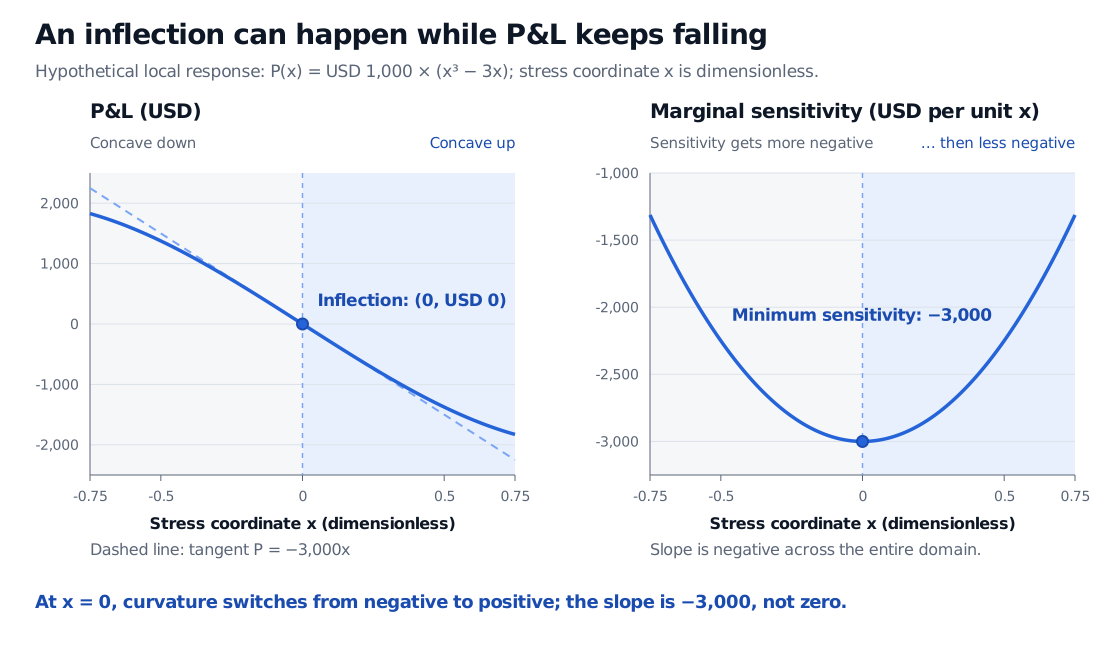
An inflection point changes concavity, without needing a horizontal tangent. Read a synthetic P&L response and distinguish a curvature switch from a zero second derivative.
Inflection point
An inflection point is a point (c,f(c)) on a continuous graph where the direction of bending changes: from concave down to concave up, or the reverse. It marks a change in how the slope evolves. The graph can keep falling through an inflection; it need not reach a peak, a trough or a horizontal tangent.
Here, concave down uses the concavity convention familiar in optimisation; concave up means a convex function. An inflection separates these two shapes locally. The coordinate c tells you where the switch occurs; the point is the pair (c,f(c)).
A P&L curve that bends without turning
Suppose a researcher uses this hypothetical local response to a stress input:
P(x)=(1,000 USD)(x3−3x),−0.75≤x≤0.75.
The stress coordinate x is dimensionless and centred on the baseline x=0. P(x) is a modelled P&L amount in USD. This is a stipulated sensitivity example, not an empirical price formula or a forecast. The bounded domain matters: extending the cubic indefinitely would assert economic behaviour that the local model has not justified.
For every negative x, f′′(x)<0: the slope becomes more negative as x increases towards zero. For every positive x, f′′(x)>0: the slope becomes less negative. The curvature changes at x=0, and f(0)=0, so the shape has an inflection at (0,0). Scaling by the positive USD 1,000 factor preserves that switch.
Stress coordinate x
Modelled P&L P(x)
Marginal sensitivity P′(x)
−0.5
USD 1,375
−USD 2,250 per unit x
0
USD 0
−USD 3,000 per unit x
0.5
−USD 1,375
−USD 2,250 per unit x
The inflection at (0,USD 0) is where this model's marginal sensitivity is most negative. P&L itself keeps decreasing across the whole specified domain because P′(x)<0 there. In particular, f′(0)=−3, not zero: this is not a stationary point.
Hypothetical P&L P(x) equals USD 1,000 times x cubed minus 3x, with dimensionless x from minus 0.75 to 0.75. P&L falls through the inflection at x zero and USD 0. Marginal sensitivity reaches minus USD 3,000 per unit x at zero, then becomes less negative. Curvature is negative on the left and positive on the right.
Original synthetic response and its marginal sensitivity. The dashed line is the P&L tangent at zero; the two panels use different vertical units. The curvature switch changes the behaviour of sensitivity while P&L continues falling.
The tangent at zero is L(x)=(−3,000 USD)x. Here the difference is exactly
P(x)−L(x)=(1,000 USD)x3.
P&L lies below this tangent for x<0 and above it for x>0. At the inflection, the quadratic term in the Taylor expansion vanishes, but the cubic discrepancy remains. Zero second derivative at one input does not make the response linear nearby or remove nonlinear exposure.
Zero second derivative is a candidate, not a verdict
A useful sufficient test is: f is continuous at an interior point c, is twice differentiable immediately to either side, and f′′ is strictly negative throughout one side-neighbourhood and strictly positive throughout the other. Those opposite signs establish the change of concavity. Reverse the signs and the point is still an inflection.
When f′′(c) exists at an inflection, it must be zero. The converse fails. For
g(x)=x4,g′′(x)=12x2,
we have g′′(0)=0, yet g′′(x)>0 on both sides of zero. The curve stays convex; (0,0) is a minimum, not an inflection. This is why solving f′′(c)=0 only generates candidates. Check the signs on neighbouring intervals, rather than relying on the value at the candidate alone. These distinctions are developed in OpenStax's treatment of concavity and inflection points.
A second derivative need not exist at the switch. For example, h(x)=x∣x∣ equals −x2 to the left of zero and x2 to the right. It is continuous, with negative curvature on the left and positive curvature on the right, but h′′(0) does not exist. It still has an inflection at (0,0) under the continuous-graph definition used here. Conversely, a discontinuity or a hole cannot be an inflection point on that graph: there must be a continuous point through which the bending changes.
What the diagnosis can tell a researcher
An inflection in a model response can locate where increasing an input stops making its marginal effect more negative and starts making it less negative, as in the P&L example. A concave-up-to-concave-down switch reverses that pattern. This is useful for reading response surfaces along a specified one-dimensional input, but it supplies no general buy, sell or optimisation rule. An inflection in an objective function is not automatically an optimum.
For measured data, a finite-difference second derivative depends strongly on spacing, noise and any smoothing choices. A sign reversal between two estimated values is evidence to investigate, not proof of a stable economic threshold. Distinguish a model's analytic curvature switch from an apparent bend in a noisy P&L history, and state which input the derivatives refer to.
The Curve Sketching lesson joins the sign tests into a full graph analysis, including examples where f′′=0 is inconclusive. The public page is a preview; the full lesson requires membership.
Sources
Stewart, J. Single Variable Calculus: Early Transcendentals, 6th ed., Thomson Brooks/Cole, 2008, §4.3, especially pp. 290–292: concavity test and the continuous-graph definition of an inflection point.