Committing resources now for expected future benefits. Track asset value and cash together, then distinguish realised return from uncertain outcomes.
Investment
An investment is a commitment of money or other resources now in the expectation of future benefits. In finance, those benefits commonly take the form of cash payments, a higher resale value, or both. For a quant, the practical task is to turn that expectation into a dated cash-flow and valuation record: a rising price is only one possible source of return, and the result can be a loss.
The asset is what is held; investing is the decision to commit resources to it. Buying a stock, lending through a bond, and financing a new factory are different investments. They create different rights to future benefits. The word investment by itself says little about how safe, liquid or profitable any of them will be.
Follow the money, not just the price
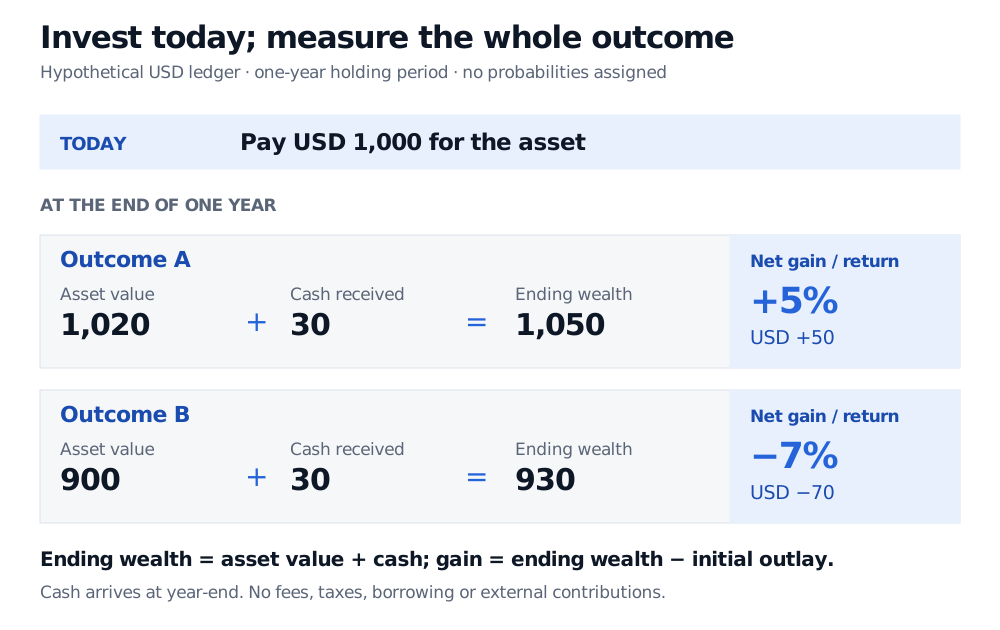
Consider a hypothetical asset bought today for USD 1,000. Hold it for exactly one year. At year-end it pays USD 30 cash and, after that payment, is worth USD 1,020. Assume no borrowing, fees, taxes, additional contributions or withdrawals. The cash arrives at the end, so no reinvestment assumption is needed within the year.
Ending wealth is USD 1,050: the asset value of USD 1,020 plus the USD 30 cash. The gain over the initial outlay is USD 50. The one-period total return is
R=V0V1+C1−V0=1,0001,020+30−1,000=5%,
where V0 is the initial investment, V1 is the ending asset value and C1 is the cash paid at year-end. The price change contributes 2% of the initial outlay; the cash contributes 3%. Adding those components gives 5% because both use the same denominator and holding period.
A hypothetical USD 1,000 investment has two one-year outcomes. Asset value of USD 1,020 plus USD 30 cash gives ending wealth of USD 1,050, a USD 50 gain and 5 percent return. Asset value of USD 900 plus the same cash gives USD 930 wealth, a USD 70 loss and minus 7 percent return.
Original hypothetical USD ledger. Cash is paid at year-end; no fees, taxes, borrowing or external flows. The two outcomes are illustrations, with no assigned probabilities.
If the asset has not been sold, its ending value includes an unrealised capital gain or loss. A cash payment does not prove that the investment made money. If the same asset instead finishes at USD 900 and still pays USD 30, ending wealth is USD 930 and the total return is −7%. Receiving income and preserving capital are separate things.
For an equity-specific worked example, the Equities lesson separates capital gains from dividends and explains why price indices differ from total-return indices. The full lesson requires membership; a public preview is available.
Time and uncertainty change the decision
The two ledger outcomes describe what could happen, not what is expected to happen. An expected return needs assumptions about possible outcomes and their probabilities. An observed return records what actually happened. Calling a purchase an investment does not turn an uncertain payoff into a promised profit.
The date matters too. Money committed now cannot simultaneously fund another use: that forgone alternative is its opportunity cost. Comparing investments therefore requires a common horizon and a suitable alternative, with attention to risk, costs and liquidity. A positive nominal return alone does not establish that the investment compensated for those trade-offs or preserved purchasing power after inflation.
In quantitative work, this becomes a discipline of keeping the decision and its measurement aligned. State what is owned, when cash moves, how ending value is measured and what comparison is relevant. Forecasts can then be evaluated against realised outcomes without confusing income with profit or a favourable scenario with a guarantee.
SEC Investor.gov — Stocks: equity ownership, capital appreciation, dividend payments and the possibility of loss.
Edwin J. Elton, Martin J. Gruber, Stephen J. Brown and William N. Goetzmann, Modern Portfolio Theory and Investment Analysis, 9th edition, Wiley, 2014: Chapter 1, p. 2, on assets and portfolio choice; Chapter 2, p. 19 and footnote 9, on holding-period return and the timing of investment income.