An asset is an economic resource controlled by a person or organisation that can provide benefits. Land, machinery and patent rights can be assets, as can cash, a bank deposit, a bond or a share. In a quant portfolio, identifying the asset is only the start: you must also record how much you hold, how it is valued and what cash it pays. A price series alone can miss part of the investment result.
The term is broader than financial asset. A machine can produce goods; a share gives its holder an ownership interest in a company. A bond gives its holder contractual payment rights, subject to its terms and the issuer's ability to pay. Assets need not pay regular income or rise in price. Their potential benefits can be uncertain.
For financial reporting under the IFRS Conceptual Framework, the definition is more specific: a current economic resource under the entity's control because of past events, with the resource understood as a right capable of generating economic benefits. Meeting that definition and recognising an item in the accounts are separate questions. The IFRS Foundation's project summary, pp. 8–10, explains this distinction. An accounting carrying amount also need not equal today's market price.
The asset, the price and your holding
These describe different things:
| Item | In a share portfolio | What it answers |
|---|---|---|
| Asset | A specified company's ordinary share | What rights do you hold? |
| Price | USD 50 per share at a stated time | What is one unit quoted or valued at? |
| Position | 100 shares held | How many units do you hold? |
| Position value | USD 5,000 at that price | What is the holding worth on this valuation basis? |
For a simple cash-market holding, position value equals quantity times unit price. The quotation unit, currency and time belong with the number. A quoted price is not a promise that the whole holding can be sold at that price; liquidity and trading costs affect the proceeds.
Perspective matters too. A loan is an asset to the lender and a liability to the borrower. A house can be an asset while the mortgage used to finance it remains a separate liability. Owning an asset does not mean owning it without debt. An asset class groups assets with shared characteristics; a portfolio combines holdings in selected assets.
A falling share price is not the whole return
Suppose you hold 100 shares throughout one period. Each starts at USD 50 and ends at USD 48. During the period, the holding pays USD 1 per share in cash dividends. You retain the cash without interest. There are no trades, external deposits or withdrawals, fees or taxes, and the final share price is an ordinary price that does not already include the dividend.
| Ledger item | Beginning, USD | End, USD |
|---|---|---|
| Shares at the stated price | 5,000 | 4,800 |
| Cash received from this holding | 0 | 100 |
| Combined wealth | 5,000 | 4,900 |
The shares lose USD 200 of market value, while the distribution adds USD 100 to cash. Combined wealth falls by USD 100. The holding's price return is −4%, but its one-period simple total return is −2%:
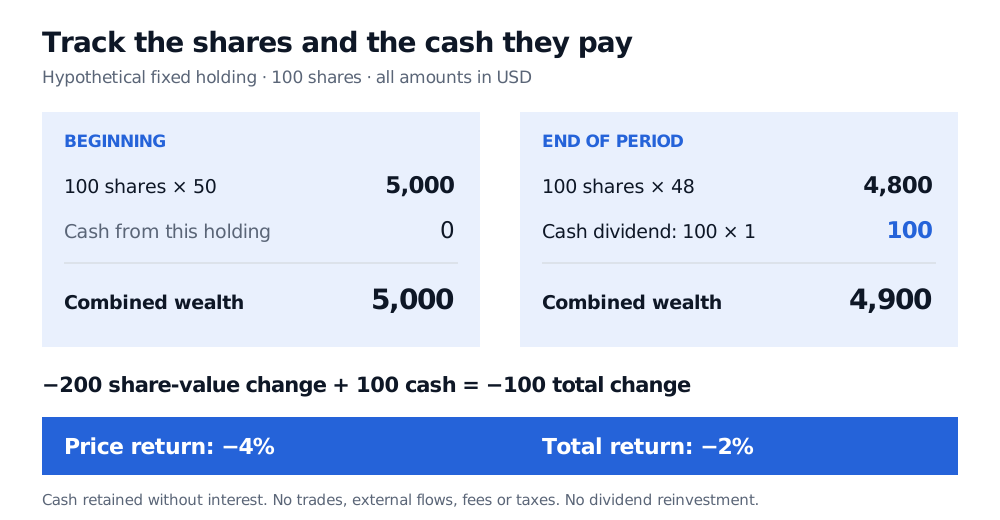
Original hypothetical one-period ledger in USD. The cash dividend is retained without interest; holdings are fixed, and fees, taxes and external flows are omitted.
The dividend offsets part of the price loss; it does not make the investment profitable. Nor does this example claim that the entire price decline was caused by the dividend. FINRA's return explanation combines value changes with investment earnings when assessing total return.
For a backtest, follow the data convention. If a total-return series already incorporates a distribution, adding the same dividend again overstates performance. If you use ordinary prices, track distributions separately and specify whether cash is retained or reinvested. With borrowing, multiple currencies or changing holdings, the ledger also needs the corresponding financing, conversion and trade cash flows.
Once those flows are accounted for, Financial Return Characteristics develops simple versus log returns and the aggregation of asset returns into a portfolio. The full lesson requires membership; its public page provides a preview.
Sources
- Elton, Gruber, Brown and Goetzmann, Modern Portfolio Theory and Investment Analysis, 9th edition (Wiley, 2014), Chapter 1, p. 2 — distinguishes real and financial assets and introduces portfolios as groups of assets.
- IFRS Foundation: Conceptual Framework Project Summary, March 2018, pp. 8, 10, 12–13 — the asset and economic-resource definitions, recognition and measurement. These are financial-reporting concepts, rather than a universal legal classification.
- FINRA: Key Concepts — Return and Rate of Return — value changes, investment income and the distinction between a cash gain or loss and a percentage return. The numerical example here is original.