Asset classes group investments by economic exposure. Separate classes from fund vehicles and strategies, then trace a 60/30/10 account into a weighted portfolio loss.
Asset class
An asset class is a category of investments grouped by shared economic characteristics, such as the claim they give the investor and the risks that drive their returns. Classifying holdings helps a portfolio manager see what the account is exposed to: a long list of fund names can conceal a concentrated bet on the same underlying market.
The familiar starting categories are equities, bonds, and cash or cash equivalents. Other frameworks separate property, commodities, private equity and further categories. There is no single classification that answers every investment question. A useful scheme makes its boundaries explicit and serves the decision being made.
What belongs in the category?
Broad category
Economic exposure
What the label leaves out
Equities
Ownership claims on businesses
Industry, country, valuation, leverage and whether the shares trade publicly
Bonds or fixed income
Debt claims with specified payment terms
Issuer credit quality, maturity, interest-rate sensitivity, currency and embedded options
Cash and cash equivalents
Immediately available balances or short-term instruments used for liquidity
Withdrawal terms, issuer or bank risk, currency and any applicable protection
Property
Exposure to buildings, land or property-related income
Financing, occupancy, valuation frequency and ease of sale
Commodities
Exposure to physical goods such as energy, metals or agricultural products
The good involved and whether exposure comes from physical holdings or derivative contracts
These are economic groupings, not promises of identical behaviour. A long-maturity government bond and a short-maturity corporate bond are both debt instruments but can respond very differently to the same shock. Cash equivalents also differ in their legal protection and liquidity; the category name does not make every product a guaranteed bank deposit.
Classification can be hierarchical. An investor might first separate equity from debt, then split equity by region and bonds by credit quality or maturity. Another might treat inflation-linked bonds as a separate allocation because inflation protection matters to the liabilities being funded. State that choice before comparing allocations.
A fund is a vehicle; a strategy is a rule
An exchange-traded fund is a way to hold an investment exposure. One ETF may own equities and another bonds; the shared wrapper does not make their economic risks the same. A fund holding both belongs across the relevant classes in a look-through exposure report. FINRA's guide to exchange-traded products explains why the underlying assets and product structure both matter.
Similarly, momentum describes a trading rule, while a hedge fund is a pooled investment vehicle rather than one homogeneous economic exposure. Such strategies and funds may trade several asset classes, use borrowing, or take offsetting long and short positions. An allocator may group them under “alternatives” for reporting, but that administrative bucket still needs an examination of the actual risks.
A gold-mining company's ordinary shares illustrate the distinction: they are equity in a business whose profits may depend on gold prices. They are not the same claim as owning bullion. Class labels help organise analysis; they do not replace it.
The class return is not its portfolio contribution
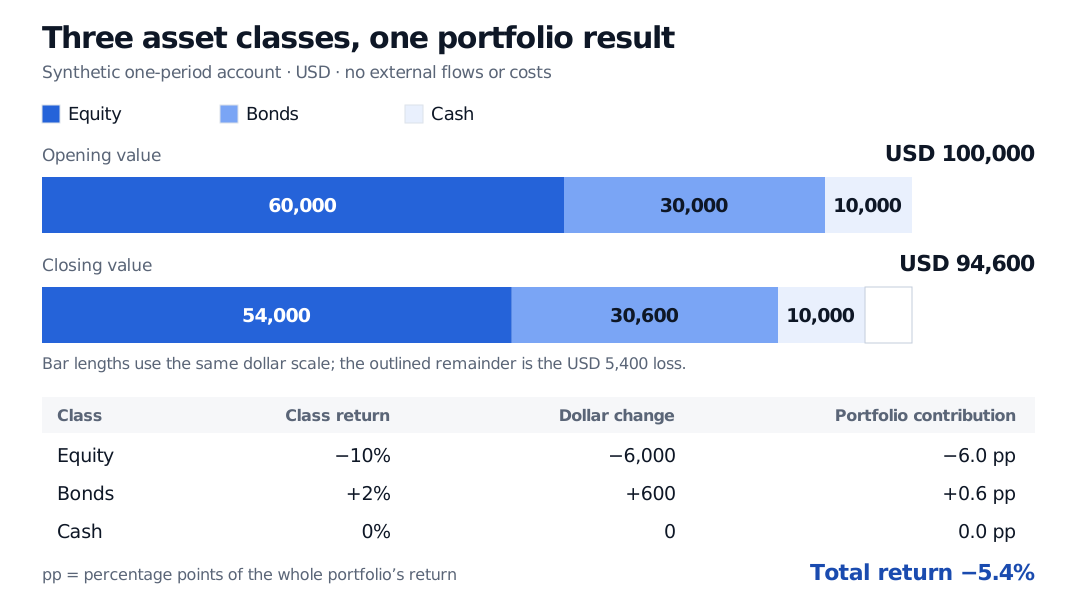
Consider an original, hypothetical portfolio worth USD 100,000. It begins with 60% in an equity sleeve, 30% in a bond sleeve and 10% in cash. Each sleeve represents the holdings assigned to that class under this account's classification.
Over one common period, suppose the sleeves' simple total returns are −10%, +2% and 0%. All values and returns are in USD, any income stays invested within its sleeve, and there are no external flows, trades, costs or taxes. The opening values of USD 60,000, USD 30,000 and USD 10,000 become USD 54,000, USD 30,600 and USD 10,000.
Opening equity USD 60,000, bonds USD 30,000 and cash USD 10,000 become USD 54,000, USD 30,600 and USD 10,000. Contributions of minus 6.0, plus 0.6 and zero percentage points give a minus 5.4% portfolio return.
Original synthetic one-period ledger in USD. Both bars use the same dollar scale. Class returns are weighted by opening capital to obtain contributions to the whole portfolio.
The ending account value is USD 94,600, a loss of USD 5,400. Using opening weights,
Rp=0.60(−0.10)+0.30(0.02)+0.10(0)=−0.054=−5.4%.
The bond sleeve's +2% return adds only 0.6 percentage points to the account's return because it started with 30% of the money. Equity contributes −6 percentage points and cash contributes zero. Adding the class returns without weights would answer a different question.
Choosing those weights is asset allocation; identifying the categories is asset classification. The example describes one realised outcome, not expected class returns or a recommended allocation.
Different labels do not guarantee different risks
Diversification depends on how the holdings behave together and on their sizes. Different asset classes can lose value at the same time. For instance, higher discount rates can affect both equity valuations and fixed-rate bond prices. Their relationship can also change across periods; a historical correlation is an estimate, not a permanent property of a class name.
In the example, the bond gain partly offsets the equity loss, but the portfolio still loses money. It establishes neither a universal hedge nor the statistical risk reduction of that mix: assessing the latter requires a distribution or a return history, with assumptions about its relevance.
For a mathematical treatment of how expected returns and covariances affect weights, see Mean-Variance Optimisation. The lesson has a public preview; the full lesson requires membership.
Edwin J. Elton, Martin J. Gruber, Stephen J. Brown and William N. Goetzmann, Modern Portfolio Theory and Investment Analysis, 9th edition, Wiley, 2014, Chapter 10, p. 206 (aggregate asset allocation), and Chapter 5, p. 87 (inflation-linked securities and uncertainty in model inputs). The account and illustration here are original.