A hedge fund is a flexible pooled investment vehicle, not a promise of hedged risk. Separate strategy, gross exposure, investor returns and withdrawal terms.
Hedge fund
A hedge fund is a pooled investment vehicle whose manager has broad scope to pursue active strategies, often using short selling, leverage or derivatives. Its name does not establish that it is hedged, market neutral or low risk. For a quant assessing a fund, the useful questions are what positions generate its returns, how those positions are financed, and what remains for investors after costs.
The term covers very different businesses. An equity manager may buy selected stocks and short others; a macro manager may trade currencies and interest rates; a relative-value manager may trade price differences between related instruments. A systematic process can support any of these approaches. “Quantitative” describes how decisions are made, while “hedge fund” describes the investment vehicle and its operating setting.
Three amounts that should not be confused
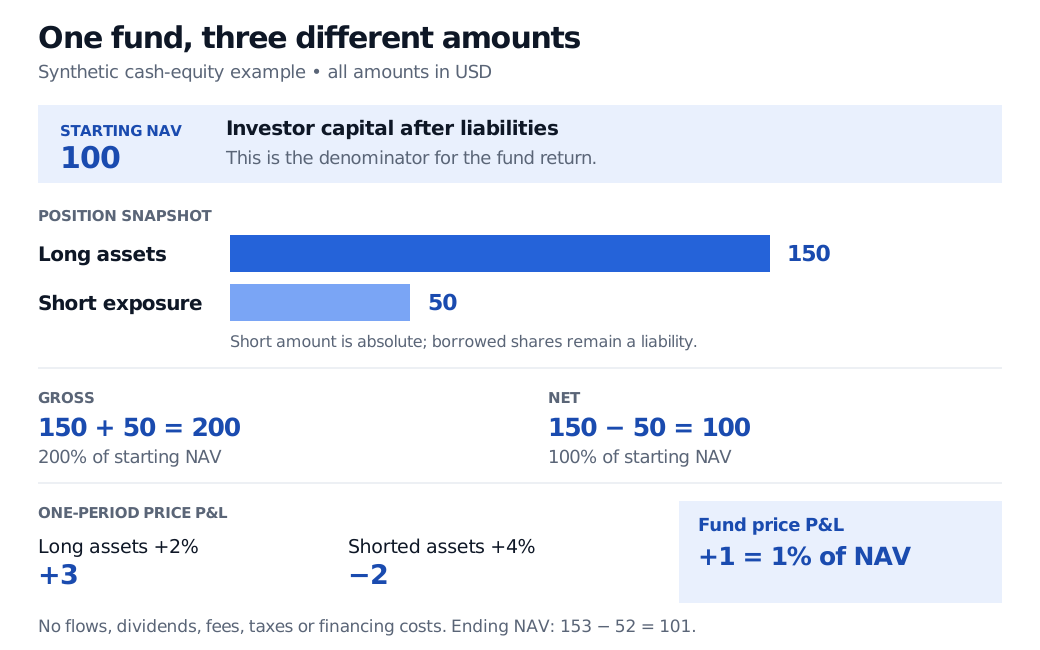
Consider a fictional cash-equity fund with USD 100 of net asset value (NAV): the assets attributable to investors after liabilities. This is the whole fund's NAV, not NAV per share. At the start of one illustrative period it holds long stock positions worth USD 150 and owes borrowed shares worth USD 50. Assume the necessary financing and collateral arrangements are in place; this snapshot does not specify a broker's margin requirements.
Measure
Calculation
Meaning
Investor capital, or NAV
USD 150 − USD 50 = USD 100
Net value belonging to investors
Gross exposure
USD 150 + USD 50 = USD 200
Total size of the two stock books
Net exposure
USD 150 − USD 50 = USD 100
Directional dollar balance
Gross exposure is 200% of NAV, while net exposure is 100% of NAV. The short-sale proceeds accompany a liability to return shares; they are not additional investor capital. Actual accounts can also include cash, financing debt and other assets and liabilities, all of which belong in NAV.
Now suppose the long assets rise by 2% and the assets sold short rise by 4%, with positions held fixed. Exclude dividends, investor subscriptions and withdrawals, fees, taxes and financing costs:
Price P&L=(150)(0.02)−(50)(0.04)=3−2=USD 1.
The price return on starting NAV is 1/100=1%. It is not the long book's 2% return and is not profit divided by USD 200 gross exposure. Revaluing the two books gives USD 153 of longs less a USD 52 short liability: ending NAV is USD 101 before the excluded items.
Illustrative fund with USD 100 NAV, USD 150 long and USD 50 short has 200 percent gross and 100 percent net exposure. A 2 percent long-asset gain adds USD 3; a 4 percent shorted-asset gain subtracts USD 2; profit is USD 1 before costs.
Synthetic cash-equity snapshot and one-period price changes. Short exposure is shown as an absolute amount; its rising asset price produces a loss. No investor flows, dividends, fees, taxes or financing costs.
This long–short portfolio is net long. Even equal long and short dollar amounts would not establish market neutrality: the holdings can respond differently to market, sector and other risk factors. Gross and net dollars are useful exposure summaries, not complete risk measures; derivatives require additional care over notional amounts and sensitivities.
For the underlying cash mechanics, Funding, Margin, Collateral and Short Selling works through stock borrowing, dividend compensation and collateral demands. The preview is public; the full lesson requires membership.
The investor owns fund terms as well as a strategy
A profitable trading book can produce a disappointing investor outcome. Read the fund's documents for the management fee, performance fee and expenses. Where a high-water mark applies, it can require recovery of past losses before another performance fee is earned; the contractual calculation matters. Neither a particular fee schedule nor a high-water mark is universal.
Withdrawal rights matter separately from whether an individual holding trades frequently. A lock-up restricts withdrawal for a stated period; notice requirements and redemption windows control when requests can be made or paid. A gate can limit withdrawals, and documents may permit suspension in specified circumstances. Investors therefore need to assess the fund's liquidity risk, valuation methods and funding commitments together. The SEC's investor guidance highlights fees, valuation, leverage and redemption restrictions.
Reported smoothness also deserves scrutiny. Infrequent or stale valuations of difficult-to-trade holdings can make measured returns look less volatile than their economic exposure warrants. Elton and coauthors discuss this measurement problem alongside changing and nonlinear hedge-fund exposures. A smooth historical series alone does not demonstrate safety or skill.
Access and regulation depend on the jurisdiction
United States. The SEC describes hedge funds as private, unregistered investment funds; depending on their structure, investors must qualify as accredited investors or qualified purchasers. “Unregistered fund” does not mean an absence of law or oversight: fund managers may be registered investment advisers, and antifraud rules still apply. SEC source.
Australia. The U.S. description is not a universal legal definition. ASIC's March 2026 RG 240 addresses disclosure for hedge-fund offers and includes registered schemes and retail corporate collective investment vehicles within its specified definition. Retail hedge-fund products therefore exist within an Australian disclosure framework; that does not imply every investor can access every fund or that the products suit most retail investors. ASIC RG 240, especially RG 240.4 and 240.31–240.36.
Elton, E. J., Gruber, M. J., Brown, S. J. and Goetzmann, W. N. (2014), Modern Portfolio Theory and Investment Analysis, 9th edition, Wiley, Chapter 26, pp. 687–689: varied strategies, incentive fees, valuation and performance measurement.