An exchange-traded fund (ETF) is a pooled investment fund whose shares or units trade on an exchange during the trading day. It lets a strategy obtain a portfolio exposure through one traded instrument, but the price paid for that instrument can differ from the value of its underlying holdings.
A vehicle, rather than an asset class
“ETF” describes how the investment is packaged and traded. It does not specify the asset class, risk or investment method. A broad equity ETF, a bond ETF and a concentrated sector ETF can have very different exposures. Diversification depends on what the fund holds, rather than the number of fund tickers in an account.
An ETF can follow an index fund strategy or be actively managed. Index tracking and exchange trading are separate choices: an index fund can also use a conventional mutual fund structure. Some ETFs hold underlying assets; others use derivatives to obtain exposure. ASIC’s ETF guide distinguishes these approaches and their risks.
Legal labels also matter. In the United States, not every exchange-traded product marketed with “ETF” in its name is an investment company registered under the Investment Company Act of 1940. Commodity trusts and exchange-traded notes can have different structures and protections. The SEC’s ETP guide explains that boundary; classification depends on the product and jurisdiction.
The fund value and the executable price
Net asset value (NAV) per share is an accounting valuation:
For a synthetic USD fund, stipulate assets of USD 1,000,000, liabilities of USD 10,000 and 99,000 shares outstanding. Net assets are USD 990,000, giving USD 10.00 NAV per share. At a stipulated market price of USD 10.05, measured at the same valuation instant, the premium is
The denominator is NAV, rather than the purchase price. This USD 0.05 per-share premium is a price-to-value comparison at one instant; it is not a yearly management fee.
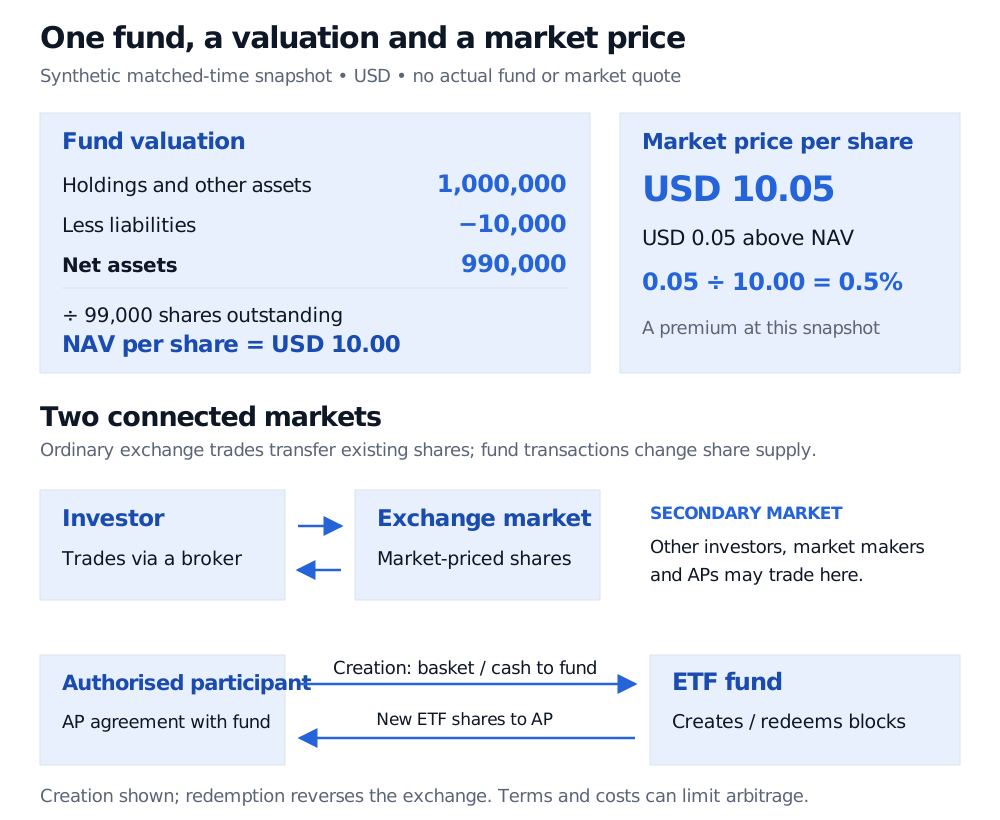
Original synthetic matched-time USD valuation and simplified market mechanism. The lower primary-market arrows show creation; redemption reverses the exchange, subject to the fund’s terms.
For a real order, the relevant executable price is the available bid or ask for the intended quantity. A last-traded price or published NAV is not a promise of that fill. The SEC’s investor guide emphasises that investors transact at market prices that can differ from NAV.
Why creation and redemption help
Ordinary exchange purchases transfer existing shares between market participants. In the U.S. structure described by the SEC’s ETF bulletin, authorised participants (APs) have agreements permitting large-block transactions directly with the fund. A retail investor generally exits by selling in the market, rather than redeeming an individual share with the fund.
On creation, an AP delivers the required basket of securities, cash, or both and receives new ETF shares. On redemption, the AP delivers ETF shares and receives the prescribed basket or cash. These transactions change shares outstanding.
If shares are expensive relative to the basket, creating and selling shares can be attractive. If shares are cheap, buying and redeeming them can be attractive. This arbitrage incentive helps connect the exchange price with the underlying value.
It does not guarantee instant equality. Basket trading, hedging, financing and creation/redemption charges affect the economics. Limited underlying liquidity or impaired AP activity can weaken the mechanism. A reported premium can also reflect different valuation times: an ETF may trade while a foreign underlying market is closed. iShares’ explanation distinguishes actionable differences from timing effects and notes that deviations can persist.
Keep three costs separate
- Fund operating expenses reduce fund assets over time; the expense ratio describes an annual expense measure.
- Trading frictions, including the bid–ask spread and any commission, arise when shares are bought or sold.
- Premium or discount to NAV describes where the share price stands relative to the stated valuation. It can change independently of operating expenses.
The prospectus or product disclosure statement identifies the exposure, strategy, charges and risks. For quantitative analysis, distinguish returns computed from NAV from returns achievable at execution prices, and state how distributions and trading costs are handled.
Sources
- SEC Investor.gov: Updated Investor Bulletin — Exchange-Traded Funds (ETFs), 23 February 2023 — U.S. registered-fund scope and primary/secondary-market mechanics.
- ASIC Moneysmart: Exchange traded funds (ETFs), updated 1 September 2026 — exposures, active/passive and physical/synthetic distinctions, costs and risks.
- SEC Investor.gov: Exchange-Traded Products (ETPs) — U.S. regulatory distinctions between product structures.
- iShares: All about ETPs — Premiums and discounts, 10 September 2026 — creation/redemption incentives, persistent deviations and valuation-time differences.
- Simplify Exchange Traded Funds: registration statement filed 29 September 2026 — illustrative AP risk and creation/redemption transaction-fee disclosures; not treated as evidence of effective offering terms.
- SEC Investor.gov: Exchange-Traded Funds (ETFs) — market transactions and fund disclosures.
- Elton, Gruber, Brown and Goetzmann, Modern Portfolio Theory and Investment Analysis, 9th edition, Wiley, 2014, Chapter 25, pp. 655–656 — fund structure, creation/redemption and price versus NAV. Numerical example and diagram are original and synthetic.