A mutual fund pools investors’ money into a managed portfolio and gives each investor shares representing a proportional interest in the fund. For portfolio analysis, the important distinction is between the fund’s investment results and the investor’s cash flows: a rising account balance may reflect new contributions, while a falling share value may reflect a distribution.
Here, “mutual fund” means a conventional open-end fund, using U.S. investor terminology. Investors subscribe for newly issued shares or redeem shares with the fund, directly or through an intermediary. The term has broader uses in some texts and jurisdictions; product documents determine the actual legal structure.
What happens to a purchase order?
The net asset value (NAV) per share is the fund’s assets less liabilities, divided by shares outstanding. For a conventional U.S. mutual fund, an accepted purchase or redemption order uses the next calculated NAV under the applicable dealing rules, with any relevant charges. The number displayed when you submit the order may be the previous valuation, rather than the price you will receive. The SEC’s prospectus guide explains this forward-pricing convention.
Check when the fund or authorised intermediary must receive a valid order, its valuation schedule and when proceeds are paid. A valuation time is not a universal order cutoff, and order submission is not immediate access to redemption cash. Redemption rights also operate under the fund’s terms and applicable law. For example, the SEC’s liquidation bulletin describes circumstances in which redemptions may be suspended during liquidation.
This differs from an ordinary purchase of an exchange-traded fund: an ETF investor normally trades existing shares on an exchange at an available market price, which can differ from NAV. Conventional mutual funds do not give the investor that intraday exchange execution.
Follow the shares and the cash separately
Consider a synthetic USD example. A valid subscription receives a next calculated NAV of USD 10.00 per share. USD 1,000 buys 100 shares, assuming no purchase charge. There are no subsequent contributions or withdrawals. At the end of the holding period, NAV is USD 10.50 per share, after a USD 0.20 per-share cash distribution has been paid. The investor keeps that cash without reinvesting it; it earns no interest. Ignore tax and investor-level charges, and treat the stated NAVs as already reflecting fund operating expenses.
| Investor ledger | Calculation | Amount |
|---|---|---|
| Initial investment | 100 shares × USD 10.00 | USD 1,000 |
| Ending fund holding | 100 shares × USD 10.50 | USD 1,050 |
| Cash received | 100 shares × USD 0.20 | USD 20 |
| Ending combined wealth | USD 1,050 + USD 20 | USD 1,070 |
The holding-period total return is
The NAV-only change is 5%. It omits the 2% of initial investment paid out in cash. This 7% is a return over the stated holding period, not an annualised rate or a reinvested-distribution performance series.
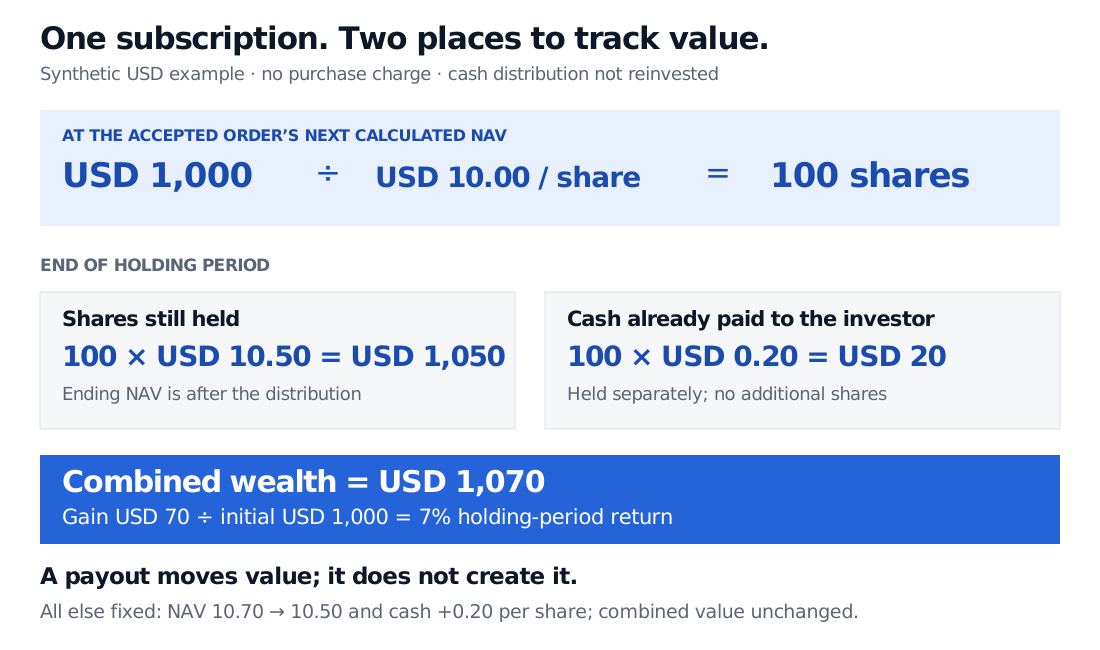
Original synthetic ledger. Cash is retained, not reinvested. Ending NAV is after the distribution; investor-level charges and tax are excluded.
A distribution is not free additional value. Holding everything else fixed, paying USD 0.20 per share transfers that amount out of fund assets: a NAV of USD 10.70 immediately before the distribution becomes USD 10.50 after it. The investor’s 100 shares lose USD 20 of value and receive USD 20 of cash. That transfer alone creates no gain. The SEC’s fund-distributions bulletin explains why a high distribution does not establish strong performance.
For the next step in return measurement, SelfMadeQuant’s Financial Return Characteristics distinguishes simple returns, log returns and compounding. Its public page is a preview; the full lesson requires membership.
The wrapper does not choose the strategy
A mutual fund can be actively managed or follow an index fund strategy. Its risk depends on the underlying holdings and mandate. Diversification across a broad portfolio can reduce exposure to individual issuers, but a concentrated fund may provide little of it, and diversification does not eliminate market losses.
Compare the actual share class as well as the strategy. Ongoing operating expenses, summarised by an expense ratio, reduce fund assets. Purchase loads, redemption charges and account fees can further change what an investor receives; “no load” does not mean “no expenses”. Avoid subtracting operating expenses a second time from a return already measured after those expenses. Tax treatment depends on jurisdiction, account type and the character of the distribution; the example makes no after-tax claim.
Sources
- SEC Investor.gov: Mutual Funds — pooled ownership, investor transactions, strategies, risks and charges.
- SEC Investor.gov: How to Read a Mutual Fund Prospectus, Part 3, 13 June 2016 — next calculated NAV, shareholder dealing information and distribution options.
- SEC Investor.gov: Fund Distributions — Investor Bulletin, 19 August 2026 — cash versus reinvestment, distributions versus performance and U.S. taxable-account considerations.
- SEC Investor.gov: Investor Bulletin — Fund Liquidation, 17 December 2021 — an example of conditional redemption access during liquidation.
- Edwin J. Elton, Martin J. Gruber, Stephen J. Brown and William N. Goetzmann, Modern Portfolio Theory and Investment Analysis, 9th edition, Wiley, 2014, Chapter 25, pp. 648–651 — conventional open-end structure, forward valuation and expenses. The numerical ledger and figure are original.