An index fund is an investment fund that seeks to track the return of a specified market index. It turns a calculated benchmark into an investable portfolio, with actual holdings, cash flows and costs. For quantitative work, the central question is how closely the fund delivers its stated exposure after those implementation effects.
The strategy and the vehicle answer different questions
Index tracking describes the investment objective. An exchange-traded fund (ETF) or a conventional mutual fund describes a way to package and transact in that strategy. An ETF can be actively managed, while an index fund can use either vehicle. The SEC’s index-fund guide explicitly distinguishes these possibilities.
A stock index specifies a basket and its calculation rules; investors buy the fund that attempts to reproduce the exposure. Index selection matters before fund selection: a narrow sector index and a broad market index can carry very different concentration risks. “Index” does not promise broad diversification, capital protection or a particular return.
Reproducing an index takes work
With full replication, a fund holds the constituent securities in the index’s proportions. With sampling, it holds a selected portfolio intended to reproduce the index’s behaviour. Sampling can reduce the burden of trading many small or illiquid positions, while introducing differences in exposure. Matching broad market sensitivity alone need not match sector or other risk exposures; Elton and co-authors discuss this trade-off in their treatment of passive management.
Passive management still involves decisions about execution, cash and corporate actions. An index rebalance can require trades, even when the manager has no view about which security will outperform. The index’s calculation and the fund’s executable portfolio are different objects. Vanguard’s prospectus, for example, describes rebalancing costs, sampling and other implementation constraints.
Follow the dollars through one period
Consider an original synthetic benchmark with beginning weights of 60% in asset A and 40% in asset B. Both assets start at USD 20. A ends at USD 22, a 10% gain; B ends at USD 19, a 5% loss. There are no distributions, investor flows or trades during the period, and all values use the same USD valuation times.
The benchmark’s portfolio return is
A replicating fund starts with USD 100 net asset value (NAV). It holds three units of A worth USD 60 and two units of B worth USD 40. At the end, those unchanged quantities are worth USD 66 and USD 38: USD 104 before costs.
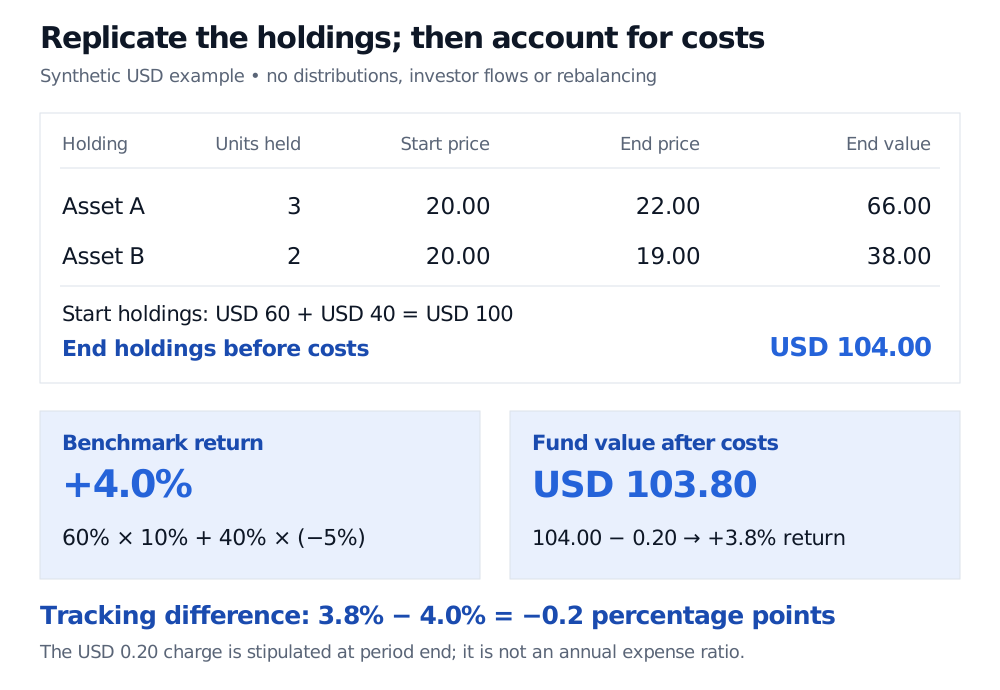
Original synthetic one-period USD holdings ledger. No distributions, flows or rebalancing; a stipulated USD 0.20 cost is deducted at period end.
Now recognise a USD 0.20 cost as a fund liability at period end. End NAV is USD 103.80, so the fund’s net return is
The cost reduces this period’s return by 0.20% of starting NAV. It is a stipulated fixed charge, not a quoted annual expense ratio. A real fund’s expense accrual, transaction costs and other cash flows must be measured under their actual conventions. Holding the same quantities also does not keep the original weights fixed as prices change.
A shortfall is different from unstable tracking
Define the tracking difference here as fund return minus benchmark return over the same stated period:
That is −20 basis points. The sign convention matters: the fund underperformed in this example.
Tracking error instead measures the standard deviation of a series of periodic fund-minus-benchmark returns. A fund that falls behind by the same amount every period can have zero tracking error and a persistent shortfall. One observed return difference cannot establish sample tracking error. State the observation frequency, sample window and any annualisation method when reporting it. The Vanguard prospectus distinguishes the return gap from its volatility.
For real comparisons, align the currency, dates and return basis. Compare total return with total return, including the stated treatment of reinvested distributions; a price return index can omit income. The example has no distributions, so that distinction does not change its numbers. An ETF investor’s return measured from execution prices can also differ from the fund’s NAV return.
Read the objective before comparing the fee
Identify the exact benchmark, its weighting and inclusion rules, and the fund’s replication method. Then compare costs and realised tracking on a consistent basis. A lower advertised expense ratio alone does not establish the smaller realised return gap: trading, tax treatment, cash and sampling can also matter. An index fund inherits the economic risks of its exposure; accurate tracking of a falling market still produces a loss.
Sources
- SEC Investor.gov: Index Funds — fund vehicles, replication approaches, fees and investment risks; checked 25 October 2026.
- Vanguard Investment Series plc: prospectus dated 29 July 2026, printed pp. 39–42, “Index Tracking”, “Index Rebalancing and Costs” and “Excess Return and Tracking Error” — implementation frictions and the return-gap/volatility distinction; checked 25 October 2026. This is illustrative fund documentation, not a universal product convention.
- Edwin J. Elton, Martin J. Gruber, Stephen J. Brown and William N. Goetzmann, Modern Portfolio Theory and Investment Analysis, 9th edition, Wiley, 2014, Chapter 16, “Passive Management”, pp. 385–386 — replication, sampling costs and matching multiple risk exposures. Numerical example and figure are original.