A retirement account, an equity fund and a trading desk's book are all portfolios, but their objectives differ. A portfolio intended to meet a payment next year faces a different problem from one seeking long-term growth. Its definition therefore includes an accounting boundary: which accounts, liabilities, currencies and cash balances count?
Turn a list of holdings into weights
Suppose an account starts with USD 100,000. It holds 600 units of hypothetical investment A at USD 100 each, and 200 units of investment B at USD 200 each. There is no uninvested cash, borrowing or external contribution during the year.
| Holding | Units | Beginning price | Beginning value | Beginning weight |
|---|---|---|---|---|
| A | 600 | USD 100 | USD 60,000 | 60% |
| B | 200 | USD 200 | USD 40,000 | 40% |
| Total | USD 100,000 | 100% |
The account has three times as many units of A as B, but only one and a half times as much money in A. Unit counts are not portfolio weights. For ordinary long holdings, with quantity and price ,
Here is cash and is beginning portfolio value. With positive equity, these weights, including cash, sum to one. Borrowing can be represented by a negative cash balance; its interest belongs in the return calculation. A short holding has a negative signed market value. Margin requirements and restrictions on short-sale proceeds still have to be respected.
Derivatives need additional care: a futures contract's small initial market value does not mean its price exposure is small. Market-value weights alone do not describe its notional exposure, sensitivity or collateral needs. Even for funds, two different tickers may hold substantially the same underlying securities.
The return belongs to the money invested
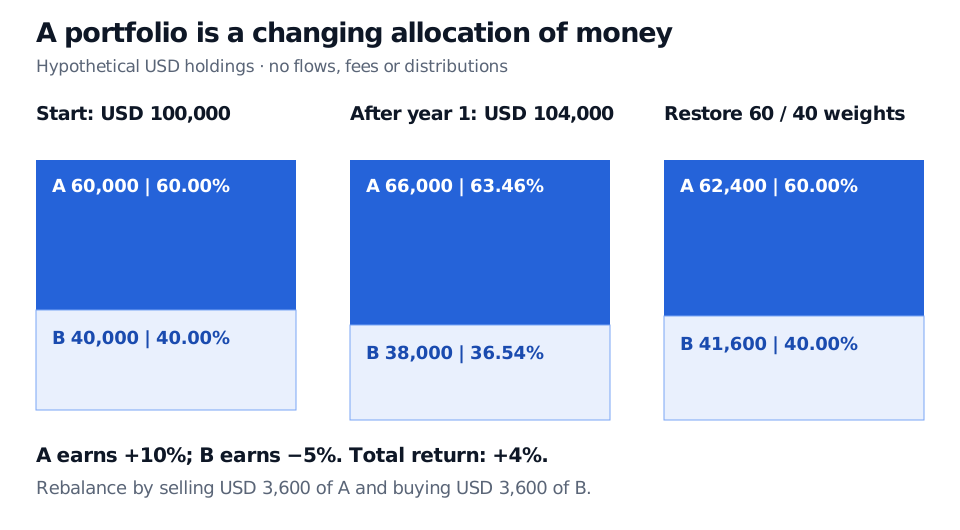
Assume A rises 10% and B falls 5% over the year, with no distributions or costs. A ends worth USD 66,000 and B USD 38,000. The account ends at USD 104,000: its realised simple return is 4%.
For beginning weights held over one period, matching asset total returns give
including cash or financing as appropriate. The example gives
This identity assumes a consistent return convention. If an asset pays income, use total return with a stated reinvestment convention, or track the income in the cash ledger; do not count it twice. Convert values and returns to the same reporting currency. Deposits and withdrawals require a performance method that separates external flows from investment gains: an increase in account value is not necessarily an investment return.
Cash is part of this accounting. If instead the account began with USD 54,000 in A, USD 36,000 in B and USD 10,000 in cash earning 3%, the same asset moves would leave USD 103,900, a 3.9% return. Reporting only the invested sleeve's 4% would overstate the whole account's return. A cash reserve changes both exposure and the amount available for payments.
A portfolio also has a trading rule
Restoring 60/40 at USD 104,000 requires USD 62,400 in A and USD 41,600 in B: sell USD 3,600 of A and buy the same amount of B. This example permits fractional units and ignores costs.
Now suppose that in a second year A loses 10% and B gains 20%.
| Policy after year 1 | Second-year ending A | Second-year ending B | Total ending value | Two-year cumulative return |
|---|---|---|---|---|
| Keep the original units | USD 59,400 | USD 45,600 | USD 105,000 | 5.00% |
| Restore 60/40 once | USD 56,160 | USD 49,920 | USD 106,080 | 6.08% |
For a strategy that trades each period, calculate each period's return with its own beginning weights, then compound those portfolio returns. Applying the initial weights to every later period silently assumes repeated rebalancing.
Expected performance needs a joint risk model
| Input | A | B |
|---|---|---|
| Expected return | 8% | 12% |
| Return standard deviation | 15% | 25% |
Judge the whole against its job
Volatility is only one risk description. Concentration, financing, liquidity and losses near a spending deadline can matter even when a volatility estimate looks moderate. Taxes, fees and trading costs determine how much of the gross result reaches the investor. A feasible allocation must also satisfy actual cash, borrowing and trading restrictions.
Sources
- Elton, Gruber, Brown and Goetzmann, Modern Portfolio Theory and Investment Analysis, 9th edition (2014), Chapter 4, “The Characteristics of the Opportunity Set Under Risk,” especially “Characteristics of Portfolios in General,” pp. 50–52. Grounding for value weights, expected return and covariance-based portfolio risk; examples here are original.
- SEC Investor.gov, Asset Allocation and Diversification, checked 25 October 2026. Grounding for allocation drift, rebalancing and overlapping fund holdings.