The derivatives market transfers risk through futures, forwards, options and swaps. Separate trading from clearing, and notional exposure from cash settlement.
Derivatives market
The derivatives market is the network of exchanges, dealers and other participants through which derivative contracts are traded. Their payments depend on an underlying price, rate, index or event. A portfolio manager can change equity exposure with an index future, and a company can change interest-rate exposure with a swap, without buying or selling the entire underlying portfolio or loan.
The market transfers risks between participants. It does not make those risks disappear. To understand a trade, separate what the contract does, where it trades and how its obligations are managed after execution.
A borrower exchanges floating-rate exposure for fixed-rate payments
An underlying need not be a physical asset. Interest rates and credit events also support derivatives. The contract fixes the reference, quantity, dates, currency and settlement rules; those details determine the exposure being traded. Hull's introductory chapter develops these contract families and their users.
Trading and clearing answer different questions
Trading establishes the price and contract. Clearing manages the resulting obligations and counterparty exposures.
In an exchange-listed market, the exchange defines standard contract terms and provides trading rules. Eligible trades pass to a central counterparty, or CCP, which interposes itself between its clearing members. Customers typically reach that structure through brokers and clearing members. The exchange and CCP perform different functions even when they belong to the same group.
In the over-the-counter market, contracts are not exchange-listed. Dealers and clients can negotiate terms, although many OTC products are highly standardised and can trade electronically. An eligible OTC trade can be centrally cleared; another can remain bilateral, with obligations between the counterparties under their legal and collateral arrangements.
Thus OTC does not mean uncleared, and an electronic trading platform does not by itself determine the clearing arrangement. The FSB's account of derivatives-market reform treats trading, reporting, central clearing and requirements for non-centrally cleared contracts separately. Actual obligations depend on jurisdiction, product and counterparty; a global reform objective is not a universal rule for every trade.
Clearing and collateral reduce and manage counterparty credit risk. They leave market losses, funding demands and risks associated with brokers, clearing members and the CCP. A sound valuation alone does not establish that a position can be funded through an adverse move.
A quote of 4,000 is not the cash committed
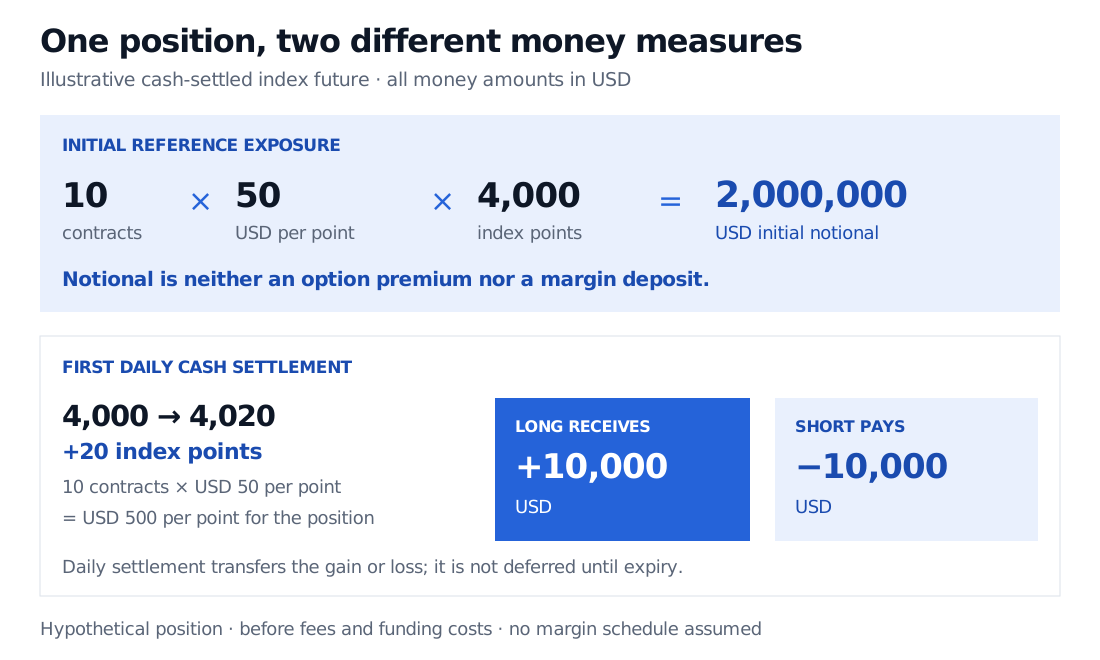
Consider an illustrative USD cash-settled stock-index future, with a multiplier of USD 50 per index point. A trader buys ten contracts at 4,000 index points. These are hypothetical prices and position sizes, not a live quote or a margin schedule.
10×index pointUSD 50×4,000 index points=USD 2,000,000.
Each one-point move changes the position's trading result by USD 500. If the first daily settlement is 4,020, the long receives
10×50×(4,020−4,000)=USD 10,000
in settlement variation, before fees and funding costs. An equivalent short pays USD 10,000. This is the cash settlement for that day's move, not a profit held back until expiry. CME's mark-to-market explanation describes daily futures gains and losses and the possibility of additional funding demands.
An illustrative ten-contract stock-index futures position has a USD 50 per point multiplier and entry quote of 4,000 points: USD 2,000,000 initial notional. A first daily settlement at 4,020 is a 20-point rise, giving the long USD 10,000 and the short minus USD 10,000 before costs.
Original hypothetical contract-scale diagram. Notional measures the initial reference exposure; the lower panel shows the first day's cash settlement. All money amounts are USD, before fees and funding costs.
The USD 2 million is neither an option premium nor the margin deposit. Premium is the price paid for an option; initial margin is collateral supporting a position. This future does not require an upfront purchase of the full notional. No margin amount is assumed here, so the example does not imply a return on deposited capital or a particular leverage ratio. Losses can exceed the initial margin.
For a fuller comparison of commitments and cash-flow timing, Forwards and Futures is available with a free signed-in account.
Who wants the other side?
The contract alone does not reveal a trader's purpose. The ICE discussion of market participation distinguishes three roles, which can coexist inside one institution:
A hedger uses the contract to offset an exposure elsewhere. An equity fund might short index futures to reduce market exposure. Its futures loss when prices rise can accompany a gain on its shares. Judge the hedge using the combined position; mismatched holdings, dates or quantities leave residual risk.
A speculator deliberately takes exposure to seek a trading profit. A long index future can express a view that prices will rise. Small initial collateral relative to notional can magnify gains and losses relative to posted cash.
An arbitrageur trades related instruments against one another to exploit an inconsistency. A cash-and-carry trade links futures to the financed underlying. True arbitrage requires the stated cash flows and execution assumptions to remove loss possibilities; simply buying one index and selling a correlated index leaves spread risk.
Dealers and market makers help connect these demands by quoting prices and managing inventory. A hedger's counterparty need not be another hedger with the exact opposite business need. Positions can pass through intermediaries that offset or redistribute the exposure elsewhere.
Reading a headline about market size
Trading volume measures activity over a period; notional outstanding measures reference amounts on open contracts at a date. Neither is the amount of money investors have lost.
Market value asks what an existing contract is worth at current conditions. Netting and collateral then affect counterparty exposure. The BIS explanation of derivatives statistics distinguishes these measures and notes that notional has different economic roles across products. In some currency contracts, principal amounts really are exchanged; in many interest-rate swaps, notional is a reference for interest calculations.
For the fictional future above, USD 2 million describes the initial scale, while USD 10,000 describes one day's settlement. Neither number, by itself, is a complete measure of the trade's risk.
Sources
John C. Hull, Options, Futures, and Other Derivatives, 9th Global Edition, Pearson, 2018, Chapter 1, §§1.1–1.2, pp. 24–28, and §1.6, p. 33: market structure, measurement and trader roles. The contract-scale example is original.