A stock collar combines shares, a long put and a short call to bound expiry value. Follow premiums, capped profit and settlement through an exact three-leg ledger.
Collar
A collar protects a long asset position by buying a put option and selling a call option, usually with a lower put strike and a higher call strike at the same expiry. For a matched stock position, the put establishes a floor under expiry value; the call pays part or all of the protection's premium in exchange for capping upside. The practical decision is how much upside to surrender for a chosen amount of downside protection.
This article describes the long-stock protective collar. The word also appears in interest-rate hedging and other markets, where the underlying cash flows and the direction of the options must be specified. OIC's collar guide describes the stock structure as combining the protection of a protective put with the written call in a covered call, using the same stock holding.
Follow all three legs
Consider a synthetic position entered today. Buy one share at USD 100, buy a European put with a USD 95 strike for USD 2, and sell a European call with a USD 110 strike for USD 1. Both options cover that same share and expire together. All option premiums and values below are quoted per share-equivalent.
The initial cash ledger is:
Entry transaction
Cash flow (USD)
Buy the share
−100
Buy the put
−2
Sell the call
+1
Net cash flow
−101
The call receipt reduces the option overlay's net cost to USD 1. It does not make this a zero-cost collar. That label normally means the put premium and call premium offset at inception, before costs; buying or already holding the underlying still commits capital and capped upside still has economic value.
Hold the complete position to the common expiry. Assume a nonnegative stock price, no dividends, funding costs, fees, taxes or default, and full contractual performance. For stock price ST, put strike KP and call strike KC, the combined terminal value per share-equivalent is
The put pays in a fall; the short call subtracts value in a rally. Adding their signed payoffs to the stock produces the bounded result. Profit subtracts the initial net outlay, so this example has ΠT=WT−101.
Stock at expiry
Stock value
Long put payoff
Short call payoff
Combined value
Profit
70
70
25
0
95
−6
95
95
0
0
95
−6
100
100
0
0
100
−1
101
101
0
0
101
0
110
110
0
0
110
+9
130
130
0
−20
110
+9
All amounts are USD per share-equivalent. These are hypothetical terminal scenarios, not forecasts or option quotes.
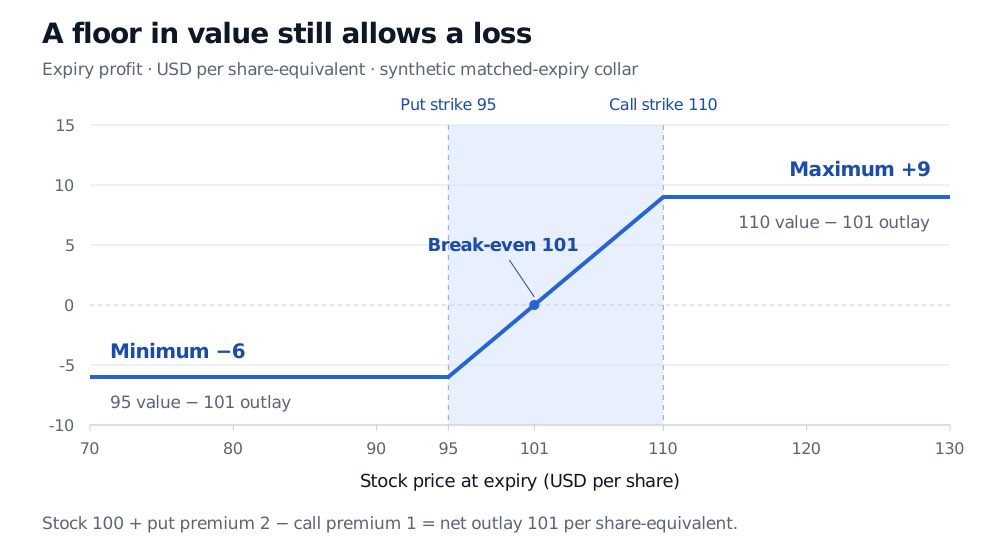
Synthetic collar expiry profit per share-equivalent: stock bought at 100, long 95-strike put for 2 and short 110-strike call for 1. Net outlay is 101, minimum profit is minus 6, maximum profit is 9 and break-even stock price is 101.
Original matched-expiry illustration. A USD 95 value floor against USD 101 net outlay leaves a USD 6 maximum loss per share-equivalent; the USD 110 value cap leaves a USD 9 maximum profit. No dividends, funding, fees, taxes or default.
A stock price of 100 leaves the share unchanged but loses the net option premium. The break-even stock price is 101, inside the two strikes. For 100 shares with each option covering 100 shares, the initial outlay is USD 10,100, maximum loss USD 600 and maximum profit USD 900. The option overlay alone does not have this floor-and-cap profile: the long stock is essential.
Value is not an extra settlement cheque
The option-payoff formula is an economic accounting identity. Contract terms determine how settlement delivers the result.
For a physically settled version of the example, if the stock finishes at 70, exercising the put delivers the share and receives 95 in cash. The investor ends with 95, rather than a share plus a separate 95 payment. If the stock finishes at 130 and the short call is exercised and assigned, delivering the share receives 110 in cash. Between the strikes, both options have zero expiry payoff and the investor retains the share, valued at ST. At a strike, settlement details can affect whether the share remains; the economic terminal value is the same under these assumptions.
For a cash-settled version on the same terminal stock reference, the investor instead keeps the share and receives or pays the option cash payoff: at 70, a share worth 70 plus a put payment of 25; at 130, a share worth 130 minus a call payment of 20. Both reconcile to the same combined value. Physical and cash settlement are alternative contract specifications, not a choice created by the payoff formula.
Actual contracts need their own rules. OCC's standard equity-option specifications describe American exercise and delivery of shares, normally 100 per contract, with corporate-action adjustments possible. Those instruments introduce early-exercise and assignment considerations absent from the synthetic European example.
What the two boundaries do—and when
The floor and cap above apply at the matched expiry while all three legs remain in place. A European put cannot be exercised early to realise its strike. Before expiry, the package's sale value depends on option market prices, remaining time, volatility and other pricing inputs; the terminal diagram does not promise an interim liquidation value between 95 and 110.
Matching matters as much as the strikes. A put on a different asset, a smaller protected quantity, different expiries or a different settlement reference can leave residual exposure. Keeping the shares after the options expire also leaves future price moves unprotected. A collar bounds a specified terminal stock exposure; it does not turn an indefinite holding into a guaranteed investment return.
You can explore the ledger in the public Option Strategy Designer. Clear the starting position and manually add Buy stock: 100 shares, entry price 100; Buy put: one contract, strike 95, entry premium 2; Sell call: one contract, strike 110, entry premium 1. Use the shared expiry and inspect the At expiry profit curve. Keep those entry premiums fixed to reproduce the example. The tool uses a 100-share option multiplier and European Black–Scholes scenarios; it excludes fees, margin, early exercise and assignment. Its scenario curve is a model valuation, distinct from the terminal ledger.
John C. Hull, Options, Futures, and Other Derivatives, ninth Global Edition, Pearson, 2018, §12.2, pp. 278–280: stock-plus-option component strategies and the terminal-payoff-minus-initial-cost convention. The collar ledger and figure here are original synthetic examples.