A covered call sells a call against owned shares. Reconcile the premium, stock exposure and delivery ledger to see why gains are capped and losses remain substantial.
Covered call
A covered call combines ownership of an underlying asset with a short call option on the same quantity of that asset. For a physically settled stock call, the owned shares can be delivered if the writer is assigned. In exchange for receiving an option premium, the investor gives up stock gains above the call’s strike price while the call remains open.
The word covered describes that delivery position. It does not mean the investment is safe: the shares can still lose most or all of their value. The strategy changes the distribution of equity returns; it does not turn equity into a guaranteed yield.
A premium receipt is only one line of the trade
Consider a fictional stock-and-option trade, quoted in USD per share:
Buy the stock at 100.
Sell a European call on that stock with strike 110 for a stipulated premium of 3.
Hold both positions to the call’s expiry. Assume a nonnegative stock price, no dividends, zero funding interest, and no fees, taxes or counterparty default.
The net initial outlay is 100−3=97 per share. The premium is an assumed trade quote, not a model valuation or a promise about available market prices.
Let ST be the stock price at expiry. Marking the stock at its terminal value and deducting the short call’s expiry obligation gives
The initial premium is already included in the 97 outlay. Adding it again to the profit formula would count the same cash twice.
Stock at expiry, USD/share
Stock value
Short call obligation
Combined terminal asset value
Profit after the 97 outlay
0
0
0
0
−97
80
80
0
80
−17
97
97
0
97
0
100
100
0
100
3
110
110
0
110
13
130
130
−20
110
13
All table amounts are USD per share. The obligation column is signed from the call writer’s perspective. At 130, the stock’s extra 20 above the strike is exactly offset by the short call’s liability.
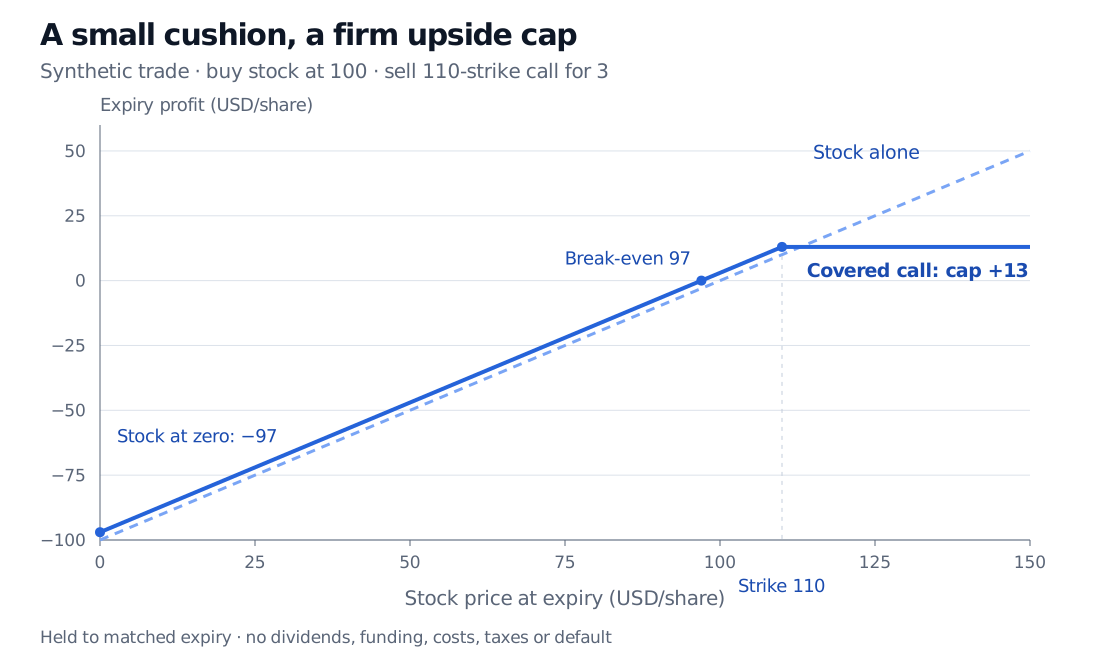
Expiry profit in USD per share for stock bought at 100 and a covered call with strike 110 and premium 3. The covered call breaks even at 97, loses 97 if the stock reaches zero, and reaches its maximum profit of 13 at 110. Stock alone continues to gain above 110.
Original synthetic expiry comparison. The solid blue line includes both stock and call; the dashed line is stock alone bought at 100. The premium cushions losses by 3 below the strike, while profit is capped at 13 above it. Dividends, funding, costs, taxes and default are excluded.
For this trade, the maximum profit is 13, the expiry break-even is 97, and the maximum loss is 97 per share, reached if the stock becomes worthless. The maximum profit includes a stock gain of 10 as well as the premium of 3. It is not limited to the option premium.
At an expiry stock price of 80, receiving the premium has softened a stock loss of 20 to a combined loss of 17. It has not protected a floor under the shares. A protective put buys a separate downside right; writing a call does not.
Delivery uses the shares you already own
Scale the example to 100 shares and one fictional call covering those 100 shares. Buying the shares costs USD 10,000; selling the call brings in USD 300. Net initial cash paid is USD 9,700.
If the stock finishes at 130 and the call is exercised for physical delivery, the writer delivers the 100 owned shares and receives the strike proceeds of USD 11,000. The complete cash ledger is
−10,000+300+11,000=1,300 USD profit.
There is no further USD 2,000 option payment on top of delivering the shares. The alternative valuation ledger—stock worth USD 13,000 less a USD 2,000 call liability—describes the same USD 11,000 terminal value, rather than an additional set of cash flows.
Stock alone would have earned USD 3,000 at 130. The covered call earns USD 1,300: its USD 300 premium compensates for accepting an obligation that, in this outcome, gives away USD 2,000 of stock appreciation. The investor must be willing to sell at the strike, not merely attracted to the premium receipt.
Expiry arithmetic does not settle every operating question
The example uses a European option to isolate one expiry ledger. With an American option, assignment can occur before expiry. For US listed equity options, OIC’s assignment guidance explains that a short position can be assigned when a holder in the same option series exercises; it is not restricted to the person who originally traded with the writer. Dividend dates can affect early-exercise incentives.
Selling the covering shares while leaving the call open removes the delivery cover. Closing the call requires buying it back at an executable price; that price may exceed the premium originally received. Broker rules, exercise procedures and funding arrangements still matter. Borrowing to purchase the shares also adds financing obligations absent from the example.
Before expiry, the position’s sale value depends on the stock price and the cost of repurchasing the call. Remaining time and implied volatility affect that cost. The diagram is an expiry result, not an estimate of what the position could be sold for today. Repeatedly selling new calls changes the strikes, premiums and holding periods; annualising one premium receipt does not establish an achievable annual return.
Recreate the combined position
The public Option strategy designer has a Covered call preset. Set the underlying price to 100 before loading it, then check that the stock leg buys 100 shares at entry price 100 and the call leg sells one contract at strike 110 with entry premium 3. Enter the premium manually and keep it fixed. Select Profit & loss and inspect the At expiry curve: at stock prices 80, 97, 110 and 130, the position totals are −1,700, 0, 1,300 and 1,300 USD.
The linked tool does not preload these settings. Its Use current model prices button replaces the stipulated entries. The separate Scenario curve uses European Black–Scholes–Merton valuation with a shared expiry; the tool excludes fees, margin, early exercise and assignment. It helps inspect the combined payoff, rather than decide how an actual broker will process the trade.
Sources
John C. Hull, Options, Futures, and Other Derivatives, ninth Global Edition, Pearson, 2018, §12.2, pp. 278–279, and §19.2, p. 422. The first section combines stock and options; the second explains why holding stock against a short call can still produce a substantial loss.