A protective put combines an asset with a long put to floor matched expiry value. Track the premium, limited loss, break-even and settlement without confusing protection with capital recovery.
Protective put
A protective put combines an owned asset with a purchased put option on that asset. For a matched quantity held to the put's expiry, the put offsets further price losses below its strike, while the asset retains its upside. The price of that protection is the option premium: a floor under terminal asset value can still leave a loss on the money invested.
The structure can protect an existing holding. When the asset and put are bought together, it is often called a married put. The example below buys both together so that the cash committed and the resulting profit are explicit.
The floor is 95; the amount invested is 102
Buy one share for USD 100 and a European put covering that share, with strike USD 95, for USD 2. Hold both to the option's expiry. These are synthetic prices, not market quotes. Assume a nonnegative stock price, the same underlying and units, full contractual performance, and no dividends, funding, transaction costs, taxes or default.
Keep the two cash ledgers separate:
Leg
Cash paid today
Value at expiry
One share
100
ST
One put
2
max(95−ST,0)
Combined
102
max(ST,95)
Amounts are USD per share-equivalent. Today's signed cash flows are −100 and −2; the total outlay is 102.
For terminal stock price ST, the portfolio's terminal wealth is
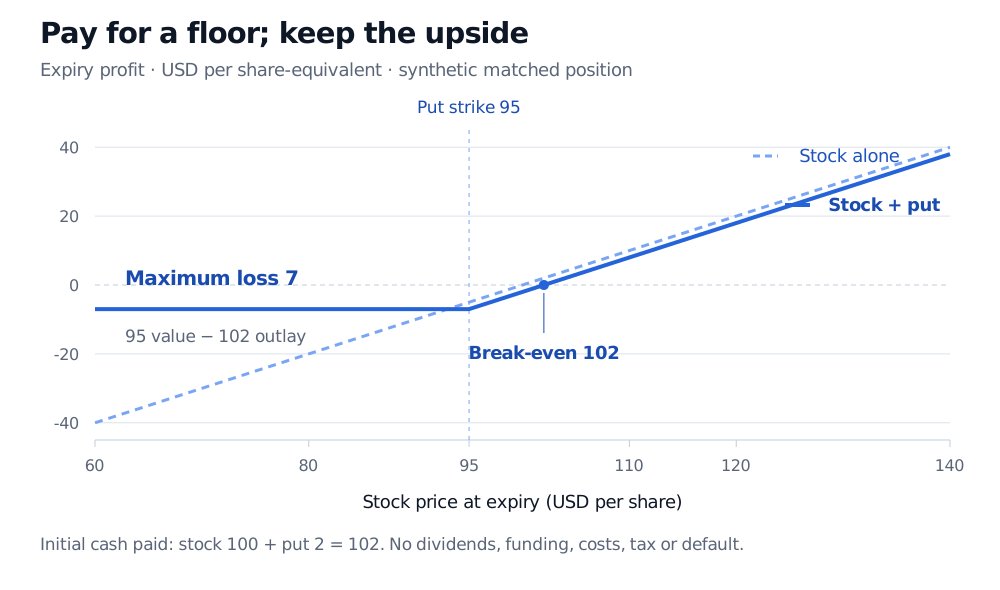
The maximum loss is USD 7: the five-dollar gap between the stock purchase price and the strike, plus the two-dollar premium. The break-even stock price is 102. Above the strike, each extra dollar of stock value adds a dollar to profit, so upside is uncapped. At 120, unprotected stock earns 20; the protected position earns 18 because it paid for the put.
Protective-put expiry profit per share-equivalent: stock bought at 100 and a 95-strike put bought for 2. The protected curve has a minimum profit of minus 7, breaks even at stock price 102 and rises without a cap. The dashed stock-only curve has no such floor.
Original synthetic expiry comparison, in USD per share-equivalent. A value floor of 95 against an outlay of 102 leaves a maximum loss of 7. Both positions exclude dividends, funding, costs, taxes and default.
For 100 shares matched by one put contract covering 100 shares, multiply the ledger by 100: stock cost USD 10,000, option cost USD 200, total outlay USD 10,200, terminal value floor USD 9,500, and maximum loss USD 700. Contract multipliers and deliverables must be checked rather than assumed.
How the put delivers protection
With physical settlement, an exercised put sells the protected share for the strike. At a terminal stock price of 70, delivery of the share produces 95 in cash. It does not leave a share plus another 95. With a hypothetical cash-settled contract on the same terminal reference, the investor instead keeps the share worth 70 and receives 25 from the put. Both deliver total value 95 under the stated assumptions; the actual contract determines settlement.
The European example fixes a floor at the matched expiry. It does not promise that the package can be sold for 95 at every earlier date. Interim liquidation uses market prices; exercise rights depend on the contract's exercise style. Selling the put removes the protection. Holding the stock after the put expires leaves subsequent stock losses exposed unless a new hedge is established, and renewing protection requires another premium.
Quantity and reference mismatches also matter. A put covering only part of the holding leaves the remainder exposed. An index put used against a different stock portfolio introduces basis risk; the exact stock-plus-put identity no longer describes the entire holding.
A call-like shape, with the strike amount included
The terminal identity can also be written
max(ST,K)=K+max(ST−K,0).
That is a call option payoff plus a claim paying the strike at expiry. It is not the standalone call's terminal payoff. Put–call parity connects the corresponding prices today under matching European contracts and suitable financing assumptions.
For a previously owned share, distinguish lifetime profit from performance since protection was added. The historical purchase price may differ from the share's current value. The put still protects the specified terminal asset value, while the chosen starting value determines the performance calculation. Neither purchase capital nor an indefinite future return is guaranteed by the word “protective.”
You can reproduce the example in the public Option Strategy Designer. Clear the initial position and manually add Buy stock: 100 shares at entry price 100, then Buy put: one contract, strike 95, entry premium 2. Inspect Profit & loss and its At expiry curve. The position should show a 10,200 debit, maximum loss 700 and break-even stock price 102. Keep entry premiums fixed; using current model prices changes the example. The tool uses a fixed 100-share option multiplier and shared expiry. Its before-expiry scenarios use European Black–Scholes; fees, margin, early exercise and assignment are excluded.
John C. Hull, Options, Futures, and Other Derivatives, ninth Global Edition, Pearson, 2018, §12.2, pp. 278–280: European protective puts, profit measured as terminal payoff less initial cost, and the call-plus-cash equivalence. The ledger and figure here are original synthetic examples.