A Treasury bill, or T-bill, is a short-term debt security issued by a government's treasury. This page uses the U.S. instrument: a marketable obligation with an original maturity of one year or less, no periodic coupon payments, and repayment of face value at maturity. For a quant comparing short-term returns, the first trap is the quotation: a bill's bank-discount rate is calculated on face value, while the investor commits the purchase price.
U.S. bills are sold at a discount or at par. When bought below par and held to maturity, their interest is the difference between the amount paid and the face value received. A bill is therefore a short zero-coupon bond, rather than a coupon bond with frequent interest payments. TreasuryDirect explains the payment structure.
Follow the cash first
Take a synthetic bill with 90 actual days from settlement to maturity, face value USD 100,000 and a stipulated purchase price of USD 98,750. These are illustrative prices, not observed market quotes. Assume the promised payment arrives in full, and exclude fees and tax.
| When | Investor's cash flow | Meaning |
|---|---|---|
| Settlement, day 0 | −USD 98,750 | Purchase price paid |
| Between settlement and maturity | None | No coupons |
| Maturity, day 90 | +USD 100,000 | Face value received |
The gain is USD 1,250. Relative to the actual cash invested, the 90-day holding-period return is
Here denotes face value and the settlement price. Per USD 100 face value, the same trade costs USD 98.75 and returns USD 100, a gain of USD 1.25. Changing the position size changes the cash amounts, not these percentage returns.
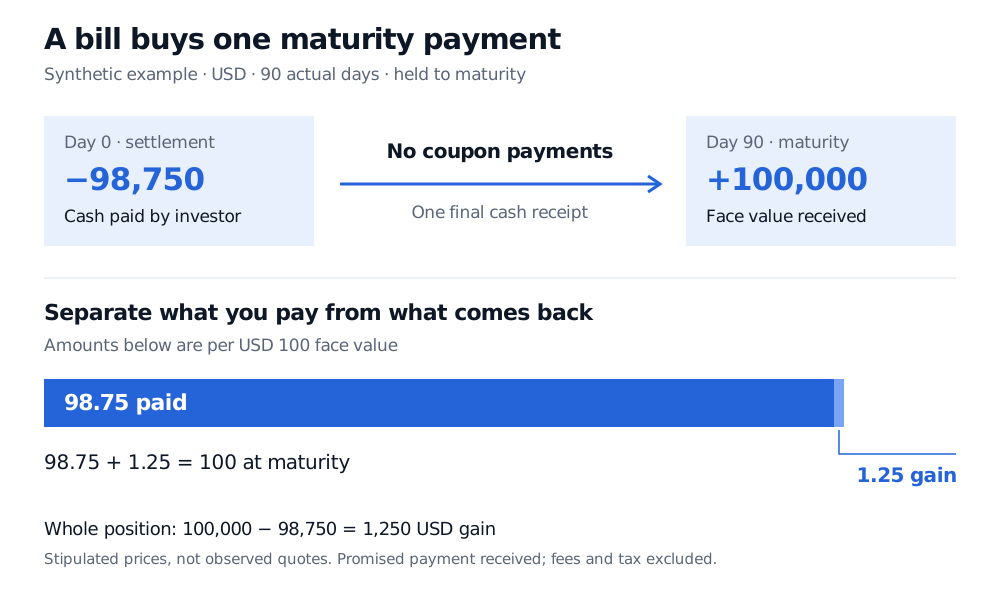
Original synthetic cash ledger. One maturity receipt contains both the recovery of the purchase price and the USD 1,250 gain. Stipulated prices; fees, tax and default excluded.
Why the quote says 5%
The bank-discount yield annualises the discount using face value and a 360-day year. With actual days remaining,
For this bill,
The quoted 5.00% describes an annualised discount on USD 100,000, rather than a 5.00% gain on the USD 98,750 invested over 90 days. TreasuryDirect's pricing formula uses this discount-rate convention.
To isolate the denominator effect, keep the same stipulated ACT/360 basis and calculate a simple investment yield on the cash paid:
This figure is slightly higher because the same gain is divided by a smaller base. Algebraically,
The label matters: this ACT/360 simple investment yield is not the official U.S. Treasury investment-rate calculation. Treasury's published investment-rate convention uses a 365- or 366-day year; consult the applicable calculation rules when reproducing an auction result. TreasuryDirect distinguishes this rate in its marketable-securities glossary.
Neither annualised simple quote above is an effective annual rate. A compound annual comparison needs its own year-length and reinvestment assumptions. This bill locks in only its settlement-to-maturity cash return, conditional on payment; it does not lock in the rate available for the next bill.
A short cash flow is still a priced asset
For this single USD maturity payment, the price-to-face ratio is a discount factor:
That is why bills are useful at the short end of a yield curve: their cash flow is simple enough to translate between prices and explicitly labelled rates. A yield quote by itself is incomplete without maturity, day count and quotation basis. The lesson Bond Prices, Discount Factors, and the Law of One Price develops this payment-by-payment view into coupon-bond pricing and curve construction. Its public preview is available; the full lesson requires membership.
The U.S. government's credit backing makes bills a common risk-free rate proxy for short USD horizons, but the horizon and currency still matter. Selling before maturity exposes the holder to the market price, which changes with rates and trading conditions. Holding to maturity fixes the promised dollar receipt, while inflation can reduce its purchasing power. An investor measuring wealth in another currency also faces exchange-rate changes. The SEC's bond-risk explanation separates credit, interest-rate and inflation risks.
A rolling bill strategy adds reinvestment risk: later bills may offer different returns. The absence of coupons removes interim coupon reinvestment, not the uncertainty of reinvesting the proceeds after maturity.
Sources
- TreasuryDirect — Treasury Bills: current U.S. instrument and maturity-payment structure, checked 26 October 2026.
- TreasuryDirect — Understanding Pricing and Interest Rates: discount-rate price formula.
- TreasuryDirect — Glossary for Treasury Marketable Securities: investment-rate year basis and zero-coupon securities.
- Frank J. Fabozzi, Bond Markets, Analysis, and Strategies, 9th edition, Pearson, 2016, Chapter 6, p. 126 (bill cash flows), pp. 130–131 (bank-discount and money-market-equivalent yields).
- SEC Investor.gov — Bonds: FAQs: U.S. Treasury credit backing and bond risks.