A quantitative analyst turns financial questions into models, tests and bounded conclusions. See how a pricing result differs from a forecast and a trading decision.
Quantitative analyst
A quantitative analyst, often called a quant, uses mathematical models, statistics and computing to answer financial questions. The output might be a derivative valuation, a portfolio risk estimate, a trading signal or an independent challenge to another team's model. The practical responsibility is to explain what the result supports, which assumptions it needs and where it can fail.
A useful result is therefore more than a number. “The model values this option at USD 10” needs a different justification from “the asset is likely to rise” or “we can trade this position safely”. Distinguishing those claims is part of the analyst's work.
A valuation method, defensible market inputs and an explanation of sensitivities and hedge limitations
Investment research
A testable hypothesis, suitable data and evidence that survives realistic validation and trading costs
Risk measurement
A description of exposures, loss scenarios and the assumptions behind a reported risk measure
Model validation
An independent assessment of a model's reasoning, implementation, evidence and intended use
These are overlapping responsibilities, not universal job-title definitions. A quantitative researcher often concentrates on hypotheses and empirical tests; a quantitative developer often concentrates on reliable software and data systems; a quantitative trader often concentrates on trading decisions, execution and live exposure. An analyst may do parts of all three. Employers divide the work differently: Jane Street's researcher description explicitly describes researchers, engineers and traders collaborating on models, systems and strategies. Carnegie Mellon's career overview likewise describes pricing, research, risk and validation roles.
A small pricing assignment, treated as an analyst would treat it
Suppose the request is to value a European call option. Before calculating, the analyst writes down the contract and the proposed model:
The call is cash-settled at one future expiry and represents one share. Its strike is USD 100.
The stock costs USD 100 today. The model permits only two expiry prices: USD 120 and USD 80, with both outcomes possible.
Interest over the model period is zero. There are no dividends, transaction costs or default. Fractional shares, borrowing and the trades needed for replication are permitted.
These are synthetic assumptions, not observations about an actual stock. A two-state model is useful here because its valuation can be checked by hand. That makes it a good implementation test; it does not make it adequate for every real contract.
The expiry payments are USD 20 and zero. The risk-neutral up weight makes the stock's weighted terminal value equal its current price at zero interest:
q(120)+(1−q)(80)=100,q=0.5.
The call's model price is therefore 0.5(20)+0.5(0)=10 dollars.
An independent implementation check uses a replicating portfolio: half a share and a cash balance of minus USD 40. Its initial cost is 0.5(100)−40=10. At expiry it gives 0.5(120)−40=20 or 0.5(80)−40=0, matching the contractual payments state by state. The negative cash balance is borrowing, not additional profit.
The two methods agree. An analyst would still ask whether both methods accidentally share the same incorrect payoff routine, whether currency and contract size are consistent, and whether the model's permitted states are appropriate. Agreement between calculations is useful evidence about implementation; it cannot establish the realism of the assumptions.
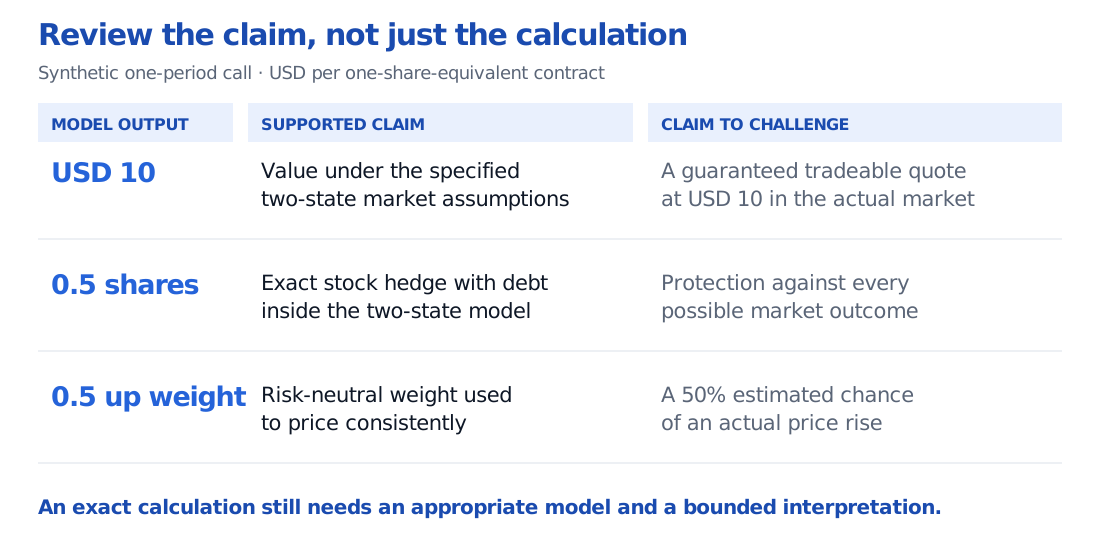
An analyst's claim review: USD 10 is a conditional model valuation, 0.5 shares is a hedge within the two-state model, and the 0.5 risk-neutral up weight is not a forecast of a 50 percent actual rise probability.
Original claim-review diagram for the synthetic one-period call. Each correct model output supports a narrower conclusion than an executable quote, universal hedge or real-world forecast.
Interpreting the answer is part of the analysis
The USD 10 value follows from no-arbitrage pricing within the stated model. It is not a recommendation to buy, a promised market quote or a forecast of the holder's profit. In particular, the 0.5 pricing weight does not estimate the actual probability of a price rise. Forecasting that probability would require a separate statistical question and evidence.
The half-share hedge also has a boundary: it matches the payoff in the two allowed states. If a real stock can finish elsewhere, or trading and funding conditions differ, the model's exact matching result does not establish a perfect real-market hedge. Choosing an unsuitable model is a source of model risk, even when the code correctly implements its equations.
A pricing analyst's conclusion could therefore read: “The specified two-state model gives USD 10 per contract, independently reconciled to a stock-and-cash hedge. Before using it for a quote, assess the actual contract, market inputs, costs and risks excluded from the model.” That statement communicates both a result and the work needed to use it responsibly.
For the mathematics behind the calculation, The Binomial Model is a free public sample lesson requiring no account. For a research assignment rather than a pricing assignment, Quant Research Dossier explains how to assemble assumptions, data provenance, validation and a bounded recommendation; its public preview is open and the full lesson requires membership.
The common skill across these assignments is judgement supported by reproducible evidence: formulate the financial question, choose a method that fits it, check the calculation and state what would change the conclusion.
Sources
Carnegie Mellon University MSCF, How to Become a Quant, 1 July 2024: quantitative analysis and the range of pricing, research, risk, development and validation work.
Jane Street, Quantitative Researcher, London, accessed 25 October 2026: an employer example of collaboration between researchers, engineers and traders; role descriptions vary by firm.
John C. Hull, Options, Futures, and Other Derivatives, 9th Global Edition, Pearson 2018, §§13.1–13.2, pp. 296–302: binomial replication, risk-neutral valuation and the distinction between pricing probabilities and actual probabilities.