A quantitative developer turns financial models and research into tested, maintainable software. A pricing-service example shows why units, validation and reproducibility matter.
Quantitative developer
A quantitative developer, often called a quant developer, builds and maintains software that puts financial models, research methods and trading ideas into use. The work connects quantitative reasoning to reliable computation: a correct price in a notebook must still arrive in the right currency, for the right contract, from identifiable inputs.
The output might be a pricing library, a research platform, a risk calculation service or an electronic trading component. Citadel, for example, describes quantitative developers as partners to investment teams who turn ideas into research and trading systems. The title does not specify one universal job. Oxford's careers guidance stresses that titles and responsibilities vary across firms; read the actual remit.
From model result to service result
Consider a synthetic European call option pricing service. Its specification says:
Stock and strike prices are in USD per share. The stock is 100 today; the strike is 100.
At the end of one model period, the stock can be 120 or 80. Interest is zero over that same period, with no dividends or transaction costs.
The model is frictionless, allows fractional shares and assumes obligations are honoured. The call is cash-settled at expiry.
One contract represents 100 shares. This is a declared synthetic multiplier, not a rule for every option contract.
The model value is USD 10 per share. A separate replicating portfolio check uses half a share and a cash balance of minus USD 40: it pays 20 in the up state and zero in the down state, matching the call. Its initial cost is 10.
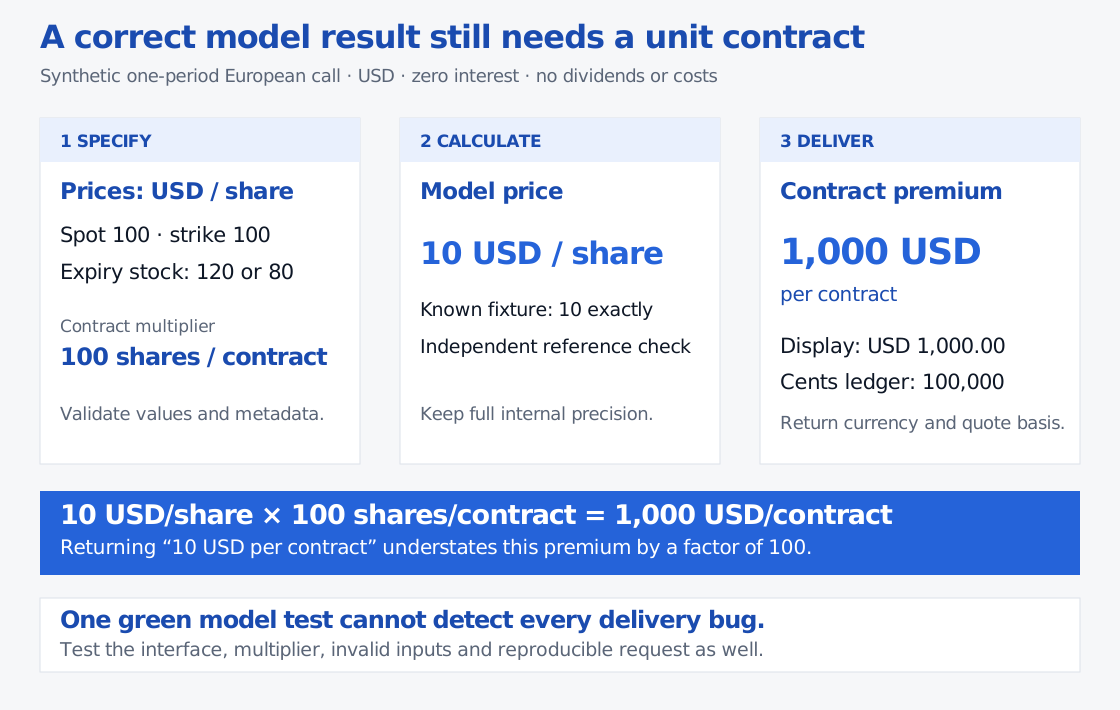
The developer's service must return USD 1,000 per contract, because 10×100=1,000. Returning a bare 10 with an undocumented unit can produce a factor-of-100 error even when the pricing calculation passes its tests. A cents-based ledger would record 100,000 cents, while a dollar display would show USD 1,000.00. Retain calculation precision and apply an explicit rounding policy at the agreed reporting or settlement boundary; these fixture amounts are exact, so no rounding adjustment is needed.
Synthetic pricing service: spot and strike 100 USD per share, expiry stock prices 120 or 80, zero interest and multiplier 100 shares per contract. Model price 10 USD per share becomes 1,000 USD per contract, or 100,000 cents. Returning 10 USD per contract is a factor of 100 too small.
Original synthetic service contract. The model result and the delivered premium have different units; validation and interface tests must cover the conversion as well as the pricing calculation.
The useful deliverable is therefore a specified calculation, with evidence that the surrounding software preserves its meaning.
What the developer has to make explicit
Inputs and failure behaviour. This service supports strictly positive stock prices, a nonnegative strike and a positive integer contract multiplier. It rejects missing or nonfinite numbers, unsupported currency metadata and inputs outside its two-state model domain. With zero interest, today's stock price must lie strictly between the two terminal stock prices for the stated model's strictly positive pricing probabilities. A nonpositive stock input is an error in this interface, not a reason to return a plausible-looking zero. Other models may support different domains.
Checks with different purposes. The same ordinary example should not be the only test:
Check
Expected result in this synthetic service
What it examines
Known pricing fixture
10 USD per share
Agreement with an independent reference
Change multiplier from 100 to 1
10 USD per contract; per-share price stays 10
Scaling and output units
Set strike to 140
Zero: neither terminal stock price reaches the strike
Payoff branch and zero result
Set strike to zero
100 USD per share
A call that delivers the terminal stock value in either state
Submit stock price zero or below
Explicit invalid-input response
Enforcement of the supported domain
These are software and model-consistency checks. Passing them does not establish that a two-state model is appropriate for a live market. Model risk remains even in correctly implemented software. For floating-point engines, tolerances must reflect the calculation and required accuracy; “the numbers look close” is not a pass criterion. Testing Numerical Code develops reference checks, identities and sensitivity tests. Its full lesson requires membership; the preview is public.
Reproducibility and maintenance. Keep the request, market-data snapshot and as-of time, contract conventions, model settings, code revision and dependency versions with the result. Stochastic calculations also need the random-generator details and seed; a seed alone does not freeze data or software. This small fixture is deterministic and needs no randomness. The Reproducibility lesson develops the run record and replay process, with a public preview and membership required for the full lesson.
Maintainable interfaces separate the financial calculation from data loading, contract scaling and presentation. Changes then have a defined place to live and a set of regression checks. Operational ownership can also include logging failures, monitoring inputs and outputs, and arranging a controlled rollback. Performance requirements follow the workload: an overnight risk run and an order-routing component need different measurements. The job title alone supplies no latency target.
Where the role overlaps
A quantitative analyst may specify and validate the model; a quantitative researcher may develop an empirical method; a developer may contribute to both. On a small team, one person can perform all three kinds of work. The developer's characteristic emphasis is making the computation usable, testable and supportable by other people over time.
Practice: which unit did the interface promise?
A different synthetic service quotes an option premium of 275 cents per share. Its contract multiplier is 50 shares per contract, and a client buys 3 contracts. What premium in USD should the interface report, ignoring fees?
Answer.USD 412.50. Convert the quote first: 275 cents is USD 2.75 per share. Then 2.75×50×3=412.50. Treating the quote as dollars produces USD 41,250, a factor of 100 too large. The financial model need not change for a unit-conversion bug to change the cash amount.
Sources
Citadel, Engineering, “Quantitative Developer”: an employer's description of translating investment ideas into research and trading systems. Checked 25 October 2026.
University of Oxford Careers Service, Quantitative finance: variation in job titles, collaboration, programming and testing. Checked 25 October 2026.
John V. Guttag, Introduction to Computation and Programming Using Python: With Application to Understanding Data, 2nd edition, MIT Press (copyright 2016; catalogued 2017), §4.2, pp. 47–50, and §§6.1–6.1.2, pp. 86–89: specifications, independent tests and boundary cases.
John C. Hull, Options, Futures, and Other Derivatives, 9th Global Edition, Pearson 2018, §13.1, pp. 296–299: one-period option valuation and replication. The service fixture and unit-conversion exercise here are original synthetic examples.