A quantitative trader uses mathematical models, market data and trading rules to take or manage positions in financial markets. The practical task is to turn an estimated opportunity into an executed position while controlling costs and risk. A good forecast can still produce a poor trade if the position is too large, the order arrives too late or the market cannot absorb it at the assumed price.
The title covers different combinations of research, execution and risk ownership. It can include running systematic strategies, providing liquidity through market making, or combining quantitative models with authorised human decisions. It does not imply that the trader manually clicks every order or that every strategy trades at high frequency.
From a promising signal to a permitted trade
A trading signal supplies evidence about a possible opportunity. The trader must connect that evidence to the instrument, the holding horizon and the current portfolio. The relevant question is how much expected value remains after implementation, within the desk's mandate and limits.
Consider a synthetic equity round trip, meaning an entry and a later exit for the same shares. At the contemplated size, a model predicts a gross expected gain of USD 0.08 per share over its stated horizon. Expected spread concessions and explicit fees for the complete round trip total USD 0.05 per share. Both amounts use the same shares and horizon; the cost allowance covers both legs, so it must not be deducted twice.
The remaining expected edge is
For a fully completed 1,000-share position under these assumptions, gross expected gain is USD 80, expected spread and fees are USD 50, and the expected remainder is USD 30. That is an expectation before additional, unmodelled market impact, financing where applicable and other effects. It is neither realised profit nor a guarantee that a loss cannot occur. Risk also concerns the dispersion and tail of outcomes, which the expected remainder does not describe.
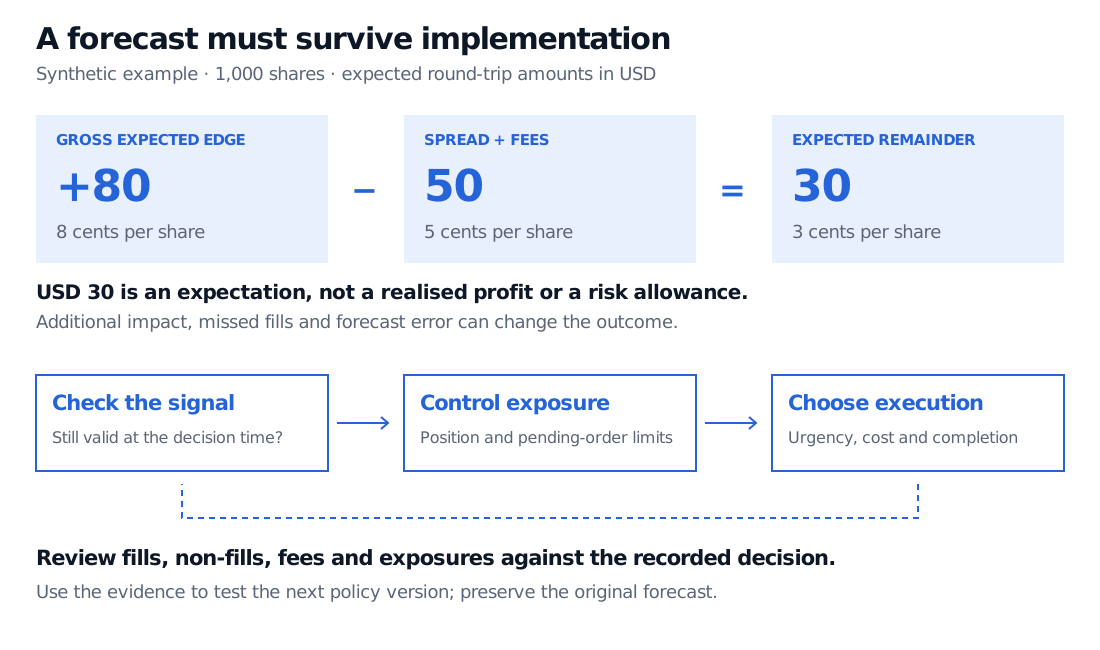
Original synthetic illustration. Amounts are expected USD totals for a completed round trip; position limits and operational checks can still prevent the trade.
A trader would therefore check more than whether 8 cents exceeds 5 cents:
- Signal validity: was the forecast computed from information available at the decision time, and has its useful horizon already passed?
- Exposure: how does the proposed position combine with current holdings, correlated risks and orders that could still fill?
- Execution: is the cost assumption credible for this quantity and market state, and what happens if only part of the order completes?
- Controls: are data, order acknowledgements, position records and the permitted trading state reliable enough to proceed?
A positive expected edge does not override a position limit. Equally, a required hedge may need execution even when its standalone expected trading profit is negative: its purpose is to reduce portfolio risk. The Implementation Shortfall lesson develops the distinction between an optional opportunity and an intended position left incomplete. Its public page is a preview; the full lesson requires membership.
The work continues after the order
A fill changes both cash and exposure. A pending order remains a possible future position; requesting cancellation is not the same as receiving confirmation that the order cannot fill. Monitoring therefore needs a coherent view of executed, outstanding and rejected orders, alongside the market state used by the strategy.
Afterwards, the trader asks whether the evidence supports the original assumptions. Did transaction costs exceed their forecast? Did supposedly cheap execution leave the position largely unbuilt? Did passive orders tend to fill immediately before adverse moves? A favourable average fill price can conceal costly noncompletion.
The useful feedback loop preserves the forecast, policy version and decision timestamp, reconciles the resulting orders and fills, and compares like conditions. One losing trade does not disprove a positive expected edge; one profitable trade does not validate the model. Proposed changes need evidence across suitable observations and subsequent testing. SelfMadeQuant's Post-Trade Analysis lesson works through this reconciliation and explains why a cost difference alone does not establish that one execution policy is better. The full lesson requires membership, with a public preview.
Where the role overlaps with other quants
A quantitative researcher may concentrate on discovering and testing models; a quantitative developer may concentrate on the software and infrastructure that operate them. A trader often brings these strands together around live decisions, execution and exposure. These are useful emphases rather than universal job boundaries: the same person or team can perform several of them.
Employer descriptions illustrate the variation. Jane Street's quantitative-trader description includes model development, pricing opportunities and risk management. Citadel Securities' description emphasises collaboration with researchers, trade selection, execution and learning from trading metrics, including a blend of systematic and discretionary decisions. Read the actual desk's responsibilities and decision authority when interpreting the title.
Sources
- Rishi K. Narang, Inside the Black Box: A Simple Guide to Quantitative and High-Frequency Trading, 2nd edition, Wiley, 2013. Chapter 2, pp. 17–18, connects forecasts, risk, costs, portfolio construction and execution, including feedback from actual executions; Chapter 5, pp. 79–85, explains transaction-cost modelling. Publisher's Chapter 2 overview. The numerical case and figure here are original synthetic examples.
- Jane Street, Quantitative Trader, New York. Primary employer description, checked 25 October 2026; responsibilities are employer-specific.
- Citadel Securities, Quantitative Trader. Primary employer description, checked 25 October 2026; responsibilities are employer-specific.