“Quant finance” is the common abbreviation. “Mathematical finance” often emphasises the mathematical theory of pricing and risk; quantitative finance also includes empirical research, implementation and trading systems. The boundaries overlap rather than define separate professions.
A quant model is not necessarily a machine-learning model, and a quant result is not necessarily a price forecast.
Four questions, four different models
Imagine a firm trading an equity option. Several quantitative jobs sit around that one contract:
| Question | Quantitative task | What a useful answer contains |
|---|---|---|
| What is the contract worth under stated assumptions? | Option pricing | A valuation, model assumptions and checks against simpler cases |
| What could the position lose? | Risk management | Exposures, scenarios and uncertainty in the estimates |
| Does a related trading signal predict anything useful? | Quantitative research | A test using information available at the decision time, with costs and an honest holdout |
| How should we trade the desired position? | Order execution | A rule balancing price, speed, fills and market impact |
A price without predicting the stock
The call pays 10 in the up state and zero in the down state. We want to price that payoff. Assume the stock pays no dividends; lending and borrowing both grow money by 2% over the year; fractional shares and borrowing are possible; and there are no trading costs. The two-state model is the whole assumed world for this calculation.
| At the end of the year | Stock is 65 | Stock is 40 |
|---|---|---|
| Value of 0.4 shares | 26 | 16 |
| Loan repayment | −16 | −16 |
| Remaining value | 10 | 0 |
| Call payoff | 10 | 0 |
The required loan today is . The cost of the whole replicating position is therefore
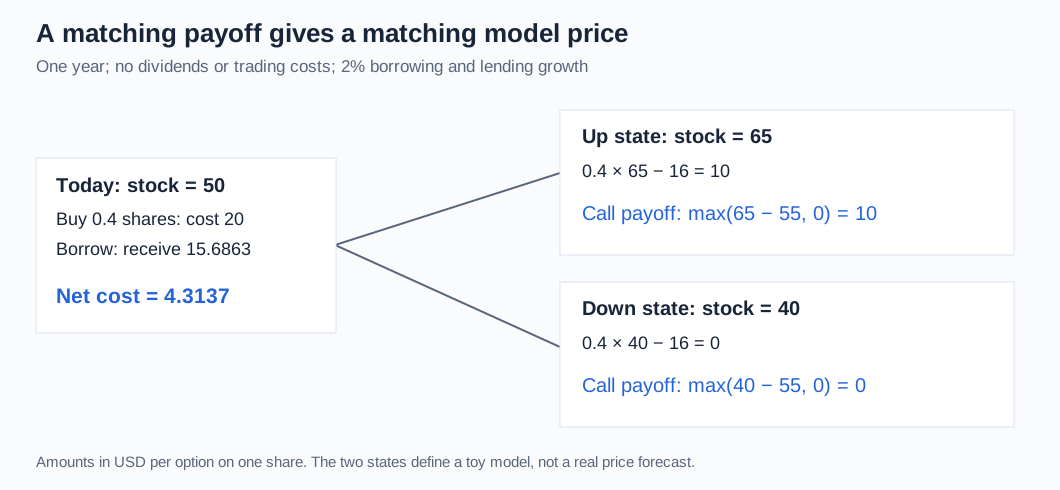
Under these assumptions, no-arbitrage requires the option and the replicating position to have the same price: they deliver the same future cash flows in every model state. If they differed, a trader could buy the cheaper payoff and sell the more expensive equivalent, subject to the model's trading assumptions.
We did not need to guess the real-world probability of the stock rising. That is the useful surprise: this particular price follows from replication, not a directional prediction. A model with more possible states, trading restrictions or unhedgeable risks can require additional assumptions and may not give a unique replication price. A real market also has costs and risks outside a two-state diagram.
This is one part of quantitative finance. A strategy researcher faces a different problem: whether an observed relationship survives a fair test on new data. Replication does not answer that question for them.
Where the mathematics enters
Programming makes a calculation repeatable and lets it operate on realistic datasets. It also introduces new ways to be wrong: misaligned dates, mixed units, missing observations and a model tested on information that was unavailable at the time. A correct formula cannot repair the wrong input.
A model needs a boundary
For any quantitative result, ask four practical questions:
- What decision does it support? A forecast, price, hedge and risk limit are different outputs.
- What assumptions make it work? In the call example, exact two-state replication and frictionless borrowing do much of the work.
- What was actually known? A backtest using a later-revised dataset can contain look-ahead bias.
- What would show the result is inadequate? Use a benchmark, a numerical check, a stress scenario or an independent dataset appropriate to the claim.
A model can be mathematically consistent and still be unsuitable for the decision. Good quantitative work makes that boundary visible rather than hiding it behind extra decimal places.