Derive the coupon rate that makes a bond worth par, replicate a dated payment schedule, and distinguish par yields from spot rates, forward rates and YTM.
Par yield
Par yield is the annual coupon rate that makes a bond with a specified payment schedule worth its face value under a given discount curve. It answers an issuance question: what coupon would a hypothetical bond need to sell at 100 per 100 of principal? A yield curve quoted in par yields therefore describes a sequence of hypothetical par bonds, rather than the contractual coupons of every bond already trading.
The maturity alone is insufficient. Payment frequency, coupon accrual fractions, redemption amount and the curve used to value the payments must also be specified.
Principal leaves a gap for coupons to fill
Let F be face value, Di the discount factor from settlement to payment date ti, and αi the coupon accrual fraction in years. An annual coupon rate c pays Fcαi at each date, with the full principal repaid at the final date. For a plain fixed-rate bond with no optional redemption, its full price is
P=Fci=1∑nαiDi+FDn.
Set P=F and solve directly:
cpar=∑i=1nαiDi1−Dn.
The numerator is the gap between one unit of principal today and the present value of its final repayment. The denominator values the coupon schedule per unit of annual coupon rate. For equal annual coupon periods, use αi=1; under an equal-half-year fixed-coupon convention, use αi=1/2. The contract determines the actual coupon weights. Changing frequency changes the schedule and generally changes the par coupon rate.
This equation uses the full settlement price. The familiar statement that a par bond has a clean price of 100 needs care when accrued interest is nonzero. The following example settles with zero accrued interest, so clean price and dirty price coincide.
A coupon chosen to make the price exactly 100
Consider a synthetic bond with face value 100 currency units, settlement on 26 October 2026, and annual payments on 26 October 2027, 2028 and 2029. Stipulate contractual accrual fractions of one year, no business-day adjustments, and no default, taxes or trading costs. The discount factors to those dates are 0.97, 0.93 and 0.88. These are illustrative inputs, not market observations.
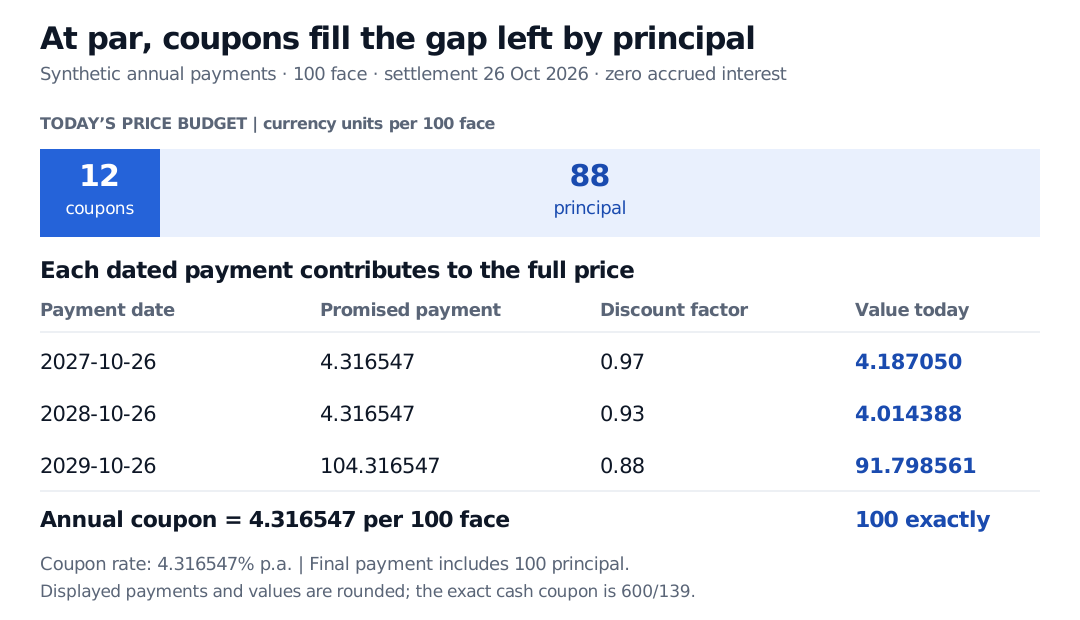
The principal repayment is worth 100×0.88=88 today. Coupons must therefore contribute the remaining 12:
cpar=0.97+0.93+0.881−0.88=1396≈4.316547%.
The exact annual cash coupon is 600/139 currency units, approximately 4.316547. The first two payments contain only that coupon; the final payment adds the 100 principal.
Payment date
Promised payment
Discount factor
Present value
26 October 2027
4.316547
0.97
4.187050
26 October 2028
4.316547
0.93
4.014388
26 October 2029
104.316547
0.88
91.798561
Payments and present values in the table are rounded. Using the exact coupon, the coupon present values sum to 12, the principal present value is 88, and the total is exactly 100.
A synthetic annual-coupon bond allocates 12 currency units of present value to three coupons and 88 to principal. Discount factors 0.97, 0.93 and 0.88 imply a 4.316547 percent annual par coupon; the dated payment present values are 4.187050, 4.014388 and 91.798561.
Original synthetic valuation. The budget separates coupon value from principal value; the final scheduled payment combines both. All amounts are currency units per 100 face.
One way to check the price is to purchase separate zero-coupon bonds: one paying the coupon at each of the three dates, plus one paying 100 at maturity. Their combined cost is 100 and their payments reproduce the entire bond schedule. This is a dated cash-flow replication, not a claim that coupons will be reinvested at the par yield.
Four rates that answer different questions
The distinctions become visible even within this one example:
Rate
What it describes
Par yield: 4.316547% annually
The coupon rate selected so this three-year annual-payment bond is worth 100.
Yield to maturity asks a different inverse question: given a bond’s payments and price, what single rate discounts those payments to that price? For this regular annual bond at a full price of par, its annual YTM equals its coupon rate, 4.316547%. That equality does not make the nonflat discount curve disappear: the same flat YTM factors need not price other payment schedules correctly. For regular semiannual coupons at par, the corresponding equality uses nominal annual YTM compounded semiannually.
For the underlying pricing method, SelfMadeQuant’s Bonds and Yields lesson develops dated discounting and separates coupon, spot rates and YTM. Its public page is a preview; the full lesson requires membership.
Reading a published par curve
A published par yield need not be the yield of an outstanding security with exactly that maturity. The U.S. Treasury’s curve methodology, revised in February 2025, constructs its official par curve from indicative bid-side security prices using bootstrapping and monotone convex interpolation of forward rates. The resulting curve supports hypothetical par-rate calculations.
Use the curve appropriate to the instrument. A government par curve does not automatically supply the issue coupon for a corporate borrower with different credit and liquidity risk. Nor should a government bond par yield be substituted mechanically for a swap par rate: the payment legs and valuation assumptions differ. The formula is useful precisely because it makes the chosen curve and coupon schedule explicit.
Sources
Bruce Tuckman, Fixed Income Securities: Tools for Today’s Markets, 2nd edition, Wiley, 2002, Chapter 3, printed p. 48, equations 3.12–3.13: par coupon rates from discount factors, with semiannual payments.