A long position holds a security or takes a derivative’s buying side. Reconcile shares, cash, dividends and profit, and distinguish being long an option from positive stock exposure.
Long position
A long position is a positive holding of a specified security, or the buyer's side of a specified derivative contract. Owning 100 shares means being long 100 shares. For a quant portfolio, that signed quantity determines how a change in the share price affects the position's value; it does not tell you whether the trade has made money.
The instrument matters. Being long a stock gives positive exposure to that stock's price. Buying a put makes you long the option, even though the put can gain value when the stock falls. “Long” also says nothing about the intended holding period: a position can be long for a few seconds.
Follow the shares and the cash
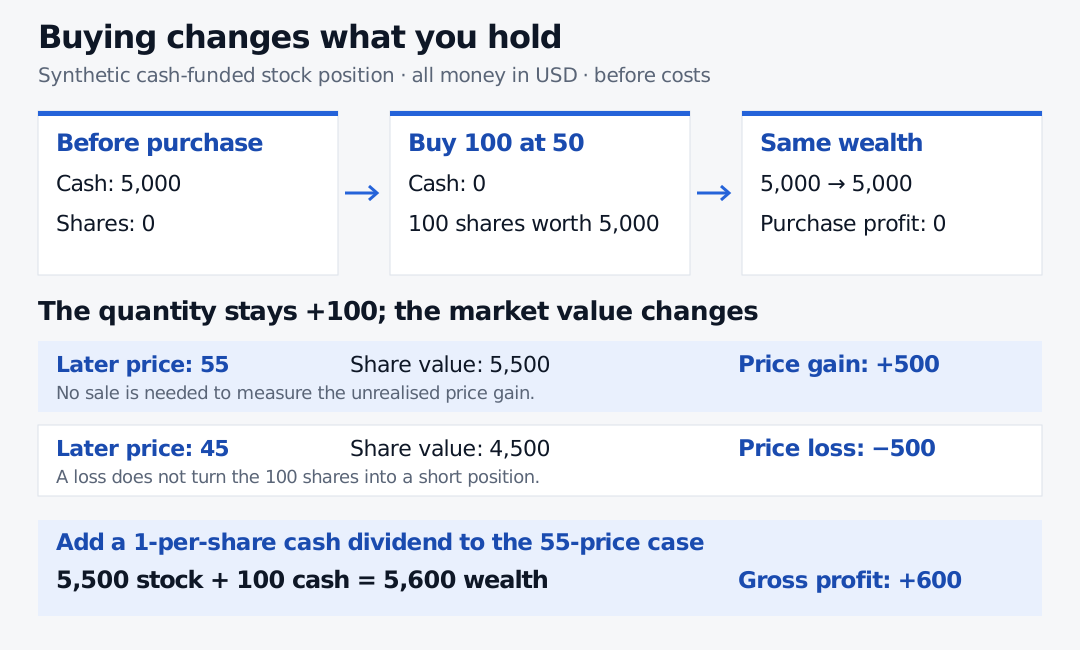
Start with USD 5,000 in cash and buy 100 shares at USD 50 per share, paying in full. After the purchase, the investor holds no remaining cash from that budget and owns 100 shares worth USD 5,000. The purchase exchanges cash for shares; it does not itself create a profit.
Assume the share count stays fixed, there are no corporate actions other than the cash dividend described below, and prices are in USD per share. Ignore fees, taxes and interest. Two possible later prices give:
Later share price
Shares held
Market value of shares
Price gain or loss since purchase
USD 55
100
USD 5,500
+USD 500
USD 45
100
USD 4,500
−USD 500
For a constant positive quantity q, entry price S0 and later price ST, the price component of profit is
Πprice=q(ST−S0).
Here, each USD 1 rise in the share price adds USD 100 to the position's value, and each USD 1 fall subtracts USD 100. The position remains long 100 shares in both scenarios. A negative profit is not a short position.
While the shares remain held, the price gain or loss is unrealised. Selling all 100 shares closes this long stock position: at USD 55, the sale converts USD 5,500 of share value into USD 5,500 of cash. Selling shares already owned to close a holding is different from selling borrowed shares to establish a short.
An original synthetic long-stock ledger: USD 5,000 buys 100 shares at USD 50. At USD 55 they are worth USD 5,500 for a USD 500 price gain; at USD 45 they are worth USD 4,500 for a USD 500 price loss. In the rising-price case, a USD 1 dividend per share adds USD 100 cash, giving USD 5,600 wealth and USD 600 gross profit.
Original synthetic cash-funded stock ledger. All monetary amounts are USD, before fees, taxes and interest. The dividend is held as cash without reinvestment; the USD 45 row shows price-only profit.
Income belongs in the result
Now suppose the investor receives a USD 1 cash dividend per share while holding the stock. This adds USD 100 of cash, without changing the 100-share quantity. In the USD 55 scenario, ending wealth is USD 5,500 of stock plus USD 100 of dividend cash: USD 5,600, or USD 600 gross profit relative to the initial USD 5,000.
With a cumulative cash dividendD per share, held without reinvestment and earning no interest, the example's gross profit is
Π=q(ST−S0+D)=100(55−50+1)=USD 600.
The price return is 10%; the total return, including the dividend, is 12%. These are holding-period returns, with no annualisation. A dividend is a separate cash flow, not a reason to add it to the stock's quoted market price. Its payment is not guaranteed, and this stipulated example does not assume that paying a dividend leaves the share price unaffected.
SelfMadeQuant's Equities lesson develops equity ownership, dividend-inclusive returns and the distinction between price and total-return indices. Its public preview is open; the full lesson requires membership.
Long what?
A position label must name the instrument and the risk being measured.
Long stock: the investor owns shares. In this cash-funded example, a nonnegative share price limits the price-only loss to the USD 5,000 purchase cost. Borrowing to finance a purchase adds a loan and financing costs, so a margin account needs a separate equity-and-debt calculation.
Long put option: the investor bought the put. The holding is positive in option units, while its delta—sensitivity to the underlying stock price—is normally negative for a standard stock put. Other inputs and time also affect the option's value; a stock-price decline alone does not guarantee a profitable option trade.
Long futures contract: the investor takes the contract's buying side under its terms. This does not mean owning the underlying asset today. Futures margin supports the contractual exposure; it is not the asset's purchase price or the maximum possible loss.
The USD 5,000 paid for the shares is a cash investment in this particular trade. A derivative's notional amount, market value, premium and margin are distinct quantities. Calling a position “long” does not make those amounts interchangeable. Record the contract quantity, the underlying exposure and the funding separately before comparing strategies.
John C. Hull, Options, Futures, and Other Derivatives, 9th edition, Global Edition, Pearson, 2018, §1.3, pp. 28–29, and §1.5, p. 33. Long forward commitments, notional versus value, and option buyers as long holders.
The stock ledger and figure are original hypothetical illustrations, not market quotations or a broker's terms.