A short position is a negative holding of a specified security or contract: other things equal, it benefits when that instrument's price falls and loses when its price rises. In cash equities, this usually means selling shares that have been borrowed and retaining an obligation to return equivalent shares. A quant strategy's negative stock weight therefore needs more than a price forecast: it needs a workable borrow and enough funding to maintain the position.
A short position can express a bearish view, offset a long position, or form one leg of a relative-value trade. Its purpose does not change the direction of its price exposure. The SEC's explanation of long and short stock positions describes both directional and hedging uses.
The shares are the obligation
Suppose a trader borrows 100 shares and immediately sells them for USD 50 per share. The sale brings in USD 5,000, but the trader still owes 100 shares. The debt is not frozen at USD 5,000: replacing those shares becomes more expensive if their price rises.
Borrowing securities and selling them are separate operations. Immediately after borrowing, the trader holds 100 shares and owes 100, giving zero net share exposure before costs. After selling, the inventory is gone and the return obligation remains: the net position is −100 shares. Simply selling shares already owned to reduce a positive holding does not necessarily establish a short position.
To close this synthetic trade, the trader buys 100 replacement shares—covering the short—and returns them to the lender. Assume no corporate actions, uninterrupted borrowing, sufficient funding and successful delivery. For now, ignore all costs and cash interest.
| Closing share price | Cash received at sale | Cost of 100 replacements | Gross price profit |
|---|---|---|---|
| USD 45 | USD 5,000 | USD 4,500 | +USD 500 |
| USD 60 | USD 5,000 | USD 6,000 | −USD 1,000 |
For shares sold at and bought back at ,
Equivalently, the signed position is , so its price profit is . Here each USD 1 rise in the share price reduces profit by USD 100. Once the replacement shares are returned, both the inventory and the share obligation are zero.
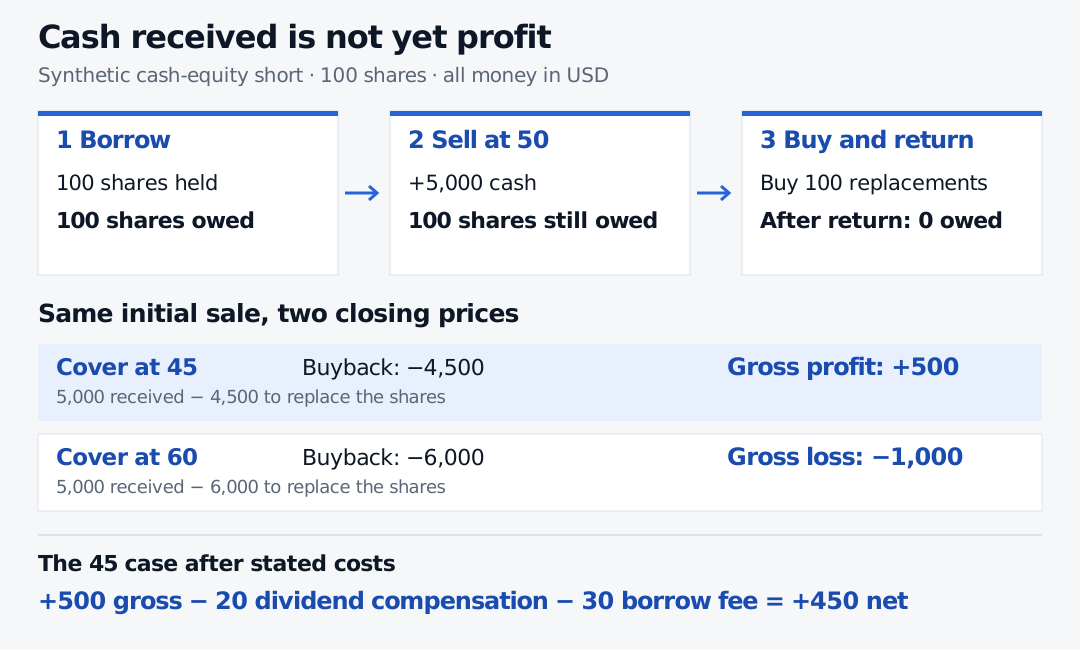
Original synthetic share-and-cash ledger. All amounts are USD. Costs are stipulated totals; commissions, taxes, interest, rebates and collateral funding costs are zero. Sufficient funding and successful share return are assumed; collateral deposits are outside the profit ledger.
A price gain is only one component
Now stipulate that, while the short is open, the trader owes USD 0.20 per share in dividend compensation and a total stock-borrow fee of USD 30. These are illustrative cash amounts, not annual borrowing rates. Keep the other zero-cost assumptions above.
The USD 45 closing case produces
The USD 20 compensation payment and USD 30 fee reduce the USD 500 gross gain by USD 50. With those same fixed total costs, the break-even closing price is USD 49.50; an unchanged USD 50 price leaves a USD 50 net loss. In an actual trade, borrow charges, distributions, cash rebates and financing can vary over time, so this fixed-cost break-even is specific to the example. Hull's short-selling treatment separates the share-repurchase cash flow from distributions, fees and margin.
The USD 5,000 received at entry is sale proceeds, not initial equity capital or free profit. Proceeds can be restricted as collateral, and the trader may need to contribute additional assets. No return on equity can be calculated here because the capital committed and its timing have not been specified. A margin deposit is not automatically an expense; the cost of funding it is a separate question.
SelfMadeQuant's Short Selling lesson develops the cash-short calculation alongside recall and margin risk. The public preview is open; the full lesson requires membership.
What can force the trade to end?
For a stock whose price is nonnegative, the gross price gain in this example cannot exceed USD 5,000: the best price-only endpoint is zero. There is no corresponding fixed ceiling on the price loss in a model with no upper bound on the stock price. A higher repurchase price means a larger loss. This is the theoretical stock-short risk highlighted in the SEC's short-sales bulletin.
That endpoint calculation does not guarantee the trader can wait for a preferred closing price. Rising prices can bring additional margin demands. If shares are recalled and replacement borrowing is unavailable, the position may have to be covered early. Borrow fees and availability can also change. The exact collateral, termination and trading requirements depend on the agreement, instrument and applicable market rules; no universal margin percentage or settlement cycle is assumed here.
The instrument must remain explicit. A short futures contract is a sold contract with its own settlement and margin mechanics, rather than a stock loan; ASIC Moneysmart explains that usage. Buying a put option can create negative exposure to a stock while leaving the investor long the option. For a standalone purchased put, the option loss is limited to its premium, before costs and any separate position created by exercise; the OCC's options-risk explanation makes that distinction. “Short” alone does not specify every instrument's risk bounds.
Sources
- SEC Investor.gov — Stock Purchases and Sales: Long and Short. Stock positions, borrowing, covering and uses.
- SEC Investor.gov — An Introduction to Short Sales, updated 9 September 2026. Stock-short price risk, dividends and margin; US investor education, not a universal statement of market rules.
- OCC Options Industry Council — Leverage & Risk. The purchased put is a long option position, with premium at risk.
- ASIC Moneysmart — Futures contracts. Going short in a futures contract and its distinct obligations.
- John C. Hull, Options, Futures, and Other Derivatives, 9th edition, Global Edition, Pearson, 2018, §5.2, pp. 127–128. Share borrowing and return, distributions, fees, recall and margin.
The cash ledger and figure are original hypothetical illustrations, not market quotations or a broker's terms.