Securities borrowing creates an obligation to return equivalent securities. Separate the loan from a short sale, track cash and shares, and understand fees, collateral and recall.
Securities borrowing
Securities borrowing is receiving securities under an agreement to return equivalent securities later. The borrower owes the security, rather than merely the cash amount it was worth when received. For a quant strategy, an attractive price signal is therefore only part of the problem: the required securities must be available on workable terms.
The same transaction is securities lending from the provider's side. It can involve shares or bonds, often through a broker or lending agent. “Equivalent” generally means matching the agreed security and quantity, with contractual adjustments for corporate actions; it does not require recovering the very same certificates. The UK Money Markets Code, Chapter 4, gives the borrowing/lending definition and identifies the terms parties should document. It is a voluntary UK market-practice code, not a universal legal rule.
Borrowing is one operation; selling is another
A borrower can use a security to deliver against a sale, bridge a settlement delay or support a hedge. The ECB's securities-lending explainer describes temporary demand from market makers, settlement needs and trading strategies.
Borrowing alone does not establish a directional short. If you receive shares and keep them, the inventory offsets the obligation to return equivalent shares, before loan costs and other effects. Selling the borrowed shares removes that inventory while leaving the return obligation. That combination creates the familiar cash-equity short sale.
Follow both the shares and the cash
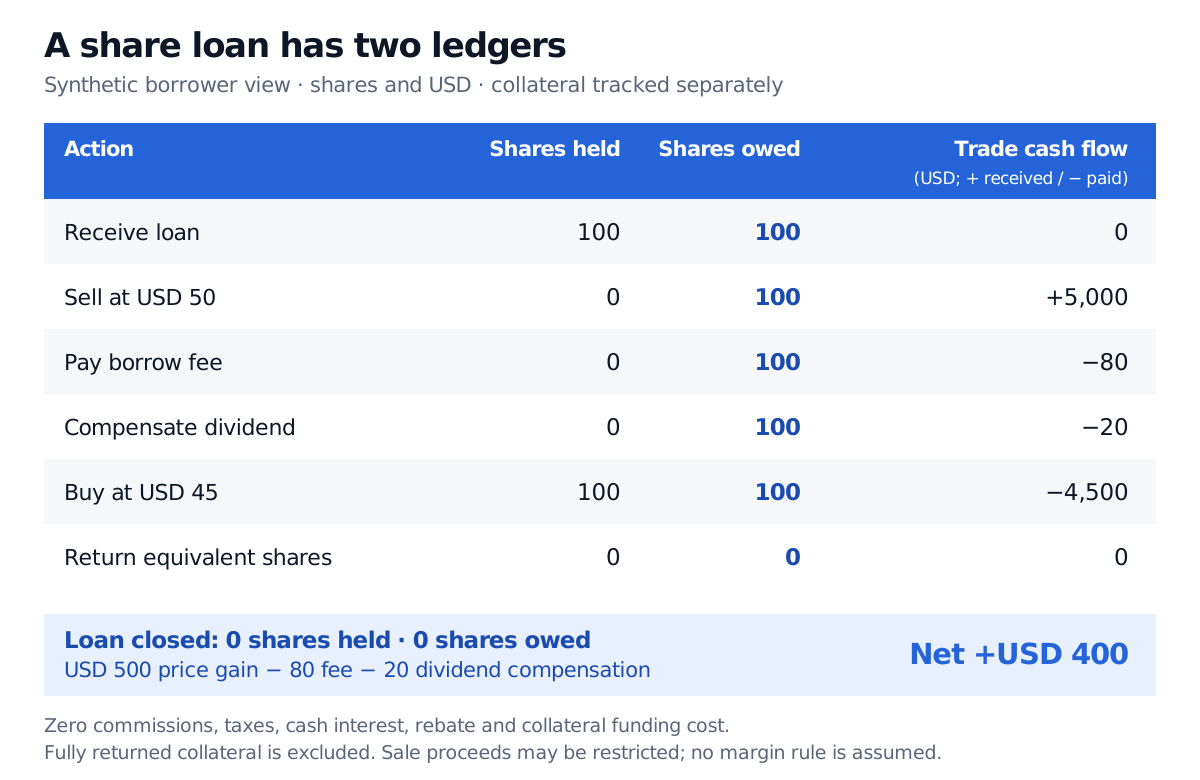
Consider a fictional borrower who receives 100 shares when the price is USD 50, sells them, later buys replacements at USD 45, and returns them. The agreement requires a total borrow fee of USD 80 and a USD 20 dividend-compensation payment during the loan. These are stipulated cash totals, not quoted annual rates.
Assume zero commissions, taxes, cash interest, rebate and collateral funding costs; sufficient funding throughout; and full return of all posted collateral. Collateral transfers sit outside the trade-cash ledger below. They are not treated as expenses simply because assets are posted.
Event
Shares held after event
Shares still owed
Trade cash flow, USD
Receive borrowed shares
100
100
0
Sell at USD 50
0
100
+5,000
Pay total borrow fee
0
100
−80
Pay dividend compensation
0
100
−20
Buy replacements at USD 45
100
100
−4,500
Return equivalent shares
0
0
0
Total trade cash flow
+400
The USD 5,000 sale proceeds are not profit: the borrower still owes 100 shares. Repurchasing shares restores the inventory; delivering them to the lender discharges the loan. Once that is done, no residual share position remains, and the stated trade cash flows sum to
Net profit=100(50−45)−80−20=USD 400.
A fictional borrower receives 100 shares and owes 100, sells them for USD 5,000, pays a USD 80 fee and USD 20 dividend compensation, buys 100 replacements for USD 4,500, and returns them. Shares owed remain 100 until delivery; net trade cash flow is positive USD 400.
Original synthetic ledger in shares and USD. Zero commissions, taxes, cash interest, rebate and collateral funding cost; fully returned collateral is excluded. Sale proceeds may be restricted. No universal margin requirement is assumed.
The dividend compensation is also called a manufactured payment: under the stipulated agreement, it compensates the lender for a distribution not received while the shares were lent. It is separate from the stock borrow fee. Payment amounts, timing and tax treatment depend on the arrangement and applicable rules; a manufactured payment need not have the same tax treatment as an issuer's dividend.
For a fuller cash-short calculation, SelfMadeQuant's Short Selling lesson connects the return obligation to dividend costs, recall and price risk. It has a public preview; the full lesson requires membership.
The contract determines whether the position can continue
The relevant terms extend beyond the headline fee:
Term to establish
Why the borrower needs it
Security, quantity and return terms
Establish what must be delivered and when.
Recall and termination
Determine when return can be demanded and how notices work.
Eligible collateral and valuation
Determine which assets must be posted and how requirements change.
Fees, rebates and distributions
Determine cash flows while the loan remains open.
Corporate actions and default
Determine adjustments and close-out procedures.
These are agreement-specific matters identified in the UK Code. Collateral helps protect the lender but ties up the borrower's resources. The ECB also points out that obtaining eligible collateral can itself cost money. Neither a collateral deposit nor a positive eventual price gain guarantees that a borrower can meet every intervening funding demand.
For a borrower who has sold the shares, a recall may require replacement borrowing or an earlier repurchase. Scarce availability and changing fees can undermine an otherwise promising strategy. A backtest that assumes continuous borrow at a constant fee can therefore describe trades that were not executable on those terms. Hull's treatment of short selling illustrates the return obligation, dividend compensation and forced closure when replacement borrowing is unavailable.
Borrow availability and regulatory permission are separate checks. Locate, delivery and short-sale restrictions depend on the jurisdiction and transaction. The SEC's Regulation SHO explanation, for example, distinguishes its US locate framework and exceptions from actual borrowing. The borrow-then-sell sequence here is an assumed arrangement, not a universal statement about when a short sale is permitted.
Practice
Does receiving borrowed shares create a price profit? A hypothetical borrower receives 40 shares at USD 30 and keeps all of them. The price rises to USD 35 before the shares are returned. Assume no sale, distributions, corporate actions, fees or collateral effects. Value the return obligation at the current cost of equivalent shares. What is the net stock-price gain?
Answer. The inventory rises from USD 1,200 to USD 1,400, but the replacement value of the obligation rises by the same USD 200. The net stock-price gain is zero. Counting the inventory gain alone ignores the obligation. Real loan costs would still need to be included; receiving borrowed shares is not a free long position.
John C. Hull, Options, Futures, and Other Derivatives, 9th edition, Global Edition, Pearson, 2018, §5.2, pp. 127–128. Borrowing and returning shares, dividends, fees, recall and margin.
The ledger, diagram and practice scenario are original illustrations, not market quotes or broker offers.