Securities lending exchanges shares or bonds for collateral and a promise of equivalent securities back. Follow a stock loan, its collateral top-up, income and lender risks.
Securities lending
Securities lending is the temporary transfer of shares or bonds to a borrower, typically against collateral, with an obligation to return equivalent securities. It lets an investor earn lending income while making securities available for settlement, market making, hedging or short selling. The lender must manage its claim for returned securities and the collateral it owes back. The ECB’s explainer describes these market uses.
A pension fund might lend through an agent to a broker-dealer, which in turn supplies a trading client. The lender and end user need not be direct counterparties. Securities borrowing describes the other side of the same loan; a short sale is a separate transaction that borrowed stock can support.
What leaves the portfolio—and what comes back
Under common title-transfer securities-lending arrangements, legal title to the lent securities passes to the borrower. The lender receives a contractual claim for equivalent securities: the agreed type and quantity, adjusted for relevant corporate actions, rather than necessarily the identical units originally delivered.
Economically, the lender remains exposed to the security’s price, assuming the return obligation is performed. Lending a falling stock does not protect the lender from that fall. The agreement also addresses substitute payments for dividends or coupons. Such payments are not automatically identical to the original distribution for tax purposes.
Voting rights generally travel with the lent shares. A lender wishing to vote ordinarily needs the shares returned in time; the ability to recall, notice requirements and settlement arrangements must be checked. The UK Money Markets Code, a voluntary UK market code, explicitly addresses these rights, documentation and recall procedures. The legal and tax result depends on the agreement and jurisdiction.
A rising share price requires more collateral
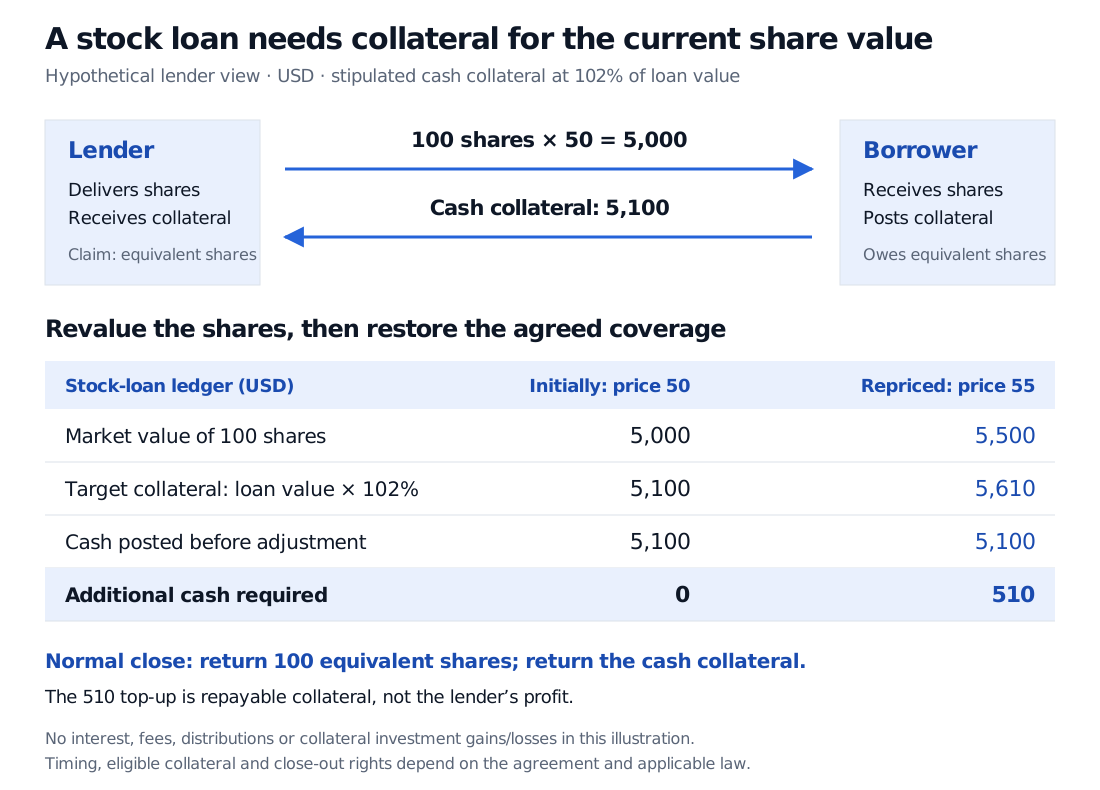
Consider a hypothetical loan of 100 shares priced at USD 50 each. Their market value is USD 5,000. Assume the contract requires cash collateral equal to 102% of the current loan market value, with immediate adjustment and no threshold or minimum transfer amount. This percentage is an illustrative contract term, not a universal standard.
Writing N for shares, S for USD per share and C∗ for required cash collateral in USD:
C∗=1.02NS.
The borrower initially posts USD 5,100. The extra USD 100 is a buffer above the current share value, not income for the lender. A 2% uplift measured against loan value is different from a 2% haircut measured against collateral value.
Now the share price rises to USD 55. The return obligation still covers 100 equivalent shares, now worth USD 5,500. Required collateral becomes USD 5,610. If the existing cash collateral remains USD 5,100, the borrower must add:
5,610−5,100=USD 510.
Hypothetical lender view: 100 shares worth USD 5,000 are lent for USD 5,100 collateral; after their value rises to USD 5,500, required collateral rises to USD 5,610 and the borrower adds USD 510.
Original hypothetical lender-side mechanism and revaluation ledger. USD amounts; fixed 100 shares and stipulated 102% coverage of loan market value. No interest, fees, distributions or collateral investment gains/losses; transfer timing is assumed immediate for the calculation.
The top-up is repayable collateral, not a USD 510 lending profit. If the loan closes normally at that point, the borrower returns the 100 equivalent shares and the lender returns the USD 5,610 collateral, with any fees or other amounts settled separately. The lender’s underlying share exposure has gained USD 500 before lending income and costs; that gain would also have arisen from holding the shares without lending them.
The Margin and Collateral lesson develops the distinction between a risk buffer, a trading loss and the funding needed for a call. Its public preview is available; the full lesson requires membership.
Lending income has its own costs and risks
With non-cash collateral, remuneration is commonly an agreed lending fee. With cash collateral, an arrangement can instead involve a rebate: interest paid to the securities borrower on the cash it has posted. The lender’s cash-reinvestment earnings less the rebate contribute to lending revenue, before agent charges and other costs. A scarce security can command a low or negative rebate. Fees and rebate arrangements must be read together to avoid counting the same compensation twice. The New York Fed’s study separates the value of accessing the security from cash-reinvestment returns.
Collateral does not guarantee absence of loss. If a borrower defaults, replacement shares may cost more before collateral can be realised. Separately, investing received cash in risky or illiquid assets can create losses or make the cash unavailable when it must be returned. These are different exposures. An agent’s borrower-default indemnity, if offered, has contractual limits; it should not be assumed to cover cash-reinvestment losses. The SEC’s overview for U.S. investment companies makes this distinction.
A recall is a request under the loan terms, not a promise of instant delivery. For a practical example of why timing matters, Operational, Borrow, Call and Corporate-Action Risk follows disruption to a convertible-arbitrage stock hedge. The full lesson requires membership and has a public preview.
Practice: whose money is released?
A separate hypothetical loan covers 200 shares initially priced at USD 30, with cash collateral fixed by contract at 105% of current loan value. Price falls to USD 27. Assume immediate revaluation, no fees, distributions, interest, investment losses or transfer thresholds, and normal performance by both parties. How much collateral should the lender release, and is that amount the lender’s profit?
Answer. Initial collateral is USD 6,300. The new loan market value is USD 5,400, so target collateral is USD 5,670. The lender releases USD 630 to the borrower. This reduces a repayable collateral balance; it is not profit. The lender’s underlying share exposure has lost USD 600, because the same 200 equivalent shares are now worth less.
UK Money Markets Code, June 2024, Chapter 4, especially §§4–7 and 12–13, pp. 41–47: agreements, income and voting rights, recalls, collateral and close-out.
John C. Hull, Options, Futures, and Other Derivatives, 9th edition, Global Edition, Pearson Education Limited, 2018, §5.2, pp. 127–128: stock borrowing, income compensation and return obligations.