An exchange-traded instrument is a financial instrument listed for trading on an organised exchange. It may be a security, such as a company share or fund share, or a derivative, such as a futures or options contract. The label tells you about its market arrangement; you still need the instrument’s terms to know what exposure you acquire and how much cash it requires.
For a quant, that distinction starts with the data. A displayed price might be dollars per share, dollars per commodity unit or points of an index. Multiplying the screen price by the number of contracts can give the wrong position size unless the contract multiplier is included.
One label, different claims
| Instrument | What the position represents | A detail that changes the economics |
|---|---|---|
| Listed company share | An equity interest in the issuer | Share class, distributions and corporate actions |
| Exchange-traded fund share | An interest in a fund | Holdings, fees and the traded price relative to net asset value |
| Futures contract | A contractual obligation linked to an underlying reference | Multiplier, expiry, daily settlement and delivery or cash-settlement rules |
| Listed option | A buyer’s right under specified exercise terms, with corresponding obligations for the seller | Strike, expiry, exercise style, premium and contract size |
An ETF is one kind of exchange-traded instrument, not a synonym for the category. Nor does exchange trading turn every product into an ownership claim: a futures position does not confer ownership of the underlying asset. The SEC’s ETF introduction explains the fund-share structure and why its market price can differ from net asset value.
Translate the contract before sizing the trade
Consider a fictional linear, USD cash-settled future. Its quote is 75.20 USD per underlying unit, each contract represents 100 units, and a trader buys three contracts. Ignore fees and funding costs.
The position represents 300 underlying units, so its initial notional amount is
That is an exposure measure. It is neither an upfront purchase of USD 22,560 of assets nor a stated initial margin requirement. The actual collateral requirement must be obtained separately.
If the quote rises to 75.30 USD per unit, the long’s trading gain is
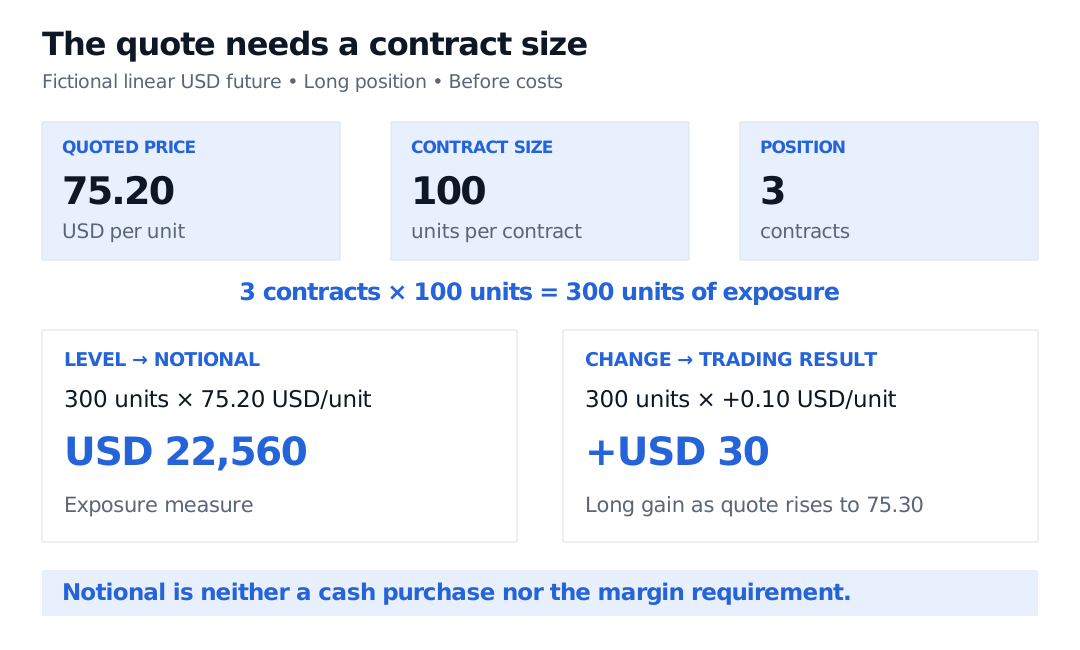
Original synthetic contract example, before fees and funding costs. Contract size converts both the quoted price into notional and the quoted price change into money.
The same move gives the short a USD 30 loss. Daily settlement determines when futures gains and losses move through the account; closing the position does not make earlier funding demands disappear. Forwards and Futures, available with a free signed-in account, develops this distinction. Actual products use their own quotation and rounding rules; CME’s tick explanation shows why the minimum price move and its monetary value depend on the contract.
Trading, clearing and risk are separate questions
Trading agrees the transaction and its price. Clearing manages the resulting obligations. For a centrally cleared derivative, a central counterparty interposes between clearing members; a customer commonly accesses that arrangement through intermediaries.
The contrast with over-the-counter trading is useful, but not absolute. OTC contracts can have standard terms and can be centrally cleared. In the EU, for example, ESMA describes central-clearing obligations for certain OTC derivative classes. Conversely, a security’s exchange listing does not establish the venue of every trade: the SEC explains that a US broker can route a listed-stock order to another exchange or a market maker.
Standard terms can make contracts easier to compare and offset, but listing does not guarantee deep liquidity, a narrow spread or an immediate exit at the displayed price. Central clearing manages counterparty exposure while concentrating risks in the clearing system; it does not protect a trader from an adverse market move. Federal Reserve supervisory guidance explicitly addresses exposures to CCPs.
Before using an exchange-traded instrument in a portfolio or backtest, identify the exact security or contract, quote units, multiplier, trading calendar, transaction costs and settlement rules. For derivatives, add expiry and margin funding. The full-membership lesson Exchanges and OTC Markets develops the venue and clearing choices behind these checks.
Sources
- John C. Hull, Options, Futures, and Other Derivatives, 9th Global Edition, Pearson, 2018, §§1.1–1.2, pp. 24–27, and §2.2, pp. 48–50: exchange and OTC structures, contract size and quotation. The numerical example here is fictional.
- CME Group: Definition of a Futures Contract: standard contract specifications and exchange trading.
- CME Group: Tick Movements—Understanding How They Work: quotation increments and monetary scaling.
- SEC Investor.gov: Exchange-Traded Funds: fund shares, market prices and investment risk; the page describes US registered investment-company ETFs.
- SEC Investor.gov: Executing an Order: execution choices for listed stocks.
- ESMA: Clearing Obligation and Risk Mitigation Techniques under EMIR: centrally cleared and non-centrally cleared OTC derivatives in the EU framework.
- Federal Reserve: Interagency Supervisory Guidance on Counterparty Credit Risk Management, §VI: CCP exposures and risk concentration.