Understand why a bond trades above face value, what the premium buys, and why principal repayment alone cannot determine the investor’s total return.
Bond premium
A bond premium is the amount by which a bond’s price exceeds its face value, or par value. Buying above par means paying more today than the principal scheduled for repayment. It does not mean the investment must lose money: the remaining coupons are part of what you buy.
For an ordinary fixed-principal bond, compare the quoted clean price with face value. Accrued interest is a separate settlement item; a full payment above face caused only by accrued interest does not establish that the clean quotation is at a premium. Always put the price and face amount on the same basis. A quote above 100 means above 100% of face, not an extra 100 currency units.
What the extra price buys
Consider a fictional, noncallable bond with USD 100 face value, two years remaining and USD 6 paid at the end of each year. Principal of USD 100 is repaid with the final coupon. Buy immediately after a coupon date, with zero accrued interest. Assume all payments arrive as promised and ignore fees, funding charges and taxes.
The premium is therefore USD 1.8594 per USD 100 face, or approximately 1.8594% of face. The coupon rate remains 6%: paying a higher price does not increase the contractual USD 6 payment.
There is a useful way to account for the premium. At the same 5% yield, an otherwise identical bond paying USD 5 a year would price at par. This bond pays one extra dollar on each coupon date. Those two extra dollars have present value
P−100=1.051+1.0521≈USD 1.8594.
The premium is the discounted value of that excess coupon stream in this example. More generally, for a standard fixed-rate, par-redemption bond on a coupon date, a coupon rate above the required yield produces a premium when both rates use consistent payment and compounding conventions. TreasuryDirect’s pricing guide gives this coupon–yield–price relationship for Treasury notes and bonds.
Principal shortfall is only one part of the ledger
The investor pays USD 101.8594 and eventually receives USD 100 of principal. That USD 1.8594 shortfall is real, but comparing only those two amounts leaves out USD 12 of coupons.
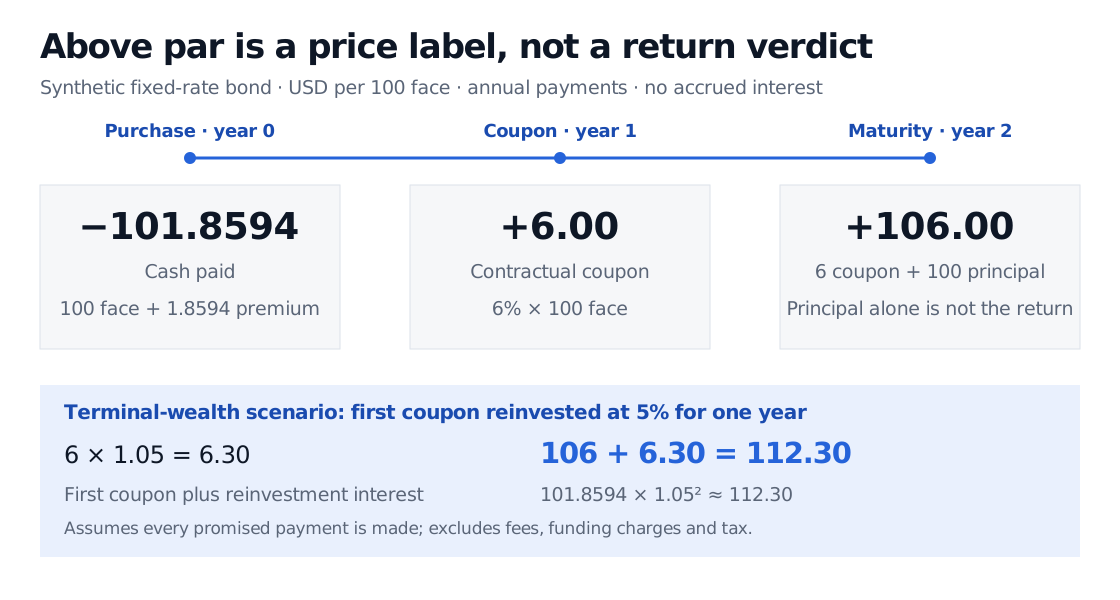
Synthetic bond cash ledger, in USD per 100 face: pay 101.8594 at year zero, receive 6 at year one and 106 at year two. Reinvesting the first coupon at 5% makes it 6.30, so terminal wealth is 112.30.
Original synthetic cash-flow ledger. Annual payments, zero accrued interest at purchase, fixed principal, no early redemption or default. The terminal-wealth panel additionally assumes 5% reinvestment of the first coupon; fees, funding charges and tax are excluded.
If the first coupon earns 5% for the remaining year, terminal wealth is USD 112.30: USD 106 from the final payment plus USD 6.30 from the reinvested first coupon. Using the unrounded purchase price,
P(1.05)2=112.30.
That scenario earns 5% compound growth a year. Calculating the promised cash-flow yield itself needs no reinvestment assumption. Reinvestment enters when turning the dated coupons into terminal wealth. If the first coupon instead sits in a zero-interest cash account, terminal wealth is USD 112, the gain is approximately USD 10.1406 and the cumulative two-year return is approximately 9.9555%. It remains positive, but differs from the 5%-reinvestment scenario. FINRA’s return guide explains why coupon receipts, redemption or sale proceeds, and reinvestment income all matter to the investor’s result.
The Bonds and Yields lesson develops the dated-payment pricing equation and separates the coupon contract from the yield implied by price. A public preview is available; the full lesson requires membership.
A premium is not a promise
At an unchanged 5% yield, the example’s price immediately after the year-one coupon is USD 100.9524. The remaining premium is smaller because only one above-market coupon remains. This conditional pull to par does not guarantee a steadily falling observed market price: yields and credit conditions can change, and between coupon dates the full price includes accrued interest.
Check the actual redemption terms. A callable bond may repay earlier, removing coupons that helped justify the purchase premium; yield to call evaluates a specified call schedule. Default may reduce or delay payments. Negative yields also matter: even a zero-coupon bond can trade above its redemption amount when its yield is negative. Above par alone therefore establishes neither a positive nor a negative total return. The SEC’s corporate-bond bulletin explains the separate effects of fixed coupons, default and early calls.
Finally, this meaning of premium concerns a bond’s purchase price relative to face value. An issuer’s call premium is an extra contractual amount payable on early redemption; an option premium is the price paid for an option. They are different quantities.
Frank J. Fabozzi, Bond Markets, Analysis, and Strategies, 9th edition, Pearson, 2016, Chapter 2, pp. 25–26 and 30–31: premium pricing, constant-yield price changes, quotations and accrued interest; Chapter 3, pp. 38–39: coupon income versus price gain or loss and cash-flow yield.