A Treasury note is U.S. government debt with fixed semiannual coupons. Trace its payments, distinguish original maturity from time remaining, and separate price from yield.
Treasury note
A Treasury note, or T-note, is a marketable U.S. government debt security that pays a fixed coupon every six months and repays its face value at maturity. It gives a bond investor a dated stream of U.S. dollar payments to value, trade or match against future spending.
As checked on 26 October 2026, Treasury issues nominal fixed-rate notes with original terms of 2, 3, 5, 7 and 10 years. The coupon rate stays fixed over the note's life; its market price and yield can change. These are the standard fixed-rate notes discussed here, rather than Treasury floating-rate notes. TreasuryDirect's note specifications set out the current terms.
The name describes the original term
A 10-year note with only one year left remains a Treasury note. It does not become a Treasury bill. Original maturity classifies the issue; remaining maturity tells you how long until its principal is due and helps determine its current interest-rate exposure.
The nearby Treasury instruments have different payment structures:
Its principal changes with inflation and deflation, so applying the fixed coupon rate to that principal produces changing cash coupon amounts.
These distinctions follow TreasuryDirect's specifications for bills, bonds and TIPS.
Follow the payments before reading the yield
Consider a synthetic two-year note with USD 1,000 face value and a 3.5% annual coupon rate. Purchase it for USD 1,000 on a coupon date immediately after any coupon due that day has been paid. Assume four complete six-month periods remain, payments occur as promised, and there are no fees or taxes.
Each semiannual coupon is
C=1,000×20.035=USD 17.50.
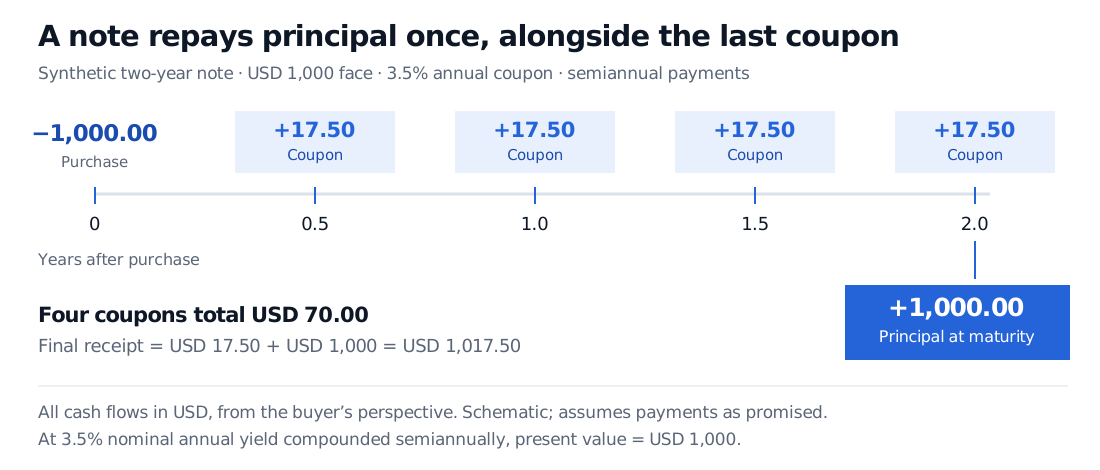
The buyer receives USD 17.50 after six, twelve and eighteen months. At month twenty-four, the buyer receives USD 1,017.50: the final coupon plus USD 1,000 principal. Coupons total USD 70; the returned principal is a repayment of capital, not another USD 1,000 of interest income.
Synthetic two-year note: purchase outflow 1,000 USD at time zero; coupons of 17.50 USD at years 0.5, 1, 1.5 and 2; principal of 1,000 USD also repaid at year 2, making the final receipt 1,017.50 USD.
Original synthetic cash-flow timeline, in USD per USD 1,000 face. The last coupon and principal arrive together. The diagram is schematic and assumes payments as promised.
At a nominal annual yield to maturity of 3.5%, compounded semiannually, these remaining payments have present value
The yield equals the coupon rate in this par-price example. A higher required yield would reduce the present value of the same payments; a lower yield would increase it. Calculating YTM does not itself assume coupon reinvestment. Realising the growth implied by that yield through maturity additionally requires reinvesting coupons at the stated yield convention and receiving all payments as promised.
For the underlying valuation method, Bonds and Yields separates contractual cash flows from discount factors and YTM. Its public preview is open; the full lesson requires membership.
A quote is a price, not the coupon or yield
A price quoted per USD 100 of face value describes how much principal you are buying for that amount. A hypothetical quote of 100 corresponds to USD 1,000 for USD 1,000 face. It does not mean a 100% yield. The coupon rate determines scheduled interest from face value; YTM is the rate that reconciles the full price with all remaining payments under the stated compounding convention.
Between coupon dates, a clean price excludes accrued interest. The settlement payment uses the dirty price, which includes it. The coupon-date example avoids an accrued-interest adjustment. Treasury notes can trade below, at or above face value; TreasuryDirect explains this price–yield relationship.
Fixed dollars still carry risk
The Treasury issuer does not make the note's market value constant. Selling before maturity can produce a loss when required yields rise. Holding to maturity avoids relying on that sale price, but fixed nominal payments can lose purchasing power to inflation. Earlier coupons also create reinvestment risk. These are separate from whether the issuer makes its promised payments. The SEC's bond risk explanation distinguishes interest-rate, inflation and credit risk.
For an investor measuring wealth in another currency, the dollar payments introduce currency risk: their home-currency value changes with exchange rates unless that exposure is hedged. A Treasury note therefore does not promise a fixed real return or a fixed return in every currency.
Bruce Tuckman, Fixed Income Securities: Tools for Today's Markets, 2nd ed., Wiley, 2002, Chapter 1, pp. 4–6: Treasury cash flows, price quotations and discount factors.