A Treasury bond, or T-bond, is a long-term marketable debt security issued by the U.S. Treasury. It pays fixed coupons every six months and repays its fixed face value at maturity. For a quant, it supplies long-dated dollar cash flows for measuring rate exposure and matching future liabilities. The payment amounts can stay fixed while the bond's market price changes.
TreasuryDirect currently lists original terms of 20 or 30 years. These marketable securities are distinct from U.S. savings bonds such as Series EE and I bonds.
The original term is not the time left
A bond issued for 30 years has 20 years remaining after ten years have elapsed. It remains an issue originally sold as a 30-year bond; its age does not rewrite its original terms. Valuation uses the payment dates still ahead of the valuation date, rather than discounting for another 30 years.
The U.S. Treasury's instrument names distinguish several payment structures:
| Instrument | Original terms currently offered | Payment structure |
|---|---|---|
| Treasury bill | One year or less | No periodic coupons; face value paid at maturity |
| Treasury note | 2, 3, 5, 7 or 10 years | Fixed semiannual coupons and principal at maturity |
| Treasury bond | 20 or 30 years | Fixed semiannual coupons and principal at maturity |
| Treasury Inflation-Protected Securities (TIPS) | 5, 10 or 30 years | Inflation-adjusted principal; fixed coupon rate applied to that adjusted principal |
The bill, note and TIPS descriptions set out their respective terms. In particular, a conventional nominal T-bond does not acquire inflation protection simply because it has a government issuer.
Follow one 30-year payment schedule
Consider a synthetic newly issued bond, with USD 1,000 face value, a 4% annual coupon rate and 30 years to maturity. The first coupon arrives after a full six-month period. Assume all promised payments arrive, with no fees or tax.
Each coupon is
There are 60 coupons. Payments 1 through 59 are USD 20 each; payment 60 is USD 1,020, comprising the last USD 20 coupon plus the USD 1,000 principal. The principal is repaid once, rather than in instalments with the coupons.
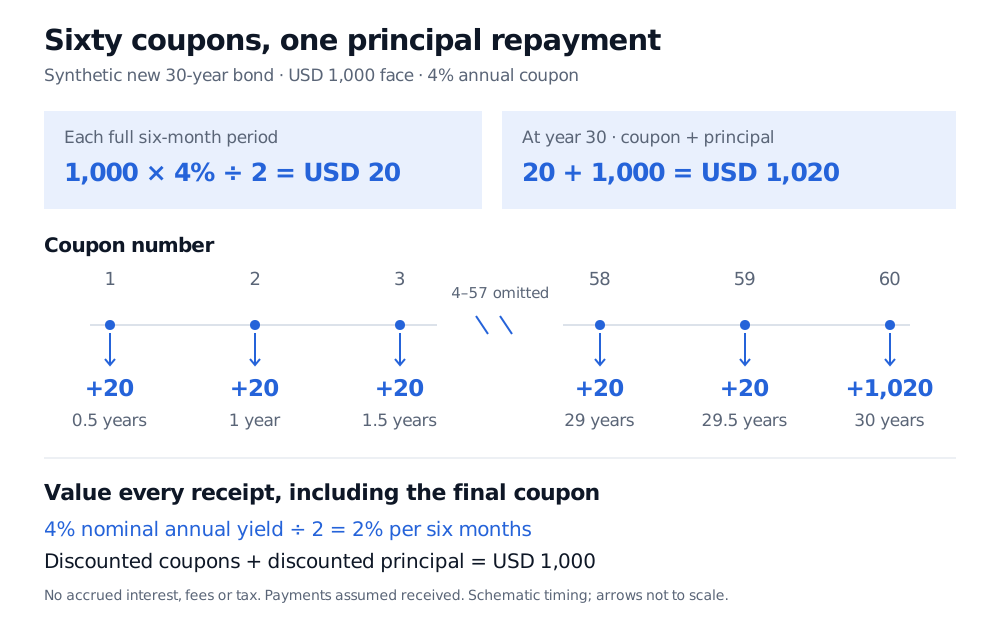
Original synthetic payment schedule, with coupons 4–57 omitted from the schematic. The final receipt contains both coupon and principal. Values assume payment in full; no accrued interest, fees or tax.
The 4% coupon rate specifies these payments. It does not specify the price at which an investor can buy the bond today.
Why this example prices at par
Value the full schedule at the start of the first coupon period, with no accrued interest. Stipulate a 4% nominal annual yield to maturity, compounded semiannually: the discount rate is 2% per six months. This is an illustrative yield, not a live Treasury quote.
One way to check the equality is a hypothetical funded account. Start with USD 1,000 earning exactly 2% each six months. Each period's USD 20 interest funds the coupon and leaves USD 1,000 in the account. At the final date, the account pays USD 1,020 and closes. The assumed account growth is a mathematical check, rather than an available investment offer.
For these fixed cash flows and this yield convention, a higher yield gives a lower price; a lower yield gives a higher price. TreasuryDirect's pricing guide explains the coupon–yield–price relationship. For a worked introduction to valuing individual payments, read Bonds and Yields (public preview; full lesson requires membership).
A benchmark still has risk
Treasury obligations carry the full faith and credit of the U.S. government, and their yields serve as a risk-free rate benchmark in many models. The Federal Reserve's nominal yield-curve explanation also makes clear that their prices and implied yields vary in the market.
A holder who sells early can realise a capital loss if the sale price falls below the purchase price. Receiving fixed nominal dollars also leaves inflation risk: those dollars may buy less when they arrive. These are separate from the issuer's ability to pay, as the SEC's discussion of bond risks explains. Holding to maturity does not fix the purchasing power of the proceeds, or the future rates available for reinvesting coupons.
Sources
- TreasuryDirect — Treasury Bonds, original terms and fixed semiannual payments; checked 26 October 2026.
- TreasuryDirect — Treasury Notes, Treasury Bills and TIPS, instrument distinctions.
- TreasuryDirect — Understanding Pricing and Interest Rates, principal repayment and the price–yield relationship.
- Federal Reserve Board — Nominal Yield Curve, fixed-dollar payments, trading and benchmark use.
- SEC Investor.gov — Bonds: FAQs, interest-rate and inflation risks.
- Frank J. Fabozzi and Francesco A. Fabozzi, Bond Markets, Analysis, and Strategies, 10th edition, MIT Press, 2021, Chapter 7, “Treasury Securities” and “Fixed-Principal Treasury Securities” (ebook PDF file pages 234–235).