Span is the set of all linear combinations of given vectors. Test whether a target exposure can be reached, see when a new instrument adds coverage, and separate algebra from trading constraints.
Span
The span of a collection of vectors is the set of every linear combination of those vectors. It answers a coverage question: can these building blocks produce the target I need?
For vectors v1,…,vk in a real vector space,
span(v1,…,vk)={i=1∑kqivi:qi∈R}.
The original vectors belong to the span, but the span also includes their sums, fractional multiples, reversals and the zero vector. It is a set of possible results, not just the original list or one chosen combination. The real-number assumption matters: restricting the coefficients changes the attainable set. Axler, §2A, gives the formal definition and empty-list convention.
Two instruments, but only one direction of coverage
A hypothetical risk desk measures sensitivity to two specified factors, in a fixed order. Each entry is the change in portfolio value in USD per one percentage-point move of that factor, holding the other factor fixed. Assume instrument sensitivities are fixed at the current market state and add linearly across holdings.
One contract of instrument A has sensitivity vector a=(1,2); one contract of B has b=(2,4). Multiplying these per-contract vectors by contract quantities gives total sensitivity. We initially permit any real quantities, including fractional and short positions.
Every combination is
qAa+qBb=(qA+2qB,2qA+4qB)=(t,2t),t=qA+2qB.
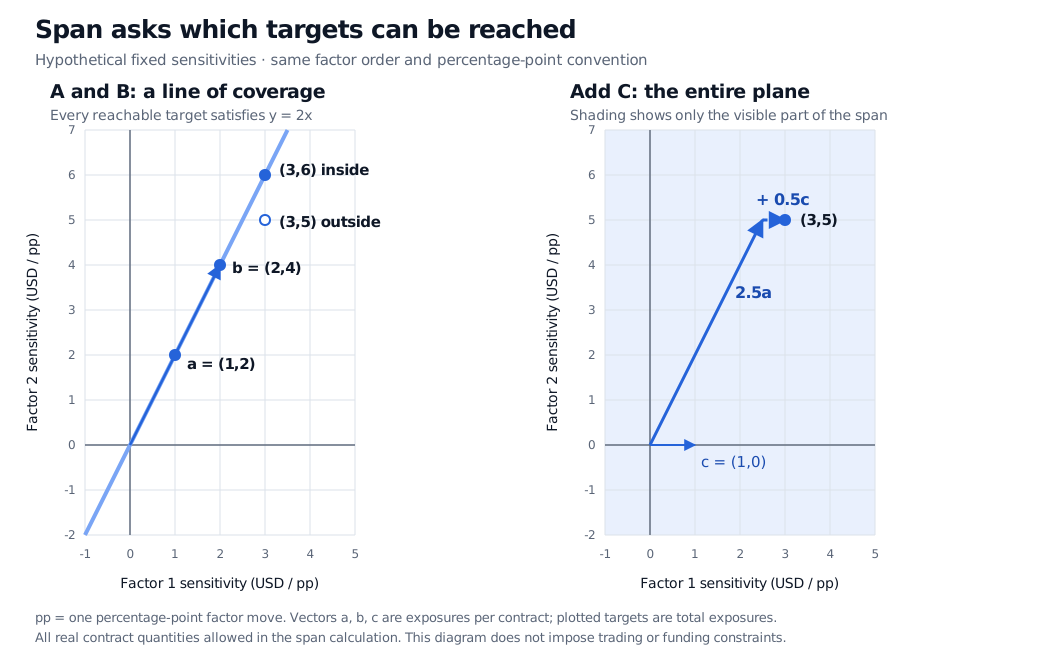
Because t can be any real number, the span is the entire line through the origin satisfying y=2x. It extends beyond both arrows in both directions. Buying more of B cannot change the second-to-first sensitivity ratio.
Now compare two targets, in the same sensitivity units:
Target
In the span?
Reason
(3,6)
Yes
a+b=3a=(3,6)
(3,5)
No
Every reachable vector has second component twice its first; 5=2(3)
For the second target, matching factor 1 forces factor 2 sensitivity to be 6. Matching factor 2 at 5 forces factor 1 sensitivity to be 2.5. Rebalancing between A and B cannot remove that conflict. This is an exact failure of coverage, rather than a failure to search hard enough for holdings.
Hypothetical two-factor sensitivities in USD per percentage-point factor move. Vectors a=(1,2) and b=(2,4) reach (3,6) on y=2x but cannot reach (3,5). Adding c=(1,0) expands coverage to the plane and reaches (3,5) as 2.5a plus 0.5c.
Original hypothetical fixed-sensitivity example. Each instrument vector is the exposure of one contract; targets are total exposures. The axes use equal scales. Shading shows only the visible part of an unbounded span; real contract quantities are allowed.
What actually expands a span?
A new vector expands coverage precisely when it lies outside the old span. Add instrument C with per-contract sensitivity c=(1,0). It breaks the relation y=2x. Indeed, every target (u,v) has the construction
(u,v)=2va+(u−2v)c.
So A and C span all of R2. In particular,
(3,5)=2.5a+0.5c.
B can remain available, but it adds no coverage beyond A. This is where span and linear dependence meet: span asks which targets exist, while dependence detects redundant generators. A basis covers the chosen space without redundancy. Here the original span has dimension 1; the expanded span has dimension 2.
For a matrix whose columns are instrument vectors, this same reachable set is its column space. Solving Aq=d tests whether the target d belongs to it. The MIT column picture makes that connection explicit.
Coverage has a boundary; execution has more boundaries
Being in the span is a statement about the specified linear model. It does not certify that a trade can be executed or funded.
Whole contracts: with integer quantities of A, B and C, the second component is 2qA+4qB, always an even integer. The target (3,5) is in the real span but remains impossible under this restriction.
Long-only positions: A, B and C have nonnegative components. Negative targets such as (−1,−2) belong to their real span but require shorting, so they are unavailable with nonnegative quantities.
Funding and risk limits: the calculation has no price, margin, position-limit or liquidity condition. Matching two sensitivities also leaves other risks unspecified. Local sensitivity matching does not imply matching full cash flows after large market moves.
A fixed starting inventory is another distinction. If its exposure is z=(0,1) and allowed adjustments cover only the original line L={(t,2t):t∈R}, final exposures fill
z+L={(t,1+2t):t∈R}.
This is an affine translate, a shifted line satisfying y=2x+1, rather than a linear span. It does not contain the origin. To neutralise inventory, ask whether its negative is in the adjustment span; here −z=(0,−1) is outside L.
Every span itself contains zero and is a subspace of its ambient vector space. Zero generators add no coverage; a collection consisting only of zero vectors, or the empty collection by convention, spans {0}. These edge cases reinforce the practical question: count independent directions of coverage, not instrument names.