Linear dependence means that a list of vectors admits a linear combination equal to zero with at least one nonzero coefficient. Some vector in the list can therefore be built from the others. In a portfolio model, another instrument may add a trading choice without adding a new attainable payoff direction.
For real vectors , dependence means that there exist real numbers , not all zero, such that
“Not all zero” is essential: choosing every coefficient to be zero works for every list and proves nothing. Linear independence means that this trivial choice is the only way to get zero. MIT's Lecture 9 summary develops dependence through the connection between a zero combination and a removable vector.
Two contracts, one payoff direction
Consider a hypothetical one-period market with exactly two exhaustive terminal states. All cash flows occur at the same date, in USD, with full contractual performance. One contract of A or B delivers:
| Contract | State 1 payoff, USD per contract | State 2 payoff, USD per contract |
|---|---|---|
| A | 1 | 2 |
| B | 2 | 4 |
Their payoff vectors satisfy , so
Shorting two A contracts and holding one B produces USD zero in both states. The holdings are nonzero; their combined payoff is zero. B is redundant relative to A, and removing B leaves the span unchanged.
Suppose the target is USD . Both three A contracts and one A plus one B deliver it:
More generally, allowing arbitrary real quantities and short positions,
always gives that target. Moving from one solution to another adds a multiple of the zero-payoff position . This is why a reachable target has infinitely many representations when its instrument list is dependent.
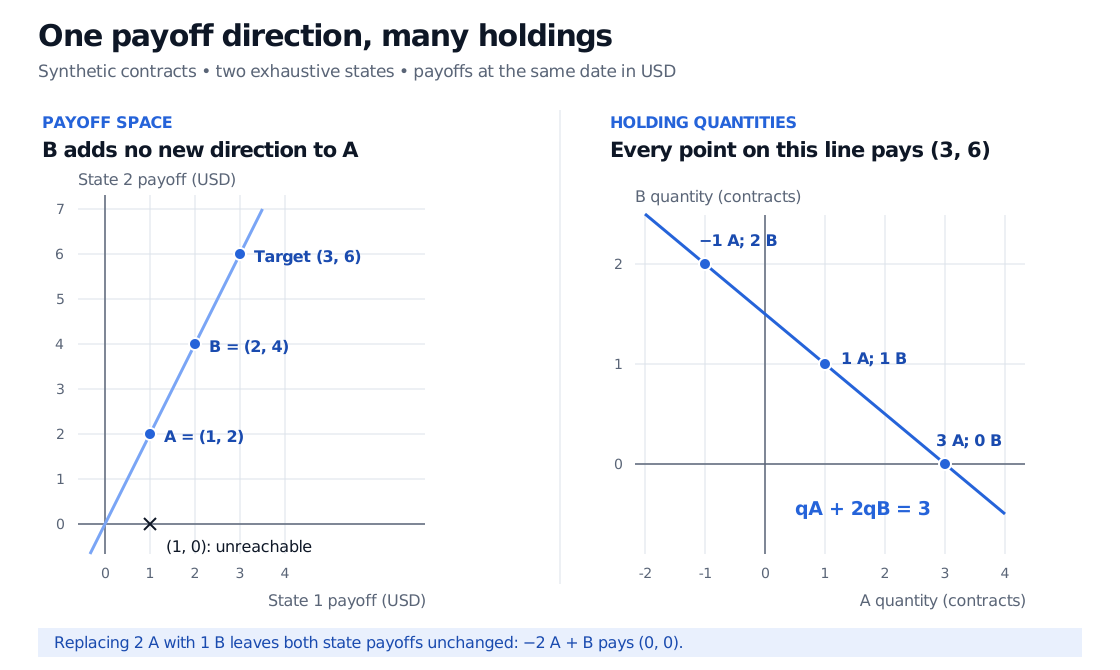
Original two-state model. The left panel measures terminal payoffs in USD; the right measures contract quantities. Replacing two A contracts with one B leaves both state payoffs unchanged.
Dependence does not make every target reachable. Every portfolio here pays twice as much in state 2 as in state 1, so USD is impossible. Nor does dependence promise infinitely many feasible trades under additional restrictions. With real, long-only quantities, this target's family is restricted to ; integer-lot requirements restrict it further.
The matrix test
Place the vectors in the columns of a matrix. In this example,
The second row is twice the first, so row reduction leaves one pivot: the rank is 1, although there are two instrument columns. In general, columns are dependent exactly when the matrix has rank less than , or equivalently when its null space contains a nonzero vector. This test also works for rectangular matrices; a determinant test applies only to square ones.
Removing redundant vectors can produce a basis for the original span. Here A alone is a basis for the attainable line; it is not a basis for the entire two-state payoff plane. For the connection to pivot columns and unique representations, see Linear Independence, Basis, and Dimension. Its full lesson requires membership; a public preview introduces the scope.
Redundancy is not automatically arbitrage
The payoff relation alone contains no prices. Suppose A costs USD 1.20 and B costs USD 2.40 per contract. Then the zero-payoff portfolio also costs zero, and both target portfolios cost USD 3.60. These prices are internally consistent: valuing each state's USD payoff at USD 0.40 today gives precisely those contract prices. Every nonzero, nonnegative terminal payoff then has positive value under that rule.
The law of one price requires B's price to equal twice A's in the frictionless model when both directions of the replication trade are available. An arbitrage claim needs an executable price discrepancy plus permissible shorting, funding and matching settlement. Redundancy by itself supplies neither. If the vectors record only local factor sensitivities, even an exact cancellation of those entries need not cancel nonlinear payoffs, other risks or future cash flows.
Two final distinctions prevent common misdiagnoses:
- A zero vector makes any list containing it dependent. Put coefficient 1 on that entry and zero on every other entry. A singleton containing a nonzero vector is independent; the empty list is independent by convention.
- Dependence need not mean two vectors are multiples. The list is dependent because the third equals the sum of the first two, although no pair is proportional. With rounded or estimated exposures, numerical “near dependence” also depends on scaling and a stated tolerance; it is not an exact algebraic identity.
Sources
- Sheldon Axler, Linear Algebra Done Right, 2nd edition, Chapter 2, “Span and Linear Independence,” pp. 23–25, including Linear Dependence Lemma 2.4. Supports the definition, list conventions and unchanged-span result.
- MIT 18.06, Spring 2009 lecture summaries: Lecture 9, “Independence, Dimension, and Bases”. Connects a nontrivial zero combination to a removable vector and the basis concept.
All contract payoffs, prices and the figure are original hypothetical examples.