A vector keeps labelled quantities in order. Learn componentwise addition, scaling and row versus column notation through a three-asset portfolio cash ledger.
Vector
A vector is an object that can be added to other vectors and multiplied by numbers. In the numerical setting used here, a vector in Rn is an ordered list of n real numbers. Its entries are called components or coordinates. In finance, those entries might record positions across assets, returns across dates, or exposures across risk factors. Their labels and units tell you what the numbers mean.
A three-entry return vector is not three competing forecasts of one unnamed quantity. It might mean “the returns of Asset A, Asset B and Asset C, in that order.” Losing that order can turn a correct calculation into a wrong portfolio result.
Three assets, two vectors, one portfolio result
Consider a hypothetical portfolio held unchanged for one period. Its initial portfolio weights and same-period simple total returns are
w=0.600.250.15,r=0.03−0.020.01.
Both vectors use the order A, B, C. Weights are fractions of initial portfolio value; returns are decimals, so 0.03 means 3%. All returns cover the same period and use the same valuation currency. Assume no external cash flows, trading costs or rebalancing within the period.
The dot product multiplies matching entries and adds the results:
This is the portfolio return. The superscript T means transpose: it turns the column of weights into a row so row-by-column multiplication produces one number.
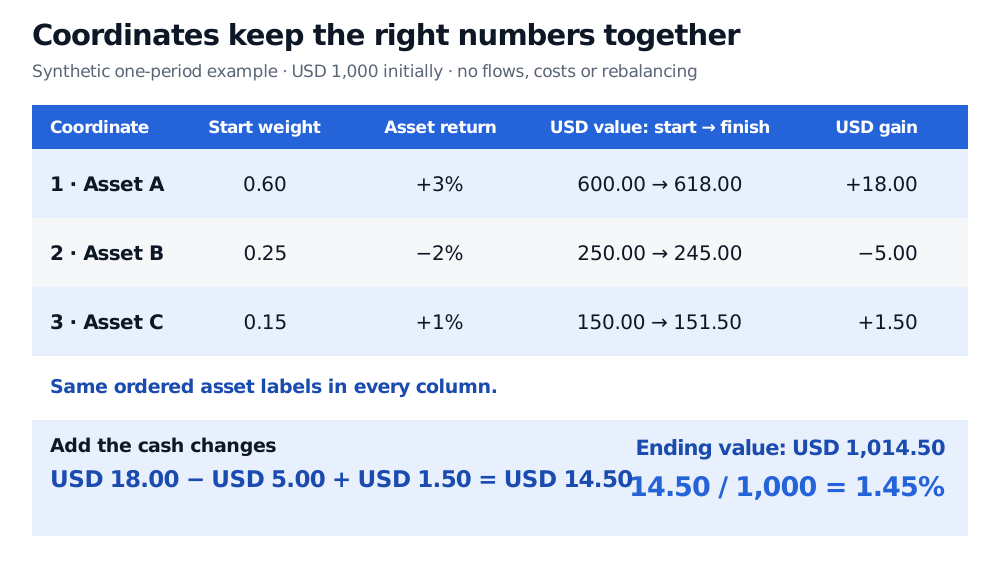
Check the result directly in cash. An initial USD 1,000 allocates USD 600, USD 250 and USD 150 to the three assets. Their final values are USD 618, USD 245 and USD 151.50. Together they become USD 1,014.50: a USD 14.50 gain on USD 1,000, or 1.45%.
Ordered Asset A, B and C coordinates match weights 0.60, 0.25 and 0.15 with returns 3%, minus 2% and 1%. A USD 1,000 portfolio ends at USD 1,014.50 after cash changes of plus USD 18, minus USD 5 and plus USD 1.50.
Original synthetic one-period cash ledger. Each row preserves one asset label across the weights, returns and currency values; the total provides an independent check on the vector calculation.
Reordering both vectors consistently changes only the bookkeeping. Reordering returns alone changes the investment you are describing: pairing the original weights with returns in order B, A, C gives −0.003, or −0.30%. Equal lengths are necessary; matching economic labels is necessary too.
Addition and scaling preserve the coordinates
Let h=(600,250,150)T record initial USD positions, and let q=(100,−50,0)T record proposed USD trade changes, again ordered A, B, C. Componentwise addition gives
h+q=700200150.
This says “add USD 100 of A, remove USD 50 of B, leave C unchanged.” It describes the resulting holdings; financing the net purchase is a separate accounting question.
Multiplication by a number, called a scalar, acts on every component:
2h=1200500300,0h=000.
A negative scalar reverses every signed position. Adding scaled vectors forms a linear combination, the operation behind combining books or constructing a hedge. Addition requires compatible components: USD holdings can be added to USD holding changes for the same assets, whereas adding those holdings to percentage returns has no direct financial meaning.
Shape is useful; meaning still needs labels
A column with three entries has shape 3×1; its transpose has shape 1×3. Both display the same three coordinates, but their orientation matters in matrix multiplication. Two columns do not multiply into the scalar dot product without an appropriate transpose. Ordinary vector addition is also undefined between a two-entry vector and a three-entry vector.
The space R3 has dimension three. A single vector in it is one element of that space, not three independent vectors. An arrow from the origin is a useful geometric picture in two or three dimensions; a portfolio of hundreds of assets uses the same coordinate arithmetic without a drawable arrow. More generally, functions and other objects can be vectors in a vector space; the numerical list is the gateway case.
Finally, being a vector imposes no probability or budget restriction. Our weight vector sums to one because the example allocates the entire initial portfolio. Doubling it gives a vector whose entries sum to two. Returns can be negative and need not sum to anything prescribed. Probabilities require additional non-negativity and sum-to-one conditions; vector notation supplies neither.
For a guided continuation, Vectors and Matrices develops these operations into factor-exposure maps and linear systems. Full lesson access requires membership; a public preview is available.
Sources
Gilbert Strang, Introduction to Linear Algebra, 5th edition (2016), §§1.1–1.2: vector addition, scalar multiplication and dot products. Author’s book website.
Nathan Barczi, MIT 14.102, Math for Economists: Lecture Notes, 14 September 2004, §2.1: column vectors and linear combinations. MIT lecture notes.