A vector space permits consistent addition and real scaling. Combine three-asset books, reverse positions, and see why fully invested weights and long-only holdings need separate constraints.
Vector space
A vector space is a collection of objects that can be added and multiplied by scalars while remaining in the collection, with operations that obey the usual linear arithmetic rules. A real vector space uses every real number as a scalar, including zero and negative numbers. It contains a zero object and, for each object, its additive inverse.
For a trading desk, the practical question is whether combining, shrinking or reversing books still produces an allowed kind of book. Unrestricted holdings answer yes. A fixed investment budget or a long-only mandate changes that answer.
Combining two books without changing the language
Imagine a hypothetical desk trading three assets, always recorded in the order A, B, C. A vector records net units of each asset: positive means long and negative means short. Assume quantities are divisible and there are no position, borrowing or capital limits. The collection of all possible holdings is
V=R3={(qA,qB,qC):qA,qB,qC∈R}.
Two teams hand over the books
x=(2,−1,3),y=(−1,4,−3).
The first holds two units of A, shorts one of B and holds three of C. Adding the books means netting each asset separately:
x+y=(2−1,−1+4,3−3)=(1,3,0).
C disappears from the combined net position. It has not disappeared from the asset universe: its coordinate is still present and equals zero. Scaling the first book by −0.5 gives
−0.5x=(−1,0.5,−1.5).
Every long becomes a short, every short becomes a long, and every quantity is halved. Both results remain three-asset holdings. More generally, every linear combinationax+by remains in V for real a,b.
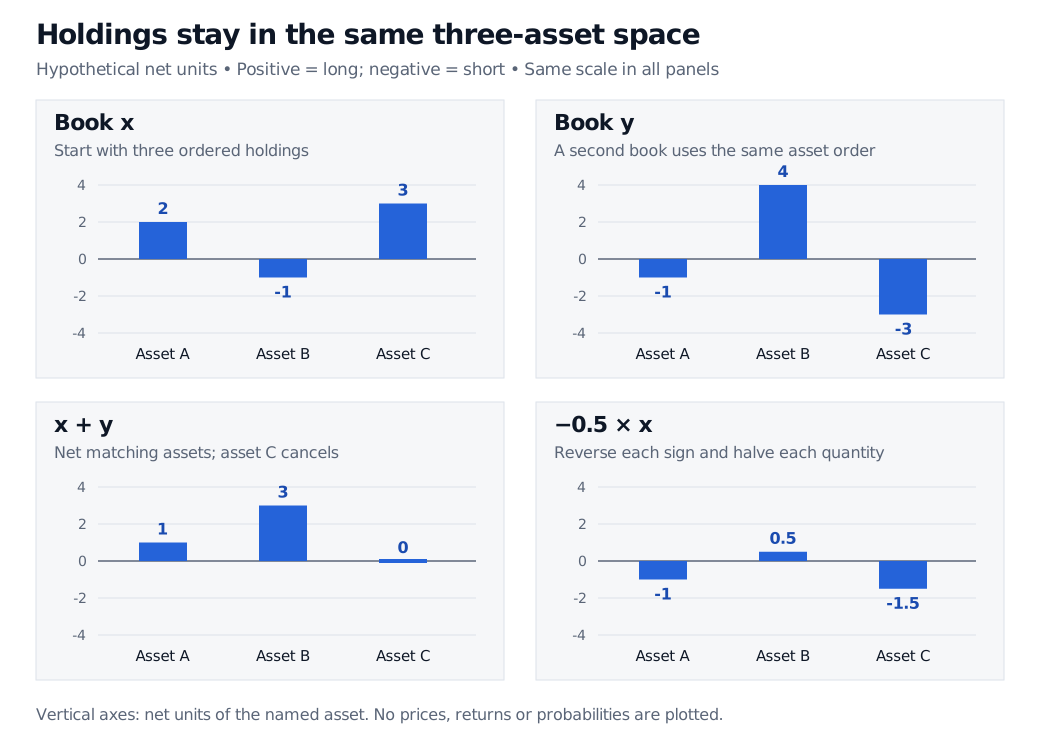
Four panels show hypothetical net holdings in assets A, B and C, all on a scale from minus 4 to plus 4 units. Book x is 2, minus 1, 3; book y is minus 1, 4, minus 3. Their sum is 1, 3, 0. Reversing and halving x gives minus 1, 0.5, minus 1.5.
Original hypothetical holdings. Each vertical scale measures units of the named asset; the panels show netting and signed scaling, not market values or returns.
The zero vector (0,0,0) means hold nothing. The inverse −x cancels x exactly in this net-holdings record. That is an algebraic cancellation of positions; it does not erase execution costs or contractual obligations from actual transactions.
This model deliberately allows arbitrary real quantities. If an instrument trades only in whole lots, its integer holdings are closed under addition but fail real scaling: half of one lot is not an integer lot. The continuous vector space remains a useful modelling environment, while executable positions require additional restrictions.
Closure makes combinations possible; arithmetic makes them consistent
The phrase closed under an operation means applying that operation never takes you outside the collection. In a vector space, addition and scalar multiplication must be closed. The other rules ensure that the answer does not depend on harmless bookkeeping choices.
For example, merging teams in either order gives the same position, and merging three teams does not depend on which pair is combined first. Scaling after merging agrees with scaling each team first:
c(x+y)=cx+cy.
Successive resizing multiplies the scale factors, and resizing by one leaves a book unchanged. These are parts of the formal definition, together with the other distributive law (a+b)x=ax+bx. Closure alone would not define a vector space if someone invented operations that violated those rules. Axler's definition gives the complete arithmetic conditions.
For ordinary coordinate vectors, the operations act component by component and inherit these identities from real-number arithmetic. Asset labels and units must stay aligned: adding an A coordinate to a B coordinate is a recording error, regardless of whether the arrays have matching lengths.
Why fully invested portfolios fail the test
Holdings and portfolio weights answer different questions. A holding states a quantity; a weight states a fraction of portfolio value. The usual fully invested weight constraint is
W={w∈R3:wA+wB+wC=1}.
The zero vector fails that equation. Adding two admissible weight vectors also produces a sum of two, rather than one. Thus W is not a vector space under ordinary addition and scaling.
For example, (0.5,0.3,0.2) and (0.2,0.5,0.3) are fully invested. Their sum (0.7,0.8,0.5) is not a valid fully invested weight vector. If these describe two books with equal positive net asset value, their combined book instead has the average weights (0.35,0.40,0.25), which sum to one. Unequal book values require a value-weighted average. Combining physical books and adding normalised weight vectors are different calculations.
The budget equation defines an affine plane. Its feasible changes Δw satisfy ΔwA+ΔwB+ΔwC=0, forming a subspace. This lets an optimiser distinguish a portfolio's location from the directions in which it can move without breaking its budget.
A long-only holdings set also fails to be a vector space: a nonzero permitted long position becomes forbidden when multiplied by −1. Containing zero and permitting additions is insufficient; negative scaling matters too.
What the structure does—and what it leaves open
The same framework applies beyond holdings. All real-valued terminal payoff functions on a fixed set of scenarios form a vector space when added and scaled scenario by scenario. A payoff function can be nonlinear in the underlying price while still being an element of this vector space: linear combination of contracts does not mean linear payoff in the stock price.
The dimension of the unrestricted three-asset holdings space is three. A basis supplies coordinates for describing its books. Neither the vector-space definition nor the number of coordinates specifies market risk, the cost of a position, or whether two assets are statistically related. Measuring lengths, angles or risk requires further structure and financial inputs.
For the formal definition and the closure test, continue with Definitions 1–2 and Examples 1–3 of Vector Spaces and Subspaces. The public page provides a preview; the full lesson requires membership.
Sources
Sheldon Axler, Linear Algebra Done Right, second edition, Chapter 1, “Definition of Vector Space,” pp. 4–10. Real coordinate spaces, scalar multiplication and the defining arithmetic rules.
Gilbert Strang, Introduction to Linear Algebra, fifth edition, §3.1, pp. 123–126. Spaces of vectors, closure, and examples beyond coordinate lists.