Linear independence rules out redundant vector directions. Test two contract payoff columns, find unique replication quantities, and distinguish spanning from feasible trades.
Linear independence
Linear independence means that a list of vectors contains no direction that can be reproduced by a linear combination of the others. Formally, real vectors v1,…,vk are linearly independent when
c1v1+⋯+ckvk=0⟹c1=⋯=ck=0.
The all-zero coefficient list always works. The question is whether any other coefficient list also gives the zero vector. Such a nontrivial zero combination proves dependence: at least one coefficient is nonzero, but some others may be zero. This is the definition used in Axler, §2A.
On a trading desk, the distinction asks whether another instrument adds a new payoff direction across the states being modelled. Buying more instruments does not necessarily increase the number of independent risks that can be controlled.
Two contracts, two payoff directions
Consider two hypothetical contracts, A and B, settling at the same date in USD. There are exactly two terminal states in this model; a vector lists state 1 first, state 2 second. Each unit pays:
Contract
State 1
State 2
A
USD 1
USD 2
B
USD 2
USD 1
Target claim
USD 4
USD 5
Write the numerical per-unit payoff columns as a=(1,2)T and b=(2,1)T. Real-valued contract quantities p,q produce the USD payoff vector
pa+qb=[p+2q2p+q].
To test independence, set both state payoffs to zero. The equations p+2q=0 and 2p+q=0 give −3q=0, hence q=0 and p=0. There is no nonzero position in these two contracts that cancels its payoff in both states.
For the target claim, solve instead
p+2q2p+q=4,=5.⟹p=2,q=1.
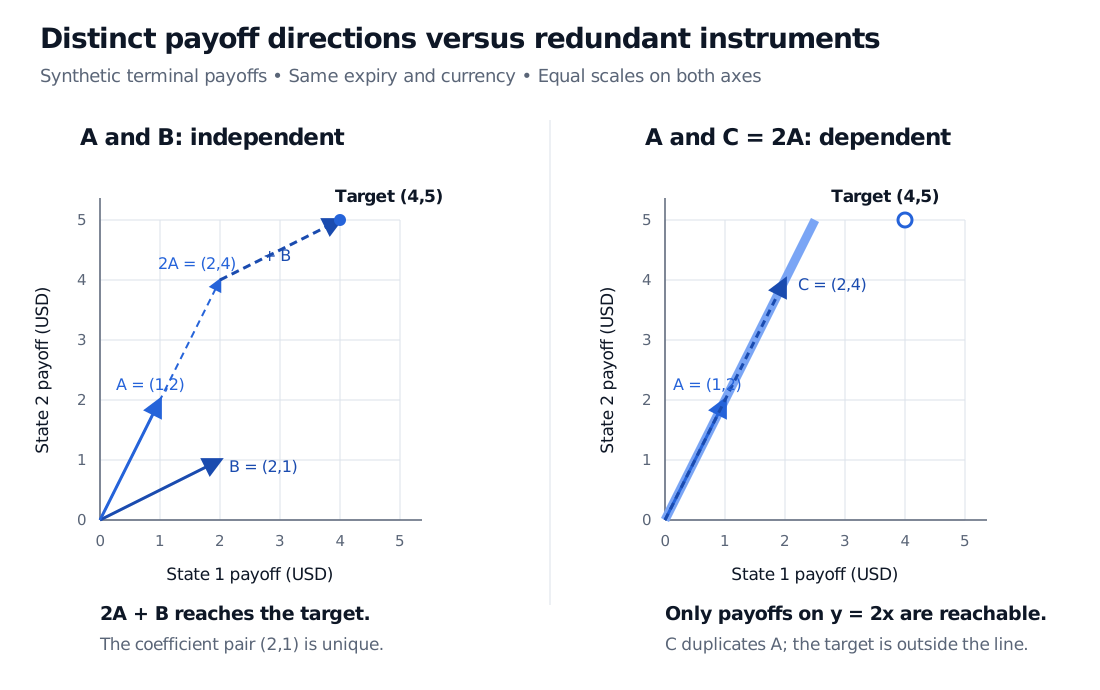
Two A contracts and one B contract pay 2(1,2)+(2,1)=(4,5), measured in USD. This coefficient pair is unique. If another pair delivered the same target, subtracting the two portfolios would create a nontrivial zero-payoff combination, contradicting independence.
Two synthetic terminal-payoff diagrams with both axes in USD. A pays (1,2), B pays (2,1), and the unique position 2A plus B reaches (4,5). Replacing B by C=2A, paying (2,4), leaves the line y=2x and cannot reach (4,5).
Original hypothetical two-state payoff model. Both axes show terminal USD amounts at the same date. The left panel constructs the target; the right panel shows how a redundant instrument fails to enlarge the attainable payoff space.
These are payoff calculations, not a pricing model. No current contract prices, state probabilities, funding terms or transaction costs have been specified. The independence result alone identifies no arbitrage and supplies no expected return.
Replace a direction with a duplicate
Now replace B by contract C with payoff c=(2,4)T=2a. Then
2a−c=0.
The coefficients (2,−1) are nontrivial, so A and C are dependent. Every combination is (p+2q)a: the span is the line y=2x. The target (4,5) is outside that line because 5=2(4), so it cannot be replicated from A and C even with unrestricted real quantities.
A reachable target has multiple representations: (2,4) comes from either two A contracts or one C contract. Dependence creates redundant descriptions; it does not mean that no payoff is attainable. C might still have practical value because of different liquidity or trading terms.
Putting vectors into the columns of a matrixM turns the test into Mc=0. The columns are independent exactly when this equation has only the zero solution, or equivalently when the matrix has one pivot per column: full column rank. This works for rectangular matrices too. A determinant test applies only to square matrices. Strang's Lecture 9 develops the connection to basis and dimension.
Here,
M=[1221],detM=1(1)−2(2)=−3=0.
Thus A and B are independent and span the entire two-state plane R2. Their payoff columns form a basis for this specified space. Independence alone would not establish that conclusion for a larger space: two independent vectors in R3 span a plane, leaving some targets unreachable. The number of independent directions is the dimension of their span.
There is also a difference between algebraic reach and feasible trades. With A and B, the target (1,0) USD requires quantities p=−1/3, q=2/3. This target is in their span, but a rule forbidding short positions excludes its unique replicating portfolio. Integer-lot, budget, collateral and position limits can restrict feasible targets further. Algebraic spanning assumes arbitrary real coefficients; it does not promise market access.
Three distinctions worth keeping
Independent does not mean perpendicular. In the example, aTb=1(2)+2(1)=4, so the arrows are not orthogonal under the ordinary Euclidean dot product. They remain linearly independent. Geometry here compares two same-currency state payoffs; it does not measure probabilistic diversification.
For three or more vectors, pairwise checks are insufficient. The list (1,2),(2,1),(3,3) is dependent because the first two sum to the third, even though no pair consists of scalar multiples. Any list containing the zero vector is dependent: use coefficient 1 on that vector and zero on the rest.
Geometric independence is different from statistical independence. This article tests deterministic vectors and exact linear relations. Statistical independence concerns a joint probability law. Independent payoff columns do not imply independent random returns, and fitting independent columns to a finite scenario table does not establish that future risks will behave independently.
Finally, exact independence can coexist with a fragile numerical solve. Nearly parallel columns can have a nonzero determinant while small payoff-estimation errors cause large changes in the calculated holdings. Check scaling, conditioning and any numerical rank tolerance rather than treating a small computed residual as proof of a reliable hedge.
For the proofs and additional pivot-based tests, continue to Linear Independence, Basis, and Dimension. The public page provides a preview; the full lesson requires membership.