Value common equity from book value and expected earnings above the equity charge, then reconcile the result to shareholder payouts.
Residual income valuation
Residual income valuation estimates the value of common equity as today’s book equity plus the present value of expected future earnings left after charging for shareholders’ required return on opening book equity. It tells an analyst what forecast profitability would support a value above or below book. A company can report a profit and still earn less than shareholders require. Ohlson (1995), equation (1)
For year t, let Bt−1 be opening common book equity, Et be earnings attributable to common shareholders on a clean-surplus basis, and ke be the annual cost of equity. Then
RIt=Et−keBt−1.
For positive opening book equity, this is opening equity times the spread between return on opening equity and the cost of equity. Using closing equity would charge shareholders for capital accumulated during the year as if it had been in place at the start.
The dividend benchmark starts with the equity roll-forward
Clean surplus means Bt=Bt−1+Et−Dt, where Dt is net cash distributed to common shareholders. In an aggregate common-equity model, count ordinary dividends and buybacks as distributions and subtract cash raised from common share issues. If gains or losses flow into equity through other comprehensive income, include them in the earnings measure used in the roll-forward. Reconcile any other direct-to-equity movements using the statement of changes in equity so that the forecast book balance, earnings and owner flows describe the same claims. Plugging reported net income into the model when it omits part of that change breaks the link to payouts. Ohlson (1995), assumptions A1 and A2a · Penman, sections 1.3.2 and 2.1
Rearrange clean surplus to get Dt=RIt+(1+ke)Bt−1−Bt. Substitute that into a dividend discount model with the same constant cost of equity. Discounted opening and closing book balances cancel across adjacent years. For forecasts through year T, with VT measured after the year-T payout, today’s equity value is
V0=B0+t=1∑T(1+ke)tRIt+(1+ke)TVT−BT.
Here the amounts are forecasts as of today. The terminal adjustment is the forecast premium or discount to book at the horizon. If expected residual income is zero from year T+1 onward, that adjustment is zero. If it persists, estimate the year-T present value of those later residuals. For example, if residual income grows perpetually at a constant rate −1<g<ke starting with RIT+1, that premium or discount is RIT+1/(ke−g). If the payout valuation converges and the discounted expected book balance tends to zero, the infinite-horizon form is opening book plus the discounted stream of expected residual income. Penman, section 1.3.2, equations (3a)–(3d)
Two ways to value a one-year company
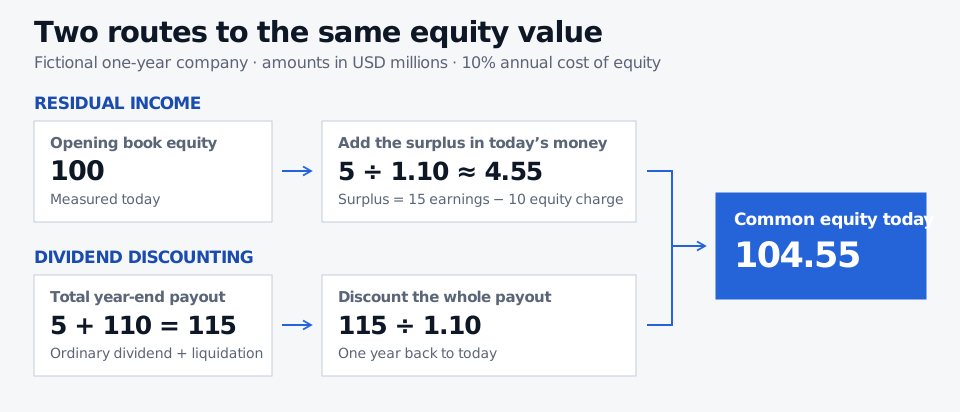
A fictional company starts with common book equity of 100, earns net income of 15 and pays an ordinary dividend of 5 at year-end. All amounts are in USD millions, and the annual cost of equity is 10%. The only changes in book equity before liquidation are net income and the ordinary dividend. Book equity just after the dividend is 100+15−5=110. The company immediately liquidates at that book value, distributing a further 110. At the instant before liquidation, V1=B1=110, so the horizon adjustment is zero.
Residual income. The charge on opening equity is 0.10×100=10. Residual income is 15−10=5, so common equity is worth 100+5/1.10≈104.55 today.
Payouts. Shareholders receive the ordinary dividend and the liquidation proceeds at year-end. Their combined present value is (5+110)/1.10≈104.55.
Two routes to equity value of USD 104.55 million today. Residual income adds the discounted USD 5 million surplus to opening book of USD 100 million. Dividend discounting discounts the USD 5 million ordinary dividend plus USD 110 million of liquidation proceeds at 10%.
The residual-income route starts with book value already measured today. The payout route discounts the entire year-end distribution.
The opening section of the SelfMadeQuant lesson derives the same one-period dividend-plus-ending-value benchmark. The public preview gives the outline and the full derivation is for members. Equity Valuation — Dividend Discount and DCF Models
Why analysts use it for banks
Bank deposits help fund the loans and other assets that generate earnings, so separating operating cash flows from financing cash flows for an enterprise valuation can be awkward. Forecasting common book equity and returns on that equity gives analysts a direct route to common equity value. The result still depends on the earnings and equity forecasts and on how long returns are expected to stay above or below the cost of equity. Damodaran, Valuing Financial Service Firms, “Excess Return Models”