Economic value added (EVA) is a period’s net operating profit after tax (NOPAT) minus a charge for the capital invested in those operations. A profitable business can have negative EVA if its operating profit falls short of what debt and equity investors require for the risk they take. Stern, Stewart and Chew used EVA to put capital efficiency at the centre of performance measurement. Stern, Stewart and Chew, EVA: An Integrated Financial Management System · Damodaran, Economic Value Added
Charge the operations for the capital they use
For a period with capital in place at the start, let be opening operating invested capital and use the weighted average cost of capital (WACC) for that period.
A fictional business starts the year with USD 100 million of operating capital. It earns USD 12 million after operating taxes and has an annual WACC of 8%. The capital charge is USD 8 million, leaving USD 4 million of EVA.
Start with operating earnings after depreciation and operating taxes. Interest stays out of NOPAT because the capital charge already accounts for debt financing alongside equity financing. Build invested capital from the operating assets, less non-interest-bearing operating liabilities such as trade payables. Keep excess cash and its earnings outside both inputs. WACC uses market-value financing weights, while the capital it charges here is an adjusted accounting balance for the operating assets. Damodaran, Value Creation and Enhancement, “Economic Value Added”
Apply adjustments to both inputs. If you capitalise R&D for analysis, include the unamortised asset in invested capital and replace current R&D expense with amortisation when calculating operating profit, carrying through the corresponding tax treatment. Use a WACC that matches the operations’ risk, currency, period and nominal or real basis. For a material investment made partway through a year, use subperiods or an explicit timing adjustment so the new capital is charged for the time it was employed. Damodaran, Economic Value Added, “EVA Computation in Practice”
When a lower return earns a larger surplus
On the same opening capital base, EVA is the spread between return on invested capital (ROIC) and WACC, multiplied by invested capital. Suppose the business adds USD 20 million of capital at the start of the year and earns USD 2 million of additional NOPAT. With unchanged risk and WACC, the expansion earns 10% against an 8% hurdle, adding USD 0.4 million of EVA. Combined EVA rises to USD 4.4 million even as company-wide ROIC slips from 12% to 11.67%. A hurdle set at the existing 12% ROIC would screen out this incremental return. An investment decision still depends on the full forecast of the expansion’s costs and returns. Damodaran, Value Creation and Enhancement, “The Bottom Line on EVA”
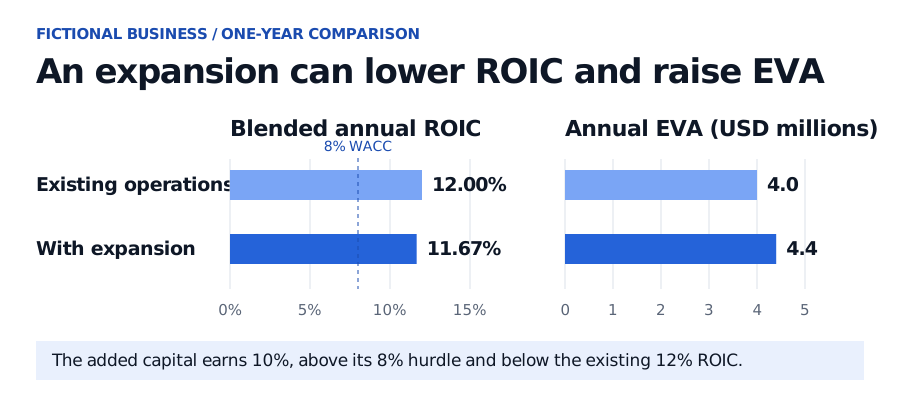
The expansion earns a smaller percentage spread than the existing business and adds a positive dollar surplus.
From a year’s EVA to the value of the business
Enterprise value is measured at a date and depends on future operations. It can fall in a year of positive EVA if expectations for later years deteriorate. An EVA valuation adds the present value of forecast EVA to opening invested capital. It agrees with a discounted cash flow valuation when free cash flow to the firm reconciles to NOPAT minus the change in invested capital, with matching discount rates and terminal assumptions. The excess of operating value over invested capital is market value added when the operating value comes from the market. Equating that market premium to the model’s discounted EVA requires the forecasts and discount rates to be consistent with the market valuation. Damodaran, Economic Value Added, “Economic Value Added, Net Present Value and Discounted Cashflow Valuation”
For the original business, suppose the USD 12 million of NOPAT all converts to cash and the business recovers its USD 100 million capital in cash at year-end, with no later cash flows. Both approaches give the same opening value, in USD millions.
Equity residual income uses earnings attributable to common shareholders and charges opening book equity at the cost of equity. EVA works on operating profit and charges capital supplied by all investors. Cash value added (CVA), in the Ottosson–Weissenrieder formulation, compares operating cash flow with the periodic cash flow required to justify the strategic investment over its life. Ohlson, Earnings, Book Values, and Dividends in Equity Valuation · Ottosson and Weissenrieder, Cash Value Added
Further reading
Section 2.1 of the SelfMadeQuant lesson applies the same spread logic to shareholders. In its dividend discount model, retaining earnings adds value when the return on the new investment exceeds the shareholders’ required return. The preview is public and the full lesson requires membership. Equity Valuation: Dividend Discount and DCF Models
Sources
- Joel M. Stern, G. Bennett Stewart III and Donald H. Chew Jr., EVA: An Integrated Financial Management System
- Aswath Damodaran, Economic Value Added
- Aswath Damodaran, Value Creation and Enhancement: Back to the Future
- James A. Ohlson, Earnings, Book Values, and Dividends in Equity Valuation
- Erik Ottosson and Fredrik Weissenrieder, Cash Value Added: A New Method for Measuring Financial Performance