Return on invested capital (ROIC) is net operating profit after tax (NOPAT) divided by the invested capital used to earn it. It measures how much after-tax operating profit a business earns per dollar tied up in its operations. Comparing ROIC with the weighted average cost of capital (WACC) shows whether that return covered the estimated cost of funding the operating assets. Mauboussin and Callahan, Return on Invested Capital
Match the profit to the capital
Profit. Start from operating earnings after operating expenses, including depreciation, and deduct an estimate of the tax on those earnings before financing effects. A simple convention uses adjusted EBIT multiplied by one minus the assumed operating tax rate. Exclude net interest and income from non-operating assets so the numerator represents the same operations as the denominator. Damodaran, Financial Measures and Ratios
Capital. On the operating side, take the book value of operating assets such as receivables, inventory and net plant and equipment, less operating liabilities such as trade payables. Leave excess cash and passive investments outside the calculation. Use the same scope at each balance-sheet date. Beginning-of-period capital and period-average capital are both used in practice. An opening and closing average works when capital changes fairly steadily. For a large late-year acquisition, capital weighted by time in use better matches the period in which the acquired business contributes earnings. Mauboussin and Callahan, Return on Invested Capital, Damodaran, Financial Measures and Ratios
What a five-point spread is worth
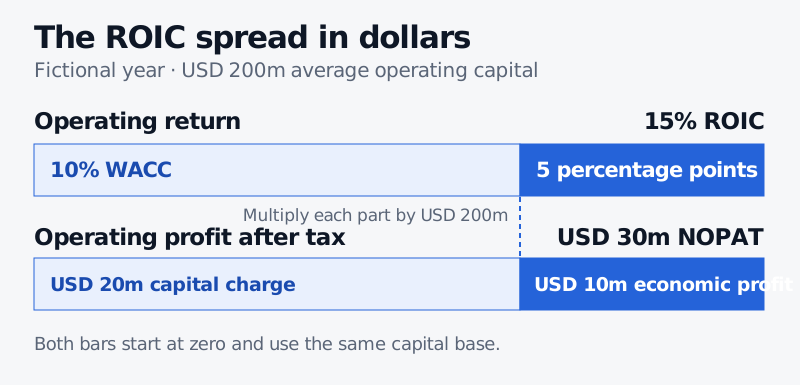
A fictional manufacturer earns USD 40 million of adjusted operating income over one year. At a 25% operating tax rate, NOPAT is USD 30 million. Its consistently defined operating capital rises steadily from USD 180 million to USD 220 million, so the year’s average is USD 200 million. Assume an annual WACC of 10% and use that same average capital to calculate the year’s capital charge.
The operations generated USD 30 million against a capital charge of USD 20 million. The difference is the year’s economic profit, measured in dollars. The same charge and surplus can be read from the rate comparison. Damodaran, Economic Value Added
Economic profit here is a firm-level measure. The equity form used in residual income valuation starts from earnings attributable to common shareholders and charges the cost of equity against beginning common book equity. Damodaran, Financial Measures and Ratios
Which return are you comparing?
Including acquired goodwill and intangibles in capital keeps more of the acquisition price visible when judging past deals. An analyst can also calculate a return excluding those balances to compare the operating economics of acquisitive companies and peers that grew internally. A measure labelled organic ROIC can still include the acquired operations’ earnings if it only strips out accounting balances. For a comparison of the pre-existing business alone, isolate both its profit and its capital. A write-down can also lift later ROIC mechanically by shrinking the capital base. Mauboussin and Callahan, Return on Invested Capital, Damodaran, Financial Measures and Ratios
Treat leased and owned operating assets consistently. When a lease is treated as financing, include the operating right-of-use asset in capital and leave the lease interest out of operating profit while retaining the operating cost of using the asset. Check which adjustments are already reflected in the statements before making them again. A very small capital base can turn a modest profit into an outsized ratio. Compare the underlying dollars and conventions before ranking companies on reported ROIC. Mauboussin and Callahan, Return on Invested Capital
A positive historical spread describes the capital already in use. When forecasting growth, ask what additional capital can earn relative to the cost of capital for that investment. A manufacturer can earn 15% across its existing plants and still face an expansion that falls short of its own hurdle rate. Damodaran, Economic Value Added
For the equity-side version of this growth question, §2.1 of the SelfMadeQuant lesson derives how retained earnings and the return on new investment affect dividend value. The full lesson is for members. Equity Valuation: Dividend Discount and DCF Models