Skip to content

Cash flow return on investment and cash value added

Calculate cash flow return on investment as a real IRR on operating assets and distinguish it from return on invested capital and cash value added.

Cash flow return on investment (CFROI) estimates the real annual return a company earns on its existing operating assets. In the HOLT framework it is an internal rate of return on an inflation-adjusted cash-flow schedule. An analyst can compare it with a real cost of capital to assess whether the assets earn enough to cover the cost of funding them. UBS, The beauty of indexing · UBS, Capital allocation

What goes into the return

Think of a manufacturer whose older machinery still produces goods. Its net book value may be small after years of accounting depreciation, and its original purchase price reflects prices at the time of purchase. The CFROI approach restates the gross operating investment in a common purchasing-power base, then asks what rate the assets' cash generation implies. The classic construction uses four inputs.

  • Gross operating investment includes both depreciating assets, such as machinery, and non-depreciating assets, such as land and operating working capital. The starting investment represents the adjusted gross capital committed to operations.
  • Gross cash flow is an adjusted operating cash measure for debt and equity capital providers together. The classic calculation uses a representative annual amount over the modelled life.
  • Economic life is the estimated period over which the depreciating assets can generate operating cash. An accounting or tax depreciation schedule can differ from that useful life.
  • Non-depreciating asset release is the recoverable amount credited in the final year. In the model it returns capital tied up in assets such as land and working capital.
The rate sets net present value to zero by equating the starting gross investment to the present value of the annual cash flows and the final release. A conventional return on invested capital instead divides one period's after-tax operating profit by a measure of invested capital. For CFROI, putting the asset base and receipts in the same purchasing-power units makes the result a real rate. If the hurdle is quoted in nominal terms, convert it to a real rate using a consistent inflation assumption before comparing. Madden, CFROI Calculation Details · Credit Suisse, Calculating Return on Invested Capital, Appendix A

A year of operations and an asset release

Suppose a fictional operation has USD 100 million of gross investment today and a one-year economic life for its depreciating assets. At year-end it generates USD 10 million of gross operating cash and recovers USD 110 million from non-depreciating assets. The deliberately high recovery assumes those assets can be released for more in real terms than they contributed to the starting base. All amounts are in today's purchasing power. The stipulated inputs isolate the real-IRR arithmetic from the accounting adjustments used in HOLT.
0=−100+10+1101+r⟹r=20%.0=-100+\frac{10+110}{1+r} \qquad\Longrightarrow\qquad r=20\%.
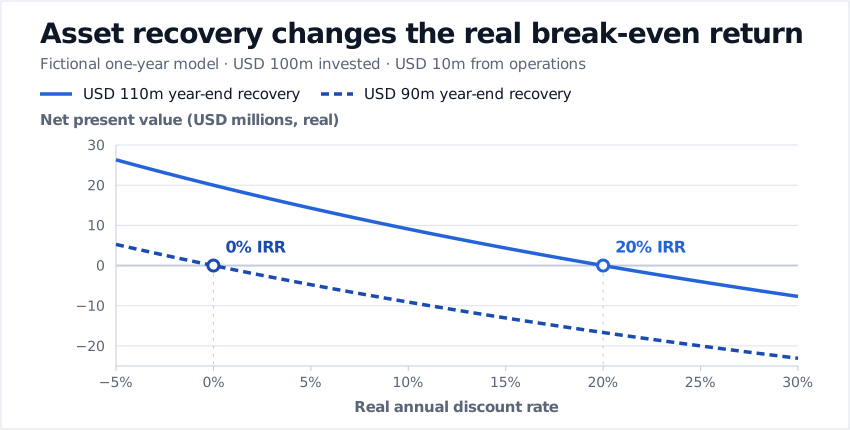
The real annual IRR is 20%. If the estimated release falls to USD 90 million, the year-end receipt falls to USD 100 million and the IRR falls to 0%. The operation generates the same cash in both cases. The change comes entirely from what the model assumes can be recovered at exit.
Fictional one-year model with USD 100 million invested and USD 10 million in operating cash. The NPV curves cross zero at 20% for USD 110 million of asset recovery and at 0% for USD 90 million of recovery. All cash amounts are in today's purchasing power.
Both curves hold the operating cash and initial investment fixed. Only the assumed year-end recovery changes.

Cash value added measures a dollar surplus

In Ottosson and Weissenrieder's cash value added (CVA) method, the analyst subtracts a period's required operating cash flow from its actual operating cash flow. Their cash-flow measure accounts for working-capital movements and the outlays needed to sustain the investment. The required stream is set to recover the strategic investment and earn the required return over its economic life. Positive CVA means the operation generated more cash than its requirement for that period. CVA is expressed in currency per period, while CFROI is an annual rate on the modelled assets. A single period's CVA measures operating performance. A cash-flow valuation of the enterprise requires a forecast of its future cash flows and a risk-matched discount rate. Ottosson and Weissenrieder, Cash Value Added

Sources

Last updated
  • cfroi
  • cash value added
  • corporate finance
  • capital allocation
  • valuation
← Back to the glossaryBack to top ↑