Net present value sums signed cash flows at today’s date. Follow a USD cash-flow ledger, separate NPV from gross receipts, and avoid discount-rate and timing mistakes.
Net present value
Net present value (NPV) is the sum of an investment’s signed cash flows after discounting each to the valuation date. Inflows count positively and outflows negatively. A positive NPV means the model assigns more value to what you receive than to what you give up, after allowing for the chosen required return.
That makes NPV useful for comparing a project’s cost with its future receipts, or a security’s purchase price with its modelled value. It is a currency amount at a stated date, rather than a percentage return. The inputs determine whether that comparison is economically meaningful.
Put the receipts and the cost on the same clock
Suppose a fictional project costs 1,000 USD today and is forecast to generate 600 USD of net cash receipts at each of the next two year-ends. Use a 10% effective annual required return, also called the hurdle rate. There are no additional fees or taxes in this example.
For yearly cash flows and a constant effective annual rate r,
NPV(r)=t=0∑n(1+r)tCt.
Here Ct is the signed net cash flow at year t, with time 0 being today. The effective-rate formula requires r>−1. Today’s payment has denominator 1; it is already at the valuation date. Each later cash flow needs its own present value.
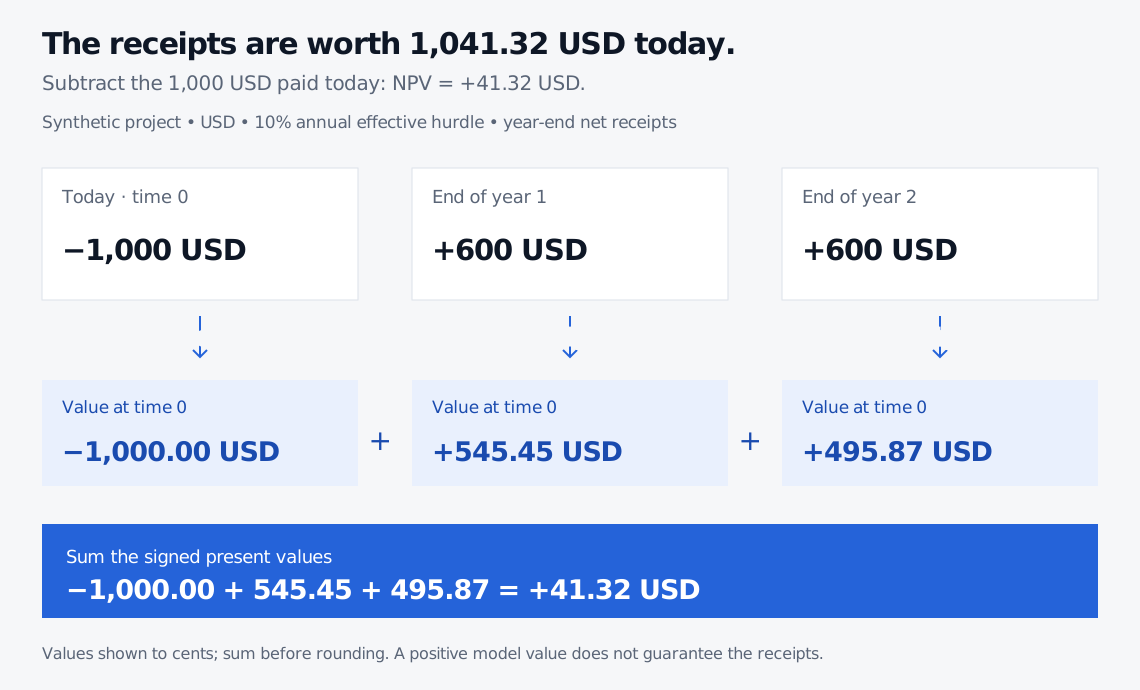
Synthetic USD cash-flow ledger: discount the two 600 USD receipts to 545.45 and 495.87 USD, then combine them with today’s minus 1,000 USD cost to obtain NPV plus 41.32 USD.
Original synthetic ledger. All values are expressed at time 0 before summing; the 10% hurdle is an assumption. Amounts are rounded only for display.
What the number means
The future receipts have a combined present value of 1,041.32 USD. That is their gross value before deducting the initial purchase cost. The 41.32 USD NPV is the excess above that cost. Paying the exact present value of the receipts would instead make NPV zero at the same hurdle.
The 200 USD undiscounted net cash surplus answers a different question: how many more dollars are received than paid, ignoring when they occur. It is neither NPV nor an accounting-profit calculation. The 10% hurdle has already been allowed for in discounting, so positive NPV represents value above that benchmark under the assumptions. It does not mean the investor receives an extra 41.32 USD today, or that forecast receipts are guaranteed.
For this particular schedule, higher hurdle rates reduce NPV because every future cash flow is positive:
Effective annual hurdle
NPV today, USD
0%
+200.00
10%
+41.32
15%
−24.57
The cash-flow forecast has not changed across these rows. Only the valuation assumption has. The internal rate of return asks the reverse question: which rate makes NPV zero? Schedules containing later outflows can have more complicated profiles and multiple IRRs; the decreasing pattern here is not universal.
The discounting model must fit the cash flows
A constant hurdle is a useful project-appraisal model. It is not a universal market discount curve. More generally, for specified cash flows and suitable discount factors,
NPV=i∑CiD(0,ti),D(0,0)=1.
Each factor translates its payment to time 0. Different maturities can have different zero rates. For risky cash flows, the forecast and risk adjustment must form a consistent valuation model; multiplying arbitrary expected receipts by a government discount curve does not automatically produce fair value.
Keep the cash-flow currency and discounting currency consistent. Use nominal cash flows with nominal rates, or inflation-adjusted cash flows with real rates, as explained in Aswath Damodaran’s valuation notes. Match the rate’s compounding convention to the time units; a monthly rate is not an annual effective rate. Irregular payment dates need explicit year fractions and a stated timing convention.
Microsoft Excel’s NPV function treats its first cash-flow argument as arriving one period from the valuation date, then assumes equally spaced period-end payments. A time-0 outlay therefore belongs outside that future-cash-flow list. For this example, discount the two future 600 USD receipts with NPV, then subtract today’s 1,000 USD separately. Microsoft’s function documentation specifies this timing rule.
Putting today’s outlay first in the same list shifts every cash flow one period later. The resulting number can look plausible while answering a different dated question. Check the timeline before trusting the output.
Sources
John C. Hull, Options, Futures, and Other Derivatives, 9th ed., Global Edition, Chapter 4, §§4.2–4.4, pp. 102–105: rate conventions, zero rates and discounting individual cash flows.
OpenStax, Principles of Finance, §16.2: Net Present Value (NPV) Method: net discounted inflows and outflows, decision interpretation and sensitivity to the hurdle rate.
Aswath Damodaran, NYU Stern, Estimating Inputs for Valuation: matching discount rates to cash-flow risk, currency and nominal or real measurement.
Microsoft, NPV function: equal-period timing and the separate treatment of a time-0 cash flow.