A hedge ratio specifies the size of an offsetting position relative to the exposure being hedged. It turns a risk estimate into a trade: how much stock offsets an option, or how many index futures reduce a fund's market exposure. The number is meaningful only when its units, direction and risk objective are stated.
Hedging usually reduces a chosen risk rather than every possible loss. A portfolio can have little remaining index exposure and still lose money through stock-specific moves, an imperfect hedge instrument or the cost of maintaining the hedge.
From portfolio beta to futures contracts
Consider a synthetic equity portfolio worth USD 1,200,000, with estimated market beta 1.1 against a specified equity index. The manager wants to offset its estimated index exposure using a futures contract on that index.
Assume the chosen future is quoted at 4,000 index points and pays USD 50 per index point per contract. These are illustrative inputs, not a current market quote. The multiplier matches the E-mini S&P 500 contract scale described by CME Group.
One contract therefore represents notional exposure of
For this approximate index-beta hedge, the number of contracts to short is
Here is portfolio value, is its estimated sensitivity to the chosen index, is the futures quote and is the contract multiplier. Short futures offset positive index exposure. This value-based calculation assumes that percentage futures-price changes track the relevant index changes sufficiently closely over the hedge horizon; CME's beta-adjustment treatment uses the same portfolio-value-to-contract-notional scaling.
The portfolio's beta-dollar exposure is USD: under the linear approximation, multiply this exposure by an index return expressed as a decimal to obtain its market-related dollar change. It is a sensitivity measure, not the portfolio's market value or a cash amount paid for futures.
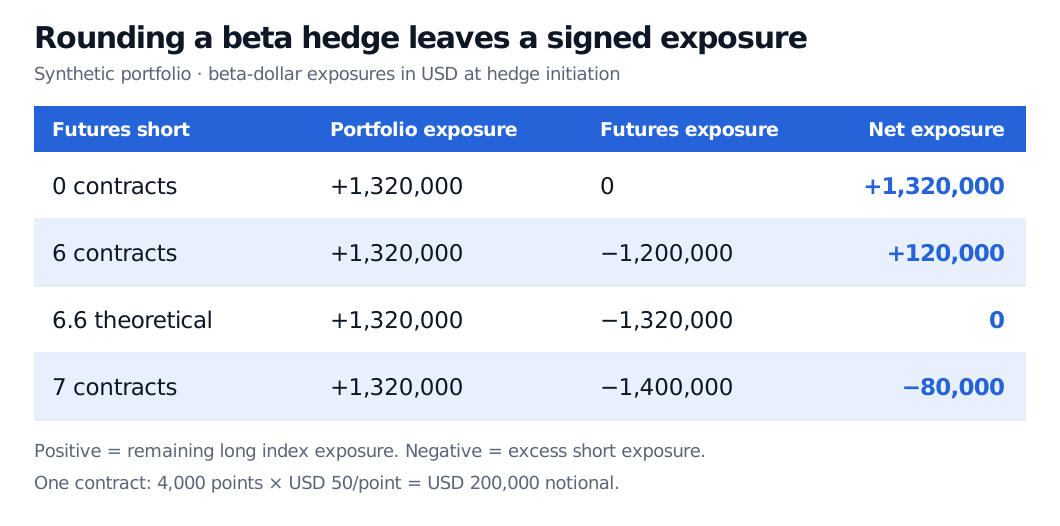
Original synthetic exposure ledger at hedge initiation. Each contract contributes USD 200,000 of index notional; the fractional position is a theoretical benchmark. Positive net exposure remains long the index; negative net exposure is overhedged relative to the estimated beta target.
Standard whole contracts do not allow a position of 6.6 contracts. Shorting six leaves positive exposure of USD 120,000; shorting seven leaves negative exposure of USD 80,000. Seven is closer to zero under this model, while six avoids crossing into net short index exposure. The manager's risk constraint determines whether that distinction matters.
For an illustrative +1% common move in the index and futures price, the model gives a portfolio gain of USD 13,200. Six short futures lose USD 12,000, leaving +USD 1,200; seven lose USD 14,000, leaving −USD 800. These are market-component stress calculations, not forecasts of realised portfolio profit.
The units change with the hedge
The beta calculation above is not a universal hedge-ratio formula.
| Setting | What the ratio describes | Conversion into a trade |
|---|---|---|
| Equity portfolio and index futures | A return sensitivity, approximated by portfolio beta when futures track the index | Scale by portfolio value divided by one contract's notional |
| Option and underlying shares | Delta: underlying units per option unit, when option value is quoted on that unit basis | Include the number of options and the contract's underlying-unit multiplier; take the offsetting sign |
| Spot exposure and a related futures asset | A minimum-variance hedge ratio based on consistently measured price changes | Convert exposure units into contract units, keeping the price-quote bases consistent |
For example, a long positive-delta option position needs a short underlying position for delta hedging. A short option position reverses that direction. Delta normally changes as the underlying price and time change; the initial ratio does not promise an unchanged hedge through expiry. The free Binomial Model sample lesson shows how the shares-per-option ratio arises from two possible future payoffs and a cash position.
The minimum-variance approach instead chooses the ratio to minimise the variance of a specified hedged change. Its covariance-over-variance expression depends on what is measured: a slope fitted to currency price changes is not automatically a dimensionless return beta. Changing the input units changes the slope and the subsequent contract conversion.
What a correctly sized hedge still leaves
The 6.6-contract target offsets one estimated market sensitivity. It does not replicate the equity portfolio's cash flows or make it risk-free.
- Estimation and composition: beta can change, and idiosyncratic risk remains after the index component is offset.
- Instrument and timing: basis risk, a different hedge expiry, dividend treatment and non-synchronous price observations can weaken the assumed relationship between portfolio and future.
- Trading and funding: spreads, fees, rebalancing and whole-contract rounding affect the result. Futures losses are settled in cash as the position is marked to market; an offsetting rise in unsold shares does not itself supply that cash. CME's settlement explanation describes why additional funds may be required to maintain a losing futures position.
A usable hedge ratio therefore belongs with a stated exposure date, measurement horizon, contract specification and rebalancing rule. The signed exposure ledger is the check that the proposed trade actually offsets the risk being targeted.
Sources
- John C. Hull, Options, Futures, and Other Derivatives, ninth edition, Global Edition, Pearson, 2018: §3.4, pp. 80–84, on cross hedging, price-change versus percentage-change ratios and contract scaling; §3.5, pp. 86–87, on index-beta hedging; §19.4, pp. 424–426, on delta and rebalancing.
- CME Group — Discover Equity Index Notional Value & Price: futures quote multiplied by contract multiplier gives notional exposure.
- CME Group — Understanding Stock Index Futures, 3 May 2013, pp. 10–11: signed contract counts for a target beta.
- CME Group — Mark-to-Market: daily cash settlement and funding requirements.