A global optimum is best over the whole feasible set. Compare minima and maxima, distinguish optimal inputs from values, and see why a local peak or an unattained bound is insufficient.
Global optimum
A global optimum is a best attained result of an optimisation problem: no other feasible choice improves the objective in the required direction. It can be a minimum, such as the least modelled portfolio variance, or a maximum, such as the greatest modelled utility. The claim always belongs to a specified objective and feasible set. It does not establish that the model captures everything an investor cares about.
f(x∗)f(x∗)≤f(x)for every x∈D≥f(x)for every x∈D(minimisation),(maximisation).
The optimal solution is the input x∗; the optimal value is its output f(x∗). The pages on global minimum and global maximum develop the two directions separately. “Global optimum” is the umbrella term; state the direction before calling a result best. Minimising −f gives the same optimal inputs as maximising f, with the sign of the optimal value reversed.
A local search can stop too soon
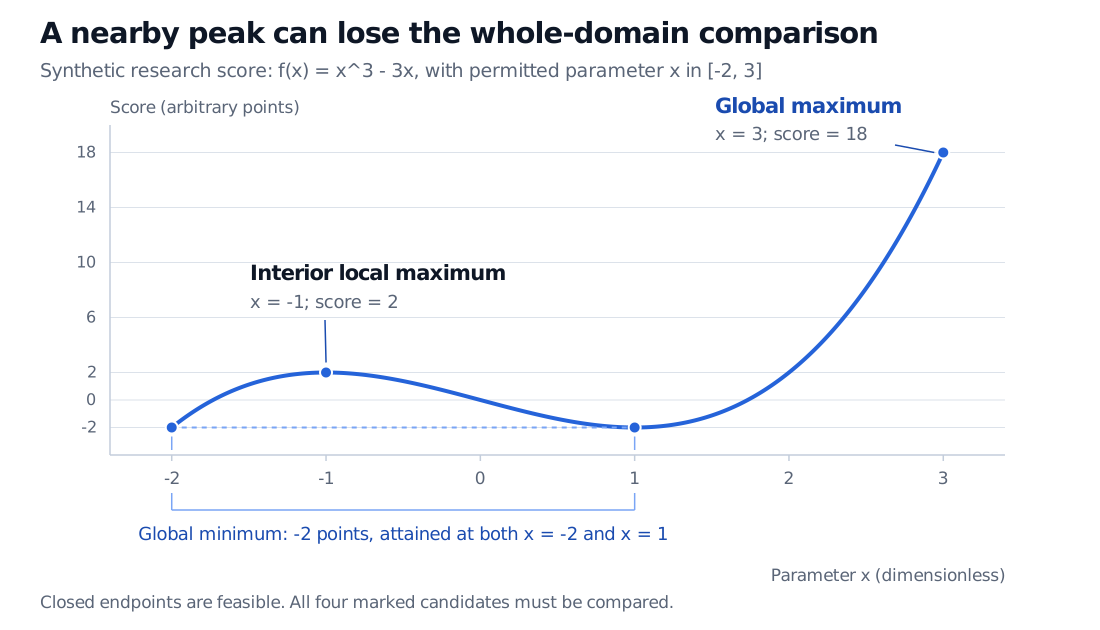
Imagine choosing a signed, dimensionless research parameter x to maximise a deliberately synthetic score, measured in arbitrary points:
f(x)=x3−3x,−2≤x≤3.
This is a stipulated search landscape; its scores are not measured strategy performance or forecast returns. Negative parameter values are allowed by construction.
The derivative is f′(x)=3x2−3, giving interior stationary points at x=−1 and x=1. Because f′′(x)=6x, the first is an interior local maximum and the second an interior local minimum. A search that climbs nearby scores could stop at x=−1 with score 2.
But the endpoints are feasible too. The closed-interval comparison is:
Candidate input
Why check it?
Score f(x)
−2
Left endpoint
−2
−1
Interior stationary point
2
1
Interior stationary point
−2
3
Right endpoint
18
The global maximiser is x=3, with value 18, even though f′(3)=24 is not zero. The boundary prevents moving farther right. Had the task been minimisation, both x=−2 and x=1 would be globally optimal, sharing the single optimal value −2.
Synthetic score f(x) equals x cubed minus three x on the closed interval from minus two to three. The interior local maximum at minus one has score two; the global maximum at three has score eighteen. The global minimum score minus two is attained at both minus two and one.
Original synthetic research-score example. All four marked points are feasible candidates; the two lowest points illustrate multiple optimal solutions with one optimal value.
A local optimum compares only a neighbourhood within the feasible set. Using that relative-neighbourhood convention, every global optimum is also local; endpoints can qualify. Here the endpoints −2 and 3 are also local extrema. Calling −1 an interior local maximum does not make it the only local maximum or make it globally best.
What makes the comparison a proof?
For a continuous one-variable function on a closed bounded interval, check every interior point where the derivative is zero or does not exist, together with both endpoints. In this polynomial the derivative exists everywhere, so the table covers every candidate. A finite grid alone would not justify the same conclusion about all real inputs.
There is also a direct certificate for this example. For every x∈[−2,3],
f(x)+218−f(x)=(x−1)2(x+2)≥0,=(3−x)(x2+3x+6)≥0.
The quadratic factor in the second line is strictly positive, since x2+3x+6=(x+3/2)2+15/4. Thus no feasible score falls below −2 or exceeds 18. Equality in the first line occurs exactly at −2 and 1; equality in the second occurs exactly at 3. These inequalities establish the entire-domain claim and its ties.
Other problems offer different certificates. A convex function minimised over a convex feasible set has the useful property that every local minimum is global. Maximisation uses the corresponding concavity condition. Convexity must concern the whole relevant domain, not just the curvature at one candidate. Boyd and Vandenberghe's optimisation slides explain this local-to-global implication.
For a portfolio application, Constrained and Convex Optimisation develops budget constraints, boundary solutions and convex optimality certificates. Its public page is a preview; the complete lesson requires membership.
A best bound may have no best feasible choice
The extreme value theorem guarantees that a real-valued continuous objective on a nonempty compact feasible set attains both a global minimum and maximum. In finite-dimensional Euclidean space, compactness means closed and bounded. This is a sufficient existence result, not a uniqueness result. Lebl's real-analysis text gives both the interval theorem and the compact-space version.
Compare maximising g(x)=x on the open interval (0,1). Its supremum, or least upper bound, is 1, but 1 is excluded. Every feasible x can be improved by the still-feasible point (x+1)/2. There is no global maximiser. Likewise, the infimum is 0, but there is no minimiser. Approaching either bound does not create an attained optimum.
Compactness is not necessary in every problem: h(x)=x2 has global minimum 0 at x=0 on the unbounded real line. What matters is whether this particular objective attains its best value on this particular domain. A solver's stopping message, a small derivative or repeated agreement from several starting points can support a numerical investigation; each needs an additional argument before it becomes a global guarantee.
Sources
James Stewart, Single Variable Calculus: Early Transcendentals, 6th edition, §4.1, “Maximum and Minimum Values” — global versus local extrema, the extreme value theorem and the closed-interval method.