The foreign exchange market, or FX market, is the network in which participants exchange currencies and trade contracts tied to exchange rates. It lets an importer obtain the currency needed to pay a supplier, a fund convert investment proceeds, and a treasurer hedge a future payment. For a quant, a price signal is only part of the trade: quote direction and the executable side determine how much of each currency actually changes hands.
A market spread across venues
Much wholesale currency trading takes place in an over-the-counter market, through dealers and trading platforms. There is no single global FX exchange or universal order book. The New York Fed’s market-structure discussion describes a decentralized market with trading spread across many venues. Currency futures also trade on organized exchanges; CME’s FX products are one example.
Participants arrive with different purposes. Businesses convert revenues and expenses, investors manage currency exposures, and traders take positions on exchange-rate movements. Dealers quote prices to customers and trade with other dealers to manage the resulting positions. In FX swaps, the BIS documents this dealer-customer and inter-dealer structure.
That structure matters when interpreting data. A displayed quote is associated with a source, time, size and trading relationship. It need not be executable for every participant. Liquidity in a familiar currency pair does not guarantee the same trading cost for every order or during stressed conditions.
Start with two currency columns
An exchange rate is a price with units. We use EUR/USD to mean USD per EUR: EUR is the base currency and USD is the quote currency. This follows the usual pair convention illustrated by the RBA’s exchange-rate explainer. Always check a data provider’s convention rather than relying on a slash alone.
Suppose a dealer gives this synthetic quote, with sufficient size available:
| Dealer price | USD per EUR | Meaning |
|---|---|---|
| Bid | 1.10 | Dealer buys EUR and pays USD |
| Ask | 1.11 | Dealer sells EUR and receives USD |
A customer buying EUR 1,000 pays the ask. The units cancel as
Now immediately sell the same EUR 1,000 at the unchanged bid. The customer receives USD 1,100. The full ledger, from the customer’s perspective, is:
| Trade | EUR change | USD change |
|---|---|---|
| Buy euros at 1.11 | +1,000 | −1,110 |
| Sell euros at 1.10 | −1,000 | +1,100 |
| Net | 0 | −10 |
The USD 10 loss comes from crossing the bid-ask spread, even though the quote never moved. Fees, funding and any additional execution costs are excluded. The deliberately wide illustrative spread is not a claim about current EUR/USD prices.
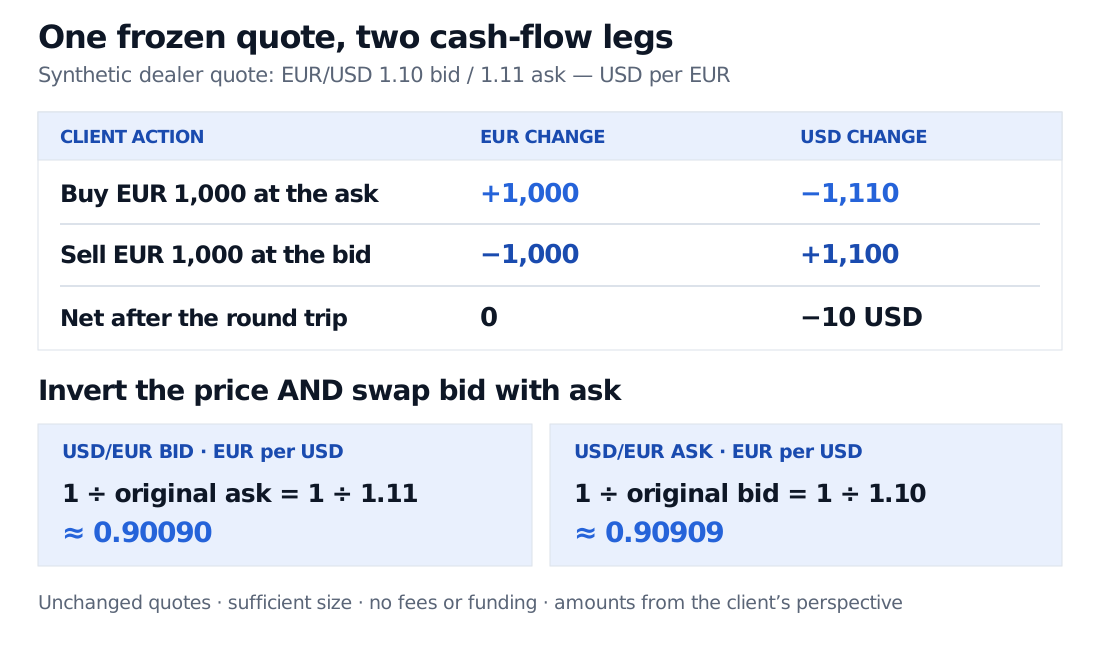
Original synthetic quote and client cash-flow ledger. Quotes stay fixed, sufficient size is available, and fees and funding are excluded. Inverse quotes are rounded to five decimal places.
Reversing the pair reverses the sides
For the same dealer quote expressed as EUR per USD, the inverse bid comes from the original ask, and the inverse ask comes from the original bid:
Why swap the sides? Selling USD to the dealer means buying EUR from the dealer. It is the original euro ask viewed from the other currency. Reciprocating the bid and ask without swapping them would put the inverse bid above the inverse ask.
Likewise, if USD per EUR rises, one euro buys more dollars: the euro appreciates against the dollar. The reciprocal rate falls. A rising rate cannot mean that both currencies strengthen against each other.
Spot conversion and future exposure
Spot FX agrees a currency exchange for near-term settlement under the relevant currency-pair convention. The trade date, when the price is agreed, and the value date, when payments are due, are different concepts. “Spot” does not promise that money reaches both accounts at the instant the quote is accepted.
A currency forward contract instead fixes the rate today for a specified future exchange. It can help an importer budget a future foreign-currency payment. An FX swap combines an exchange of two currencies with an agreed reverse exchange at a later date; its two rates are agreed when the contract is made. The BIS explanation shows why these contracts also serve funding and hedging needs. An FX swap is distinct from a currency swap that also exchanges interest-payment streams.
Choosing between these trades starts with the exposure: currency, amount and payment date. Hedging a future payment differs from converting cash already held. A forward quote also reflects the two currencies’ funding conditions; it is not simply a prediction of the later spot rate.
The FX lesson in the Finance Primer, available with a free signed-in account, extends this ledger into cross rates and covered interest parity. Keep the same discipline throughout: identify the currency being bought, attach units to the rate, then record both currency cash flows.
Sources
- Reserve Bank of Australia, Exchange Rates and their Measurement: bilateral exchange-rate units, cross rates and exchange-rate regimes.
- Michelle Neal, Federal Reserve Bank of New York, Foreign Exchange Market Structure: The Land of a Thousand Lakes (19 November 2024): decentralized venues and changing market structure.
- BIS, Bank positions in FX swaps: insights from CLS (September 2023): dealer intermediation and the distinction between FX swaps and currency swaps.
- CME Group, FX Futures: exchange-traded currency futures and options.
- John C. Hull (2018), Options, Futures, and Other Derivatives, 9th ed., Global Edition, §1.2, p. 25; §1.3, pp. 28–29; §2.11, pp. 65–66; §5.10, p. 140: OTC markets, dealer quote sides, spot versus forward contracts currency-quote conventions and interest parity.