Understand spot trading through the trade date, contractual value date and a two-currency settlement ledger, without confusing prompt delivery with instant delivery.
Spot market
A spot market, also called a cash market, is a market for buying or selling an asset for delivery under its near-term settlement convention. The price is agreed when the trade is made; payment and delivery follow the contract’s settlement terms. For a quant or treasurer, this distinction matters: a trade can fix a price today while leaving a payment obligation due on a later value date.
Spot markets include currency conversion and cash purchases of securities or commodities. The asset, delivery specification and market rules determine what is being exchanged. “Spot” alone does not specify an exchange venue, a universal settlement lag or immediate access to the purchased asset.
One agreement, two dates
The trade date is when the parties enter the transaction. The value date is the date on which the agreed payments are due. In foreign exchange, that means identifying both currency amounts and their settlement date.
The Basel Committee’s FX guidance describes spot delivery by reference to local market convention, giving two business days as an example. It does not equate spot with instantaneous delivery.
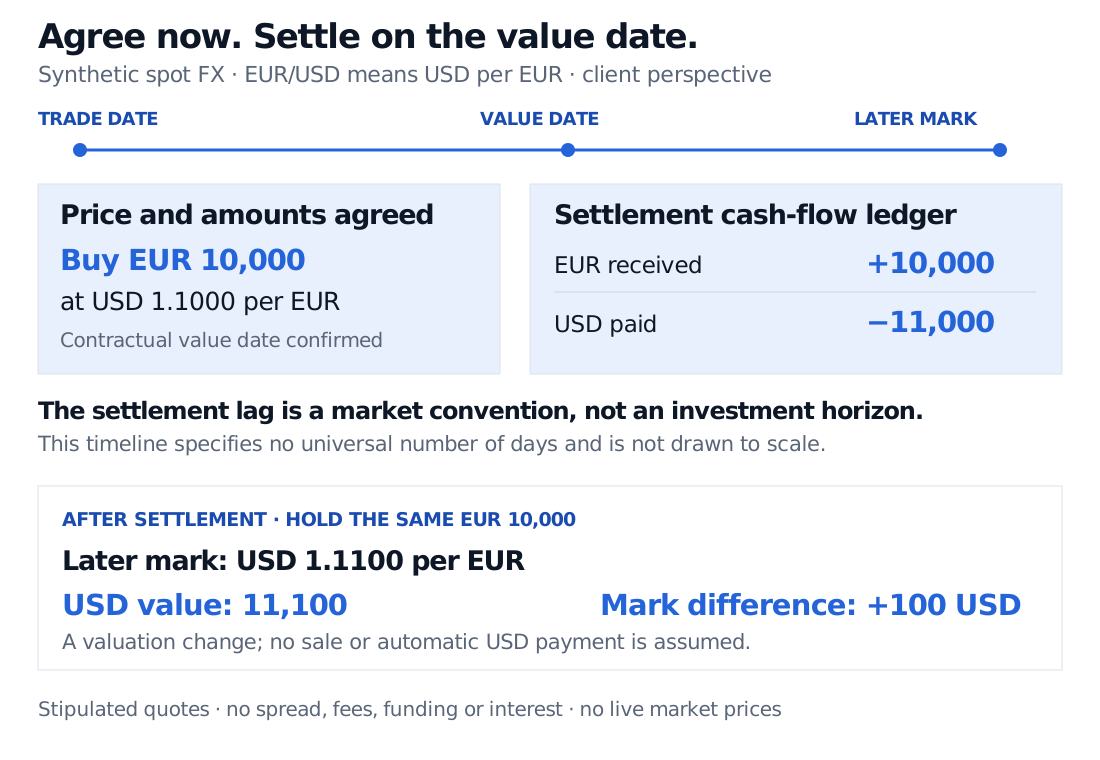
Suppose a customer agrees a synthetic spot purchase of EUR 10,000 at 1.1000 USD per EUR, for the contractual value date. This is a stipulated transaction price, not a current market quote. The customer’s settlement ledger is:
Currency
Customer receives or pays on the value date
EUR
+10,000
USD
−11,000
The dollar amount follows from the quote’s units:
10,000EUR×1.1000EURUSD=11,000USD.
The counterparty has the opposite entries in each currency. Adding euros directly to dollars would produce a meaningless “net cash flow”; each currency needs its own column. Once the rate is agreed, a subsequent quote change does not rewrite these contractual amounts.
Synthetic client purchase of EUR 10,000 at USD 1.1000 per EUR. Trade date fixes the rate; the contractual value date brings EUR 10,000 received and USD 11,000 paid. After settlement, a later mark of USD 1.1100 per EUR values the holding at USD 11,100, a USD 100 mark difference before costs.
Original synthetic timeline and currency ledger. Timing is schematic, with no universal settlement lag assumed. The later mark applies after settlement; spread, fees, funding and interest are excluded.
A spot position can outlive its settlement
After settlement, suppose the customer retains the euros. At a later stated mark of 1.1100 USD per EUR, the same EUR 10,000 is worth USD 11,100. Relative to the USD 11,000 paid, the mark difference is +USD 100 before funding, interest, spreads and fees.
This is a valuation comparison, not an automatic dollar receipt. Realizing the change would require another transaction at an executable price. A market mark may differ from the price available to sell because of the bid-ask spread. The original purchase settled promptly; the owner’s subsequent holding period can be much longer.
The FX lesson in the Finance Primer, available with a free signed-in account, develops the quote units, bid and ask sides, cross rates and spot–forward relationship used in currency calculations.
“Near-term” depends on the market
T+1 means one business day after the trade date; T+2 means two. Business days are not elapsed periods of 24 hours. Relevant holidays and settlement calendars affect which dates qualify.
For example, NAB’s FX product explanation distinguishes value-today, value-tomorrow and two-business-day spot transactions, subject to the currency’s business-day requirements. That is a provider’s stated convention, not a rule for every currency pair or product.
A different asset class illustrates the danger of assuming T+2 everywhere: SEC guidance identifies 28 May 2024 as the compliance date for the U.S. T+1 standard for securities transactions covered by Rule 15c6-1, with exclusions and exemptions. Check the instrument, jurisdiction, currency pair and actual settlement confirmation before scheduling cash.
An agreed value date also does not eliminate settlement risk. Paying away one currency without receiving the other can expose the payer to loss of principal. The Basel guidance explains how payment-versus-payment arrangements make one final currency transfer conditional on the other, while other risks can remain.
Why a forward is a different contract
A forward contract fixes terms today for a specified future delivery beyond the ordinary spot arrangement. The distinction concerns the contracted delivery, not when a trader expects to close a position. Buying euros spot and holding them for a future bill requires obtaining and funding the euros now; contracting a forward schedules the exchange for its future delivery date. The forward rate need not equal today’s spot rate.
Likewise, a futures contract references a future settlement or delivery under the exchange’s contract specifications. A quoted futures price and a spot price are prices for different contractual arrangements. Treating them as interchangeable can conceal funding, storage or delivery differences.
Practice: count eligible days, then convert
A synthetic EUR purchase is agreed on Friday at 1.0800 USD per EUR for EUR 2,500. Stipulate T+2 settlement, with weekends excluded and the following Monday ineligible because of a holiday in a required settlement calendar. Tuesday and Wednesday are both eligible. Which statement is correct?
A. The euros arrive on Friday because the purchase is spot; USD 2,700 is due immediately.
B. The customer receives EUR 2,500 and pays USD 2,700 on Tuesday.
C. The customer receives EUR 2,500 and pays USD 2,700 on Wednesday.
Answer. C. Tuesday is the first eligible day after Friday; Wednesday is the second. The agreed payment is 2,500×1.0800=2,700 USD. A confuses the trade date with settlement; B counts the ineligible Monday. The calendar is stipulated for this question, not a claim about an actual EUR/USD holiday.
Sources
John C. Hull (2018), Options, Futures, and Other Derivatives, 9th ed., Global Edition, §1.3, pp. 28–29: spot versus forward agreements and future currency delivery.