A discrete-time process models random quantities at separate observation dates. Separate the time index from the state space, and distinguish a whole path from its endpoint.
Discrete-time process
A discrete-time process is a stochastic process whose time index runs over separate, finitely or countably many observations. It is usually written X0,X1,X2,…. Each Xn is a random variable on the same probability space; the realised sequence is one sample path.
For a quant, choosing the observation clock comes before fitting a model: daily closing returns, monthly portfolio weights and the inventory after each trade are different discrete-time processes. One step can mean a trading day or one event. Equal spacing in calendar time is not required.
Discrete dates do not imply discrete values
The word discrete here describes when the process is indexed, not which values it can take.
Process
Observation index
State space in the model
Daily market regime
Trading-day number
Calm or Stress
Daily log return
Trading-day number
Real-valued
Inventory after each execution
Execution number
Integer number of units
All three have discrete time. The second can have a continuous probability distribution even though observations arrive one day at a time. Conversely, a Poisson process has integer-valued counts but continuous time.
The clock also says nothing about dependence. Discrete-time observations need not be independent, identically distributed, stationary, or Markov. Those are additional assumptions about their joint law.
A daily regime path
Suppose a hypothetical risk model records Calm (C) or Stress (S) at each close, starts in Calm with certainty, and assumes a time-homogeneous Markov chain. Its transition matrix, with rows and columns ordered C,S, is
P=(0.80.30.20.7).
A row gives tomorrow's probabilities conditional on today's regime. In particular, tomorrow's Stress probability is 0.2 from Calm but 0.7 from Stress: these successive states are not independent.
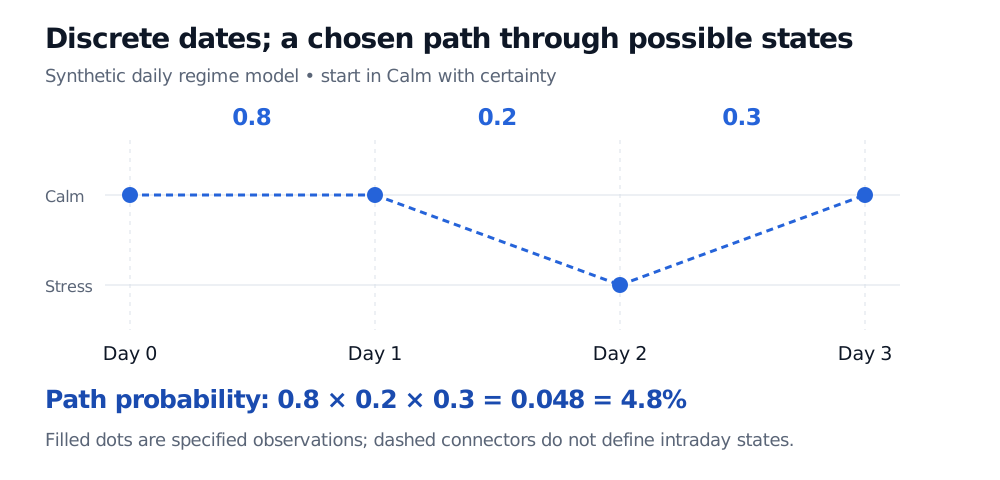
Consider the ordered event (X0,X1,X2,X3)=(C,C,S,C). Under the stated Markov assumption, the probability chain rule reduces to multiplying the three transition probabilities:
P(X0=C,X1=C,X2=S,X3=C)=1×0.8×0.2×0.3=0.048.
A selected daily regime path is Calm at days 0 and 1, Stress at day 2, and Calm at day 3. Transition probabilities 0.8, 0.2 and 0.3 give path probability 4.8%; connectors do not specify intraday states.
Original hypothetical daily regime model. A path specifies every dated state; ending in Calm alone allows several paths.
That is a 4.8% probability of this whole path, not the probability of Calm at day 3. Summing all paths ending in Calm gives 65%. A risk rule triggered by any intervening Stress observation therefore asks a different question from a rule that inspects only the final close.
A continuous-time process can generate a discrete-time process by observation. If Yt is defined for t≥0 and the sampling interval is Δ>0, then
Xn=YnΔ,n=0,1,2,…
is a discrete-time process. This operation restricts the observation times; it does not round the values or specify what happened between observations. A sampled price can finish above a barrier despite having crossed below it intraday. Connecting two closing prices on a chart cannot settle that question. A model for the intervening path, or finer observations, is needed.
Richard Durrett, Essentials of Stochastic Processes, third edition (2016), §1.1: Markov chains as a particular discrete-time model, with an explicitly time-homogeneous transition rule.