A butterfly spread shapes option payoffs around a target price. Reconcile the long call butterfly’s legs, debit, expiry profit, break-evens and implementation risks.
Butterfly spread
A butterfly spread combines options at three strikes to shape the payoff around a target price. In the standard long call butterfly, the trader buys one lower-strike call, sells two middle-strike calls and buys one higher-strike call, with equally spaced strikes on the same underlying and a common expiry. The result is a bounded, tent-shaped expiry payoff. Its highest payout occurs at the middle strike, so an accurate terminal-price view matters more than simply getting the market’s direction right.
The middle strike is the body; the two outer strikes are the wings. The equal spacing is essential to the symmetric construction below. Unequal-wing and other butterfly variants require their own cashflow calculation.
Build the tent, then subtract its price
Consider synthetic European calls, held to their common expiry and cash-settled against the same underlying price ST. All figures below are USD per share-equivalent. Fees, taxes and financing are zero; the premiums are illustrative entry amounts rather than market quotes.
Position
Strike, USD/share
Premium per option, USD/share
Entry cashflow, USD/share-equivalent
Buy one call
90
12
−12
Sell two calls
100
6 each
+12
Buy one call
110
2
−2
Whole butterfly
−2
The net premium paid is d=12−2(6)+2=2. Using (x)+=max(x,0), the terminal cash receipt and profit are
BTΠT=(ST−90)+−2(ST−100)++(ST−110)+,=BT−2.
Between 90 and 100, only the lower-strike call pays, so the receipt rises with the stock price. Between 100 and 110, the two short calls reduce that receipt faster than the lower call increases it. Above 110, the higher-strike long call restores a flat total payoff of zero. For example, at 120 the three contributions are 30−2(20)+10=0: substantial individual exercise values can cancel across the position.
Underlying at expiry, USD/share
Gross payoff, USD/share-equivalent
Profit, USD/share-equivalent
80
0
−2
95
5
3
100
10
8
105
5
3
120
0
−2
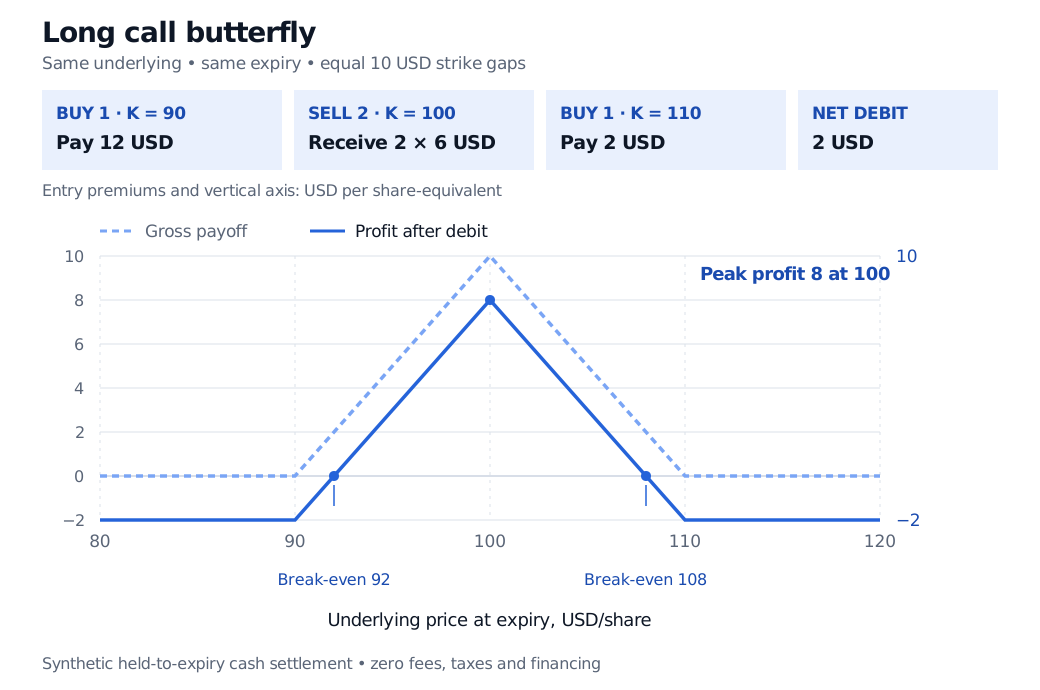
Long call butterfly with strikes 90, 100 and 110, entry premiums 12, 6 each and 2 USD per share. Gross expiry payoff peaks at 10 when the underlying is 100; profit peaks at 8, breaks even at 92 and 108, and is −2 at or outside the outer strikes.
Original synthetic European-call diagram, in USD per share-equivalent. The 2 USD entry debit shifts gross payoff down to profit. Common expiry, cash settlement and zero fees, taxes and financing are stipulated.
For this position, the maximum expiry profit is 8, attained at 100. The maximum expiry loss is the 2 debit, attained at or outside 90 and 110. The break-even prices are 92 and 108; profit is positive strictly between them. A terminal price inside the wings can still lose money if the payoff fails to recover the debit.
With a stipulated 100-share multiplier for each option contract, one butterfly uses one long contract at each wing and two short contracts at the body. The entry debit and maximum loss become USD 200, while maximum expiry profit becomes USD 800. The break-even underlying prices stay 92 and 108.
What the symmetric formula assumes
For strikes K1<K2<K3 with equal wing width w=K2−K1=K3−K2, the long call butterfly has
For an entry debit 0<d<w, zero financing and costs, and performance of all legs through the common expiry, maximum profit is w−d, maximum loss is d, and the break-evens are K1+d and K3−d. The same underlying, expiry, settlement basis and compatible contract multipliers make the leg values comparable. Changing the wing widths while keeping the quantities fixed changes the shape and can leave a nonzero outer payoff.
Reversing all the legs produces a short butterfly: its expiry profit profile is the negative of the long position’s if the entry premiums are also reversed without trading costs. A long put butterfly can reproduce the same terminal tent with matched strikes and quantities. An iron butterfly mixes calls and puts, so the long/short label and entry cashflows must be checked rather than inferred from the name alone.
A terminal target is not a guarantee about the path
A long butterfly can express a view that the underlying will finish near the body. It does not require the price to remain there throughout the trade: an unhedged European butterfly’s terminal payoff depends on ST, not the route taken to reach it. Before expiry, the position’s value also reflects remaining time and the implied volatilities of its legs. The tent alone does not establish its current delta, gamma or sensitivity to a volatility change.
The bounded calculation also presumes the position remains intact. With American options, early assignment of a short body call can change the holdings and funding needs. With physical settlement, exercise outcomes near the body can leave a residual stock position whose subsequent gains and losses lie outside the diagram. OIC specifically highlights assignment and expiration risk for this strategy. Entry and exit spreads, commissions and funding costs further reduce the idealised result; they are not included in the 2 USD loss bound above. OIC’s long-call butterfly guide discusses these implementation risks.
To reconstruct the example, open the public Option strategy designer, clear the initial position and add three call rows manually: buy quantity 1 at strike 90/premium 12; sell quantity 2 at 100/6; buy quantity 1 at 110/2. The tool uses a 100-share option multiplier and a shared expiry. Its expiry P&L view lets you inspect the USD 200 debit, USD 800 maximum profit and the two break-evens. It has no butterfly preset; these entries are manual. Its theoretical European model excludes assignment, early exercise, margin and trading costs, so it illustrates the intact position rather than those operational outcomes.
Sources
John C. Hull, Options, Futures, and Other Derivatives, 9th Global ed., Pearson, 2018, Chapter 12, pp. 284–287, especially Table 12.4: European-call butterfly construction, equal-spacing condition, payoff regions, put construction and reverse position. The worked example and figure here are original and synthetic.